
Remote Control Protocol (RCP) and the Concurrent Paradigm Shift to Zonal Architecture
Discover how Microchip’s LAN866x 10BASE-T1S endpoints with Remote Control Protocol can help streamline your designs as the transition towards zonal architecture continues.

Over the last several years, the automotive industry has seen significant innovation, bringing major advancements in driver assistance technologies from parallel parking and braking all the way up to fully self-driving cars. With the continuous increase in technological requirements associated with these advancements, car manufacturers have had to pivot. To streamline manufacturing and enable faster deployment of highly advanced cars and features, designers must find a way to simplify the wiring harness. Slowly slipping into the rearview are traditional designs which are based on domain architectures, which group Electronic Control Units (ECUs) by their function. This model is being superseded by zonal architecture, which instead groups ECUs by their physical location. Creating a zone which, for example, may include taillights, backup camera, rear speakers, rear climate control, rear power windows and the rear windshield wiper: items which in a domain-based architecture would be under different controllers.
Software-Defined Vehicles (SDVs) are taking over roadmaps for Original Equipment Manufacturers (OEMs) across the globe; these vehicles are innately more technologically advanced than their predecessors and will require zonal architecture to successfully integrate these components while maintaining scalability. By using a zonal network with a Single Pair Ethernet (SPE) backbone and 10BASE-T1S at the edge with its multidrop topology, massive savings can be realized. Zonal architecture reduces overall design complexity, cabling requirements and consequentially weight and cost. Decreased cabling requirements coupled with the smaller physical size of SPE creates very real weight benefits for vehicle manufacturers who are urged to provide products with lower emissions and higher performance.
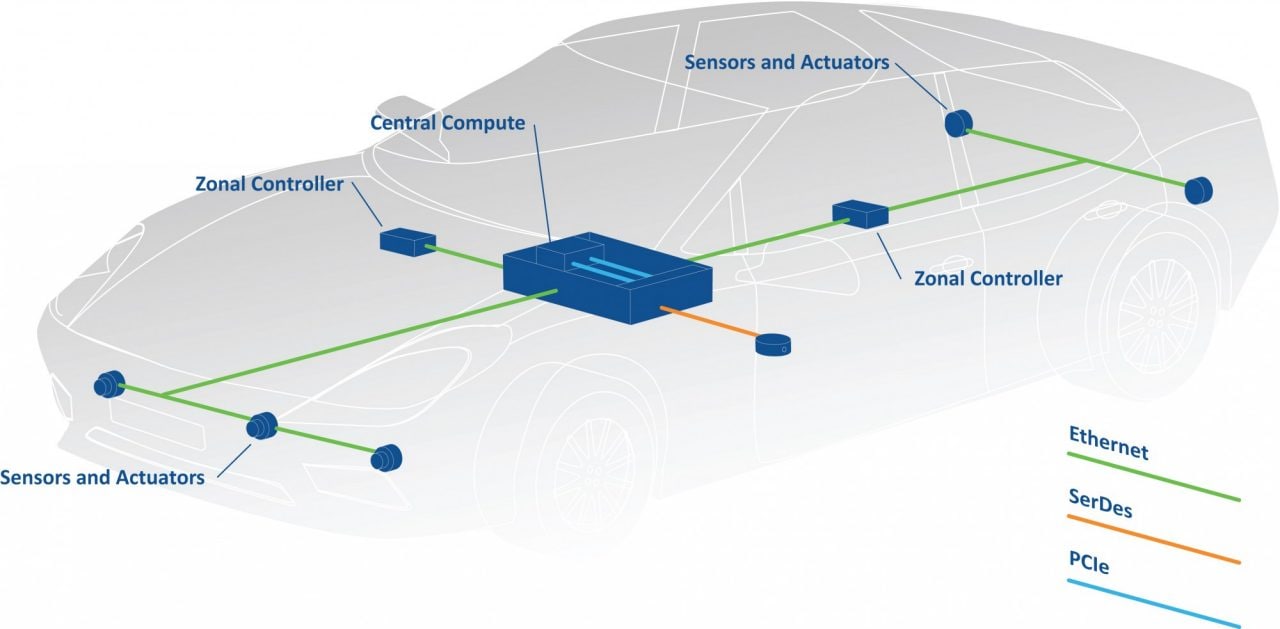
The above diagram shows an example of a zonal architecture implemented within a car.
Central Compute Module
A key feature of zonal architecture is the central compute module, which connects to and controls each “zone.” Central compute modules serve to reduce overall design effort and programming requirements by allowing everything to be controlled from this individual location. To effectively transmit data throughout the system, these modules rely on PCIe® and Ethernet infrastructure. The central compute module combined with SPE allows the concept of a zonal network to exist. This zonal approach also serves as the basis for SDVs.
Our Solution
Building on the foundation provided by the SPE backbone and central compute module, it is critical to consider how to integrate peripherals onto this network. These peripherals would ideally also be managed through the central compute module for further integration and simplification of the wiring harness. Previously, integrating peripherals into the network required use of microcontrollers/gateways to relay data between the peripherals, as there was no solution to directly interface between them. Enter the LAN866x family of 10BASE-T1S endpoints with standards-based Remote Control Protocol (RCP) which are well-suited for control, lighting or audio applications. These endpoints directly bridge data between the 10BASE-T1S network with peripheral devices, such as LED ICs or audio devices, eliminating the need for a gateway. With RCP, these devices can operate without microcontrollers (MCU-less) and do not require individual programming of every end node as they can all be controlled by the central compute module. With this centralized control, designers can further reduce design cycles and speed time to market while simultaneously reaping the weight and cost benefits of using SPE. This approach also streamlines the flow of data from the central compute module throughout the system all the way to end nodes by removing the need for added protocol translation.
Key Applications for Zonal Networks, Automotive and Beyond
In addition to these advantages, our 10BASE-T1S endpoints can enable highly advanced applications such as adaptive beam control or headlamps which project icons directly on the road as another form of driver assistance, all managed through the vehicle’s central compute module.
In industrial settings, zonal networks also provide key benefits for factory floors, like establishing zones throughout the facility to minimize wiring requirements and simplify future expansion. For building automation/control cases, using a zonal network can enhance energy efficiency by enabling localized control of specific areas that have differing needs. Additionally, within a train or other mass transit system, a zonal network can be used to independently control each carriage’s audio and climate.
With use cases across industries, zonal architecture has become the logical way forward for countless designers looking to optimize their systems.
Want More?
Microchip offers a complete portfolio of SPE and complementary devices to enable In-Vehicle Network (IVN) and zonal architecture in applications beyond the car. For more information on the LAN866x or any other SPE offerings, visit our Single Pair Ethernet webpage.