Part Number:
Quantity:
Price per Unit (in USD):
Total Amt:
Log in to myMicrochip to access tools and benefits. Sign up in just one minute.
Maximize Your Experience: Reap the Personalized Advantages by Completing Your Profile to Its Fullest. Update Here
Stay in the loop with the latest from Microchip. Update your profile while you are at it. Update Here
Complete your profile to access more resources. Update Here

true
dsPIC33A Digital Signal Controllers (DSCs)
Real-Time Control With Precision and Performance
Embedded system developers seek a solution that delivers top-notch performance, precise real-time control and a versatile suite of development tools to enhance and streamline their development endeavors. Our dsPIC33A DSCs are meticulously crafted to cater to these demands and enable you to achieve your design objectives.
Key Features
- High Performance
- Functional Safety
- Embedded Security
Designed for High-Performance Applications
The dsPIC33A family of DSCs with low latency responsiveness is designed for high-performance and real-time precision control applications. These DSCs combine the advantages of MCUs with the signal processing capabilities of Digital Signal Processors (DSPs), making them suitable for a wide variety of applications that require quick control loop computations using multiple sensor inputs.
- 32-bit CPU, 200 MHz operation with a DSP engine with 72-bit accumulators
- Double-Precision Floating Point Unit (DP-FPU) to accelerate math operation and simplify model-based design development
- Enhanced pipelining for speculative instruction fetching and branch prediction to reduce latency
- High-speed analog peripherals
- Up to 40 Msps, 12-bit Analog-to-Digital Converters (ADCs)
- 100 MHz Gain Bandwidth (GBW) op amps
- 5 ns high-speed comparators with 1 Msps, 12-bit Digital-to-Analog Converters (DACs) with slope compensation for precision sensing and signal conditioning
- Advanced peripherals
- Application-specific inter-coupled peripherals with many core-independent capabilities for motor control, digital power, advanced sensing and general high-performance applications
Functional Safety Ready
Our functional safety compliant/ready dsPIC33A DSCs offer a variety of integrated hardware safety features that help you develop safety-critical applications to meet the ISO 26262 (ASIL B), IEC 61508 (SIL 2) and IEC 60730 (Class B) functional safety requirements. These functional safety-compliant devices follow a certified development process based on the ISO 26262 and IEC 61508 standards.
- Hardware safety features include ECC Flash, ECC RAM with MBIST, core power monitor, IO pin integrity monitors, clock monitoring with backup oscillator, Deadman Timer (DMT), Cyclic Redundancy Check (CRC), Watchdog Timer (WDT) and more
- Failure Modes, Effects and Diagnostic Analysis (FMEDA) reports, safety manuals and diagnostic software libraries developed following the TÜV-Rheinland-certified functional safety management system*
- TÜV SUD-certified MPLAB® XC Compiler and a complete and fully qualified development environment*
For more information on the dsPIC33A Functional Safety program, contact your local Microchip sales office.

Advanced Security Features
Our dsPIC33A Digital Signal Controllers (DSCs) come with advanced security features, including device locking and configurable Flash protection regions for Immutable Root of Trust (IRT) and access control. These features allow you to implement scalable protection measures in your embedded applications as your security needs evolve. Additionally, some dsPIC33A device families are equipped with crypto accelerators to enhance the performance of cryptographic algorithms. The cryptographic accelerator supports:
- RSA, DSA and DH public key cryptography with up to 4096-bit key length
- Elliptic Curve Cryptography, with support for Elliptic Curve Diffie Hellman (ECDH), Elliptic Curve Digital Signature Algorithm (ECDSA), Edwards-curve Digital Signature Algorithm (EdDSA), P-256, P-384, P-521, 25519 and custom curves
- Key exchange protocol; J-PAKE, SRP
- AES encryption that is fully compliant with NIST FIPS 197 (256-bit key length)
- Hash and Message Authentication Code (MAC) with SHA-1, SHA-256, SHA-224, SHA-384, SHA-512, SHA3-224, SHA3-256, SHA3-384, SHA3-512, SHAKE128 and SHAKE256 capability to support Post-Quantum Cryptography (PQC)
- True Random Number Generator (TRNG) compliant to NIST 800-90A/B/C
These hardware security features enable the implementation of a variety of security use cases, including:
- Secure boot and secure firmware update
- Secure debug and disable entry into debug
- Immutable Root of Trust (IRT)
- Code protection
- PQC library supports ML‑KEM, ML‑DSA and other PQC algorithms
- ICSP program/erase disable to configure the entire Flash as One-Time Programmable (OTP) memory
- Firmware IP protection
- Flash segment access protection
Refer to the data sheet of your selected dsPIC33A DSC for additional information about the security features.
Why Choose a dsPIC33A DSC for Your Next Design?

Enhanced Energy Efficiency for Sustained Performance
The real-time performance dsPIC33A DSCs enable implementing complex algorithms that enhance energy efficiency for optimal power utilization in your design for sustained performance.

Cost Savings With High Peripheral Integration
To optimize costs and minimize board space, dsPIC33A DSCs integrate an expansive array of advanced analog and digital peripherals.

Efficient Execution of Multiple Functions
By enabling the execution of multiple functions in a single MCU through low-latency responsiveness, accelerated mathematical operations and real-time control capabilities, dsPIC33A DSCs provide a unified and high-integration platform operation and help tackle increasing software complexity.

Increased Focus on Safety and Security
dsPIC33A DSCs incorporate advanced hardware safety and security features and a comprehensive ecosystem to provide your target level of protection and reliability. These DSCs include next‑generation security features with support for post‑quantum cryptography.
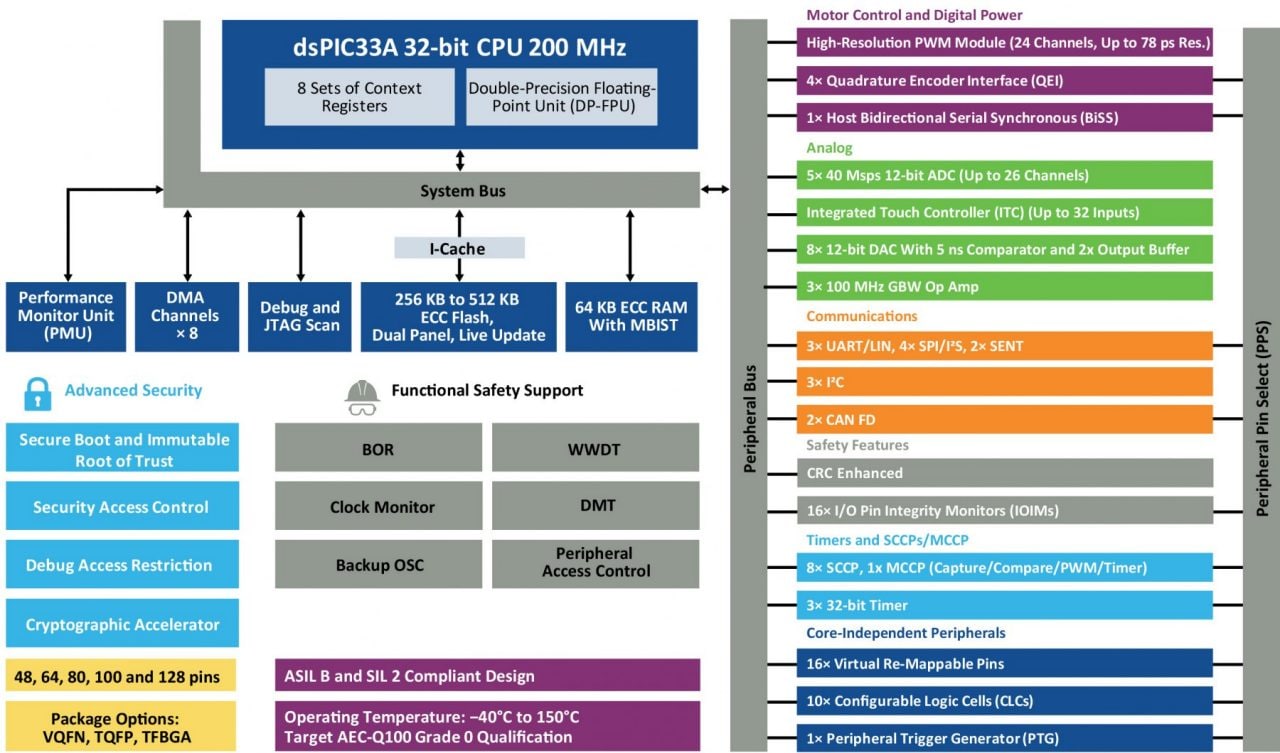
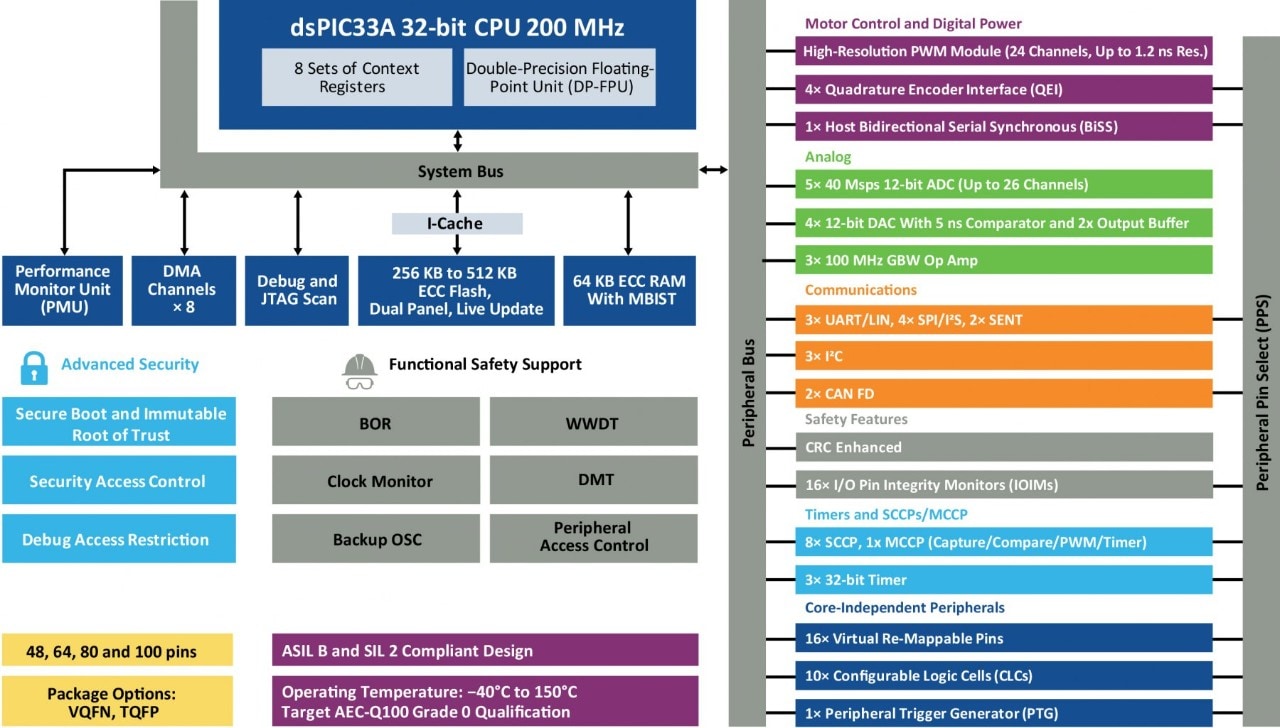
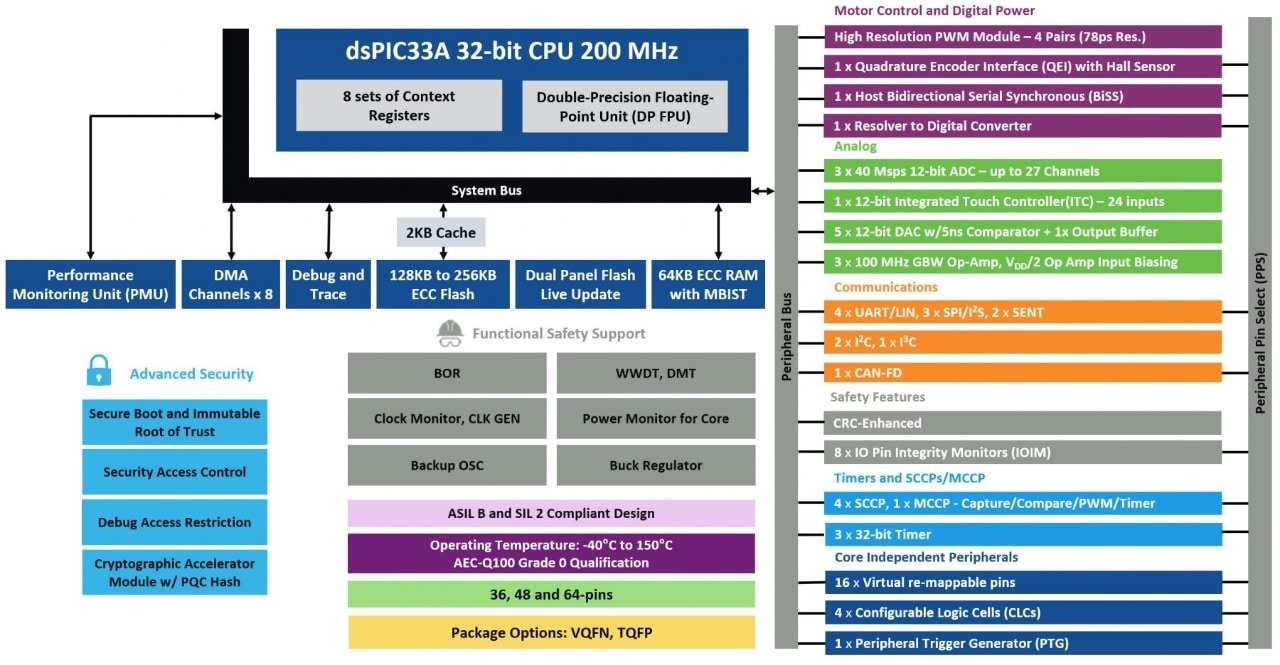
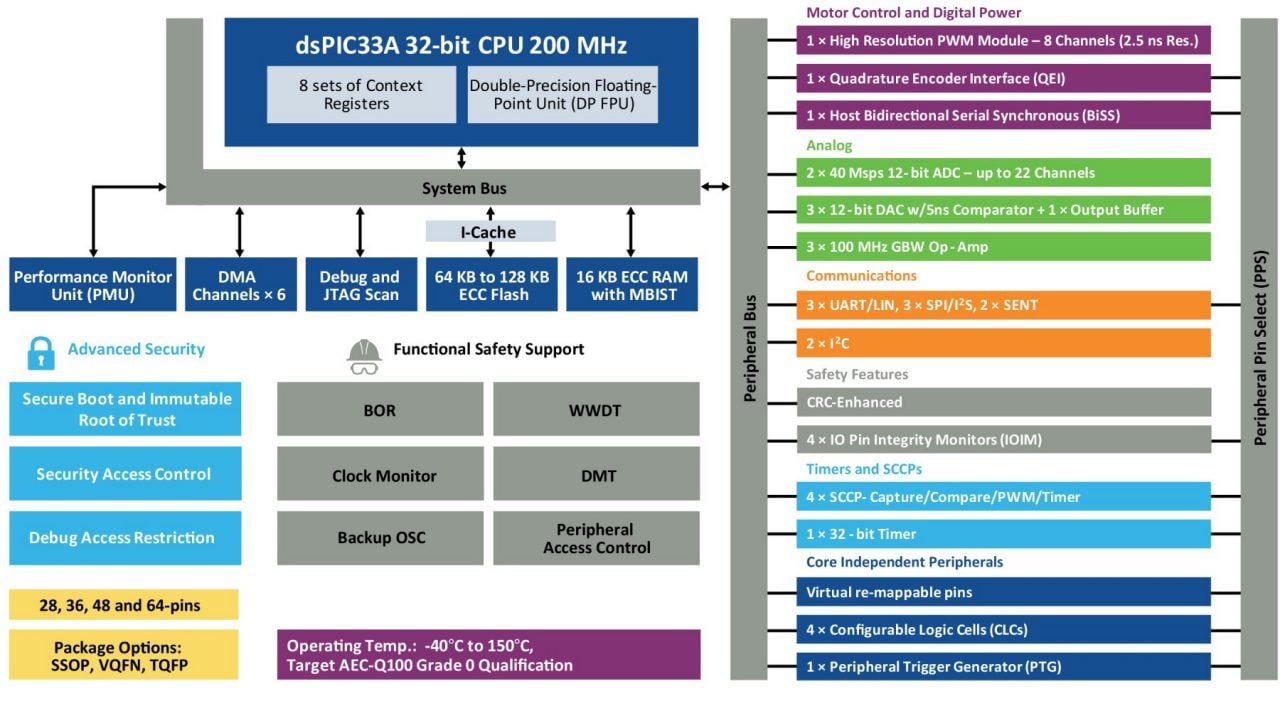
Block Diagrams
- dsPIC33AK512MPS512 Family
- dsPIC33AK512MC510 Family
- dsPIC33AK256MPS306 Family
- dsPIC33AK128MC106 Family
Simplify Higher Safety Compliance With Decomposition
Are you worried about the increased design complexity and developmental costs of meeting higher safety standards? Our application note discusses how to use the decomposition method when creating an ASIL D/SIL 3 E-Fuse application to reduce software development effort (equivalent to implementing ASIL B/SIL 2 twice), deliver substantial cost savings and provide scalability. Explore the benefits of this modular solution and simplify the development of your next higher safety compliance design.
Accelerate Your Development Journey With dsPIC33A DSCs
Accelerate your complex, real-time embedded designs with our comprehensive ecosystem support for the dsPIC33A DSCs.
Documentation
Tools and Software
- Demo & Evaluation Boards
- Development Environment
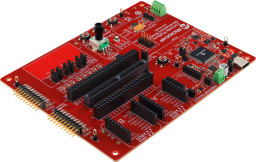
The Curiosity Platform Development Board (EV74H48A) is a full-featured development and demonstration platform enabling customers to explore the capabilities of the dsPIC33A Digital Signal Controller (DSC) family and also the PIC32A MCU family. The board operation requires the insertion of a 120-pin General Purpose Dual In-Line Module (DIM) containing a dsPIC33A DSC device or a PIC32A MCU device.
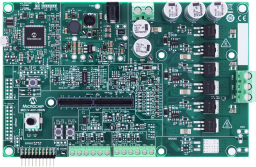
The Motor Control System (MCS) Development Tool Ecosystem enables rapid prototyping of motor control designs using the dsPIC® DSCs, SAM, PIC32MK, PIC32MC and PIC32C MCUs. The MCS Development Tools consist of modular and interchangeable inverter boards, controller boards (Dual In-Line Modules or DIMs) and expansion boards. DIMs and expansion boards must be purchased separately, see the links for the MC DIMs below. The MCLV-48V-300W Inverter Board is targeted to drive a low-voltage (12-48V) three-phase Permanent Magnet Synchronous Motor (PMSM) or Brushless DC (BLDC) motor up to 25A RMS continuous per phase at 25°C.
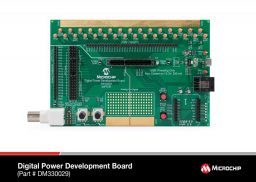
The Digital Power Development Board is a demonstration board that provides the user a flexible measurement platform for all compatible Microchip dsPIC33’s Digital Power Plug-In Modules (DP PIMs).
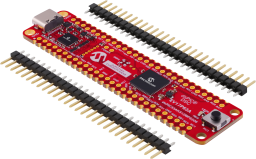
This cost-effective board facilitates easy evaluation and adoption of 32-bit dsPIC33A Digital Signal Controllers. It features the high-performance dsPIC33AK512MPS506 DSC with 200 MHz 32-bit CPU, DP-FPU, up to 40 Msps 12-bit Analog-to-Digital Converters (ADCs and several high-performance analog and digital peripherals).

MPLAB X IDE is a highly configurable software platform that provides powerful, free tools for developing, debugging and qualifying embedded designs that use microcontrollers and digital signal controllers.
The MPLAB XC-DSC C/C++ Compiler is a full-featured, optimizing compiler that translates standard ANSI C programs into Digital Signal Controller (DSC) device assembly language sources. This compiler also supports many command-line options and language extensions that allow full access to the DSC device hardware capabilities and gives users fine control of the compiler code generator.
MPLAB Code Configurator supports 8-bit, 16-bit and 32-bit PIC® microcontrollers. MCC is incorporated into both the downloadable MPLAB X Integrated Development Environment (IDE) and the cloud-based MPLAB Xpress IDE.

MPLAB Tools for VS Code are a set of extensions that integrate the MPLAB development ecosystem with VS Code, offering a seamless and efficient environment for developing designs based on Microchip devices.
Learning

dsPIC33A DSC 12-bit, 40 Msps ADC
In this course you will learn about the dsPIC33A DSC’s Analog-to-Digital Converter (ADC), a high-performance ADC designed for advanced embedded control systems.
Getting Started With the dsPIC33A DSC Interrupt Controller
In this course you will gain foundational knowledge and practical skills necessary to confidently integrate and utilize this interrupt controller and its features in your dsPIC33A development projects.
FAQs
What is a dsPIC33A DSC, and for which applications is it designed?
What is a dsPIC33A DSC, and for which applications is it designed?
The dsPIC33A is our high-performance Digital Signal Controller (DSC) family, built on a 200 MHz 32-bit CPU with a Double-Precision Floating-Point Unit (DP-FPU) and a DSP engine with dual accumulators and single-cycle multiply-accumulate. It combines MCU-style embedded control with digital signal processing and low-latency response, making it well suited to precision real-time control applications such as motor control, high-frequency digital power, advanced sensing, audio and edge ML. These devices are available from 28 pins and 32 KB Flash up to higher pin counts and memory, so a common architecture, tools and code base cover cost-sensitive to high-end designs. Refer to the product page for the current range of pin counts and memory.
Which dsPIC33A device should I choose for motor control, digital power or advanced sensing?
Which dsPIC33A device should I choose for motor control, digital power or advanced sensing?
Match the device to your application area:
- Motor control: dsPIC33AK-MC series with 200 MHz DP-FPU, up to 512 KB Flash, 40 Msps ADCs, 2 ns resolution PWMs, LIN/CAN FD
- Digital power/high-performance sensing: dsPIC33AK-MPS with 78 ps resolution PWMs, multiple 40 Msps ADCs, high-speed 5 ns comparators and DACs with slope compensation
Our “MC” DSC series targets motor control and “MPS” series targets digital power and high-performance sensing. Always confirm the exact ADC, PWM, memory and connectivity needs against the device data sheet, and confirm availability on the product page.
What analog and control peripherals make the dsPIC33A suited for precision real-time control?
What analog and control peripherals make the dsPIC33A suited for precision real-time control?
The dsPIC33A integrates a high-performance Analog Front-End (AFE) on-chip—12-bit ADCs; up to 40 Msps, with a 16-bit oversampling mode; op amps; high-speed comparators; 12-bit DACs, with slope compensation; high-resolution PWMs; and an Integrated Touch Controller (ITC). These are coupled to the CPU through a Peripheral Trigger Generator (PTG) for deterministic, low-latency event coordination. Combined with the 200 MHz DSP core and DP-FPU, this lets designers acquire, filter and act on control signals in a single device, which reduces external op amps, comparators and PGAs to save BoM and board space. Refer to the data sheet to confirm peripheral counts for a specific part number.
What functional safety and security capabilities do dsPIC33A DSCs provide?
What functional safety and security capabilities do dsPIC33A DSCs provide?
dsPIC33A DSCs support ISO 26262 ASIL B, IEC 61508 SIL 2 and IEC 60730 Class B applications, with AEC-Q100 qualification up to Grade 0 (−40°C to +150 °C) on qualified devices. Hardware safety features include ECC on dual-panel Flash and RAM; multiple, independent ADC cores for redundancy; I/O integrity monitors; a fail-safe clock monitor; windowed watchdog/deadman timers and a core power monitor that are supported by diagnostic libraries, FMEDA reports and a TÜV SÜD-certified MPLAB® XC-DSC functional-safety compiler. On security, select devices integrate an immutable root of trust for secure boot, secure debug, a cryptographic accelerator (AES, SHA-2, ECC, RSA, TRNG) and Post-Quantum Cryptography (PQC) support; select devices add SHA-3/SHAKE engines to accelerate ML-DSA/ML-KEM. For higher-assurance key protection, dsPIC33A devices can be paired with our secure element.
How do I get started on developing with a dsPIC33A DSC?
How do I get started on developing with a dsPIC33A DSC?
To start a dsPIC33A design, install MPLAB X IDE and MPLAB XC-DSC Compiler, configure peripherals with MPLAB Code Configurator (MCC) Melody and evaluate on a dsPIC33A Curiosity development board. For application-specific starting points, use the motorBench® Development Suite for motor control, MPLAB Device Blocks for Simulink® for model-based design and MPLAB Machine Learning Development Suite for edge AI/ML. Refer to the dsPIC33A product page for the current list of development boards and getting-started resources.