
MOST® NetServices
Software Library for Developing MOST® Network Designs
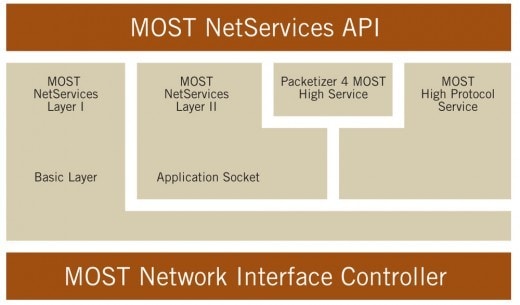
MOST® NetServices API and Components
- API
- Layer 1
- Layer 2
- High Protocol Service
- Packetizer 4 MOST High Service
MOST NetServices API
The NetServices Application Programming Interface (API) provides a software interface to the MOST network low-level system services. MOST NetServices provides access to all data transportation mechanisms on a MOST network. The MOST System Management Module, another component of the MOST NetServices library, handles system related tasks ‘above’ the MOST NetServices API and can be considered as the ‘middleware’ of a MOST System.
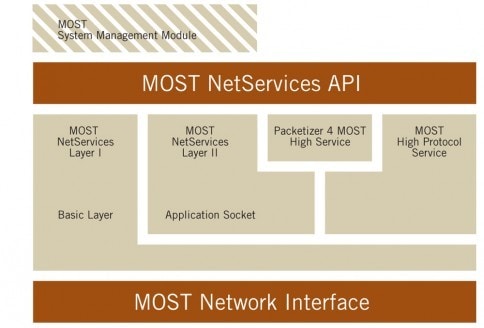
MOST NetServices Layer I
MOST NetServices Layer I is the foundation of MOST NetServices providing the application with access to all the transportation mechanisms of MOST networks. Configuration files allow Layer I to be adapted to different application and platform requirements.
All INIC circuits have a majority of NetServices Layers integrated on chip. A wrapper is required in MOST NetServices V2/V3 to interface to the Layer I on chip. This wrapper is included in all grades and components.
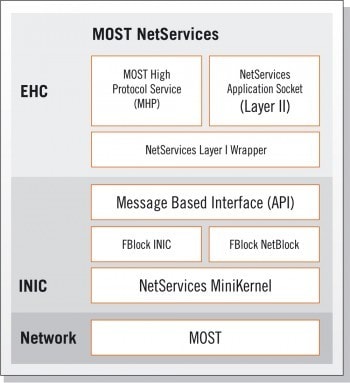
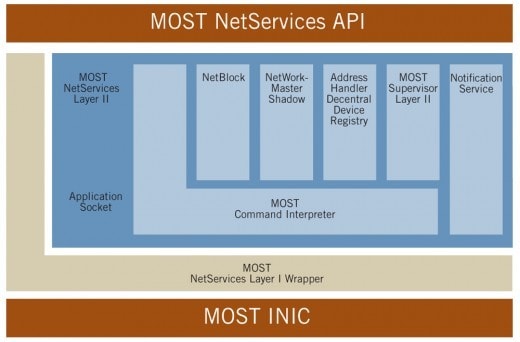
MOST NetServices Layer II
NetServices Layer II, in combination with MOST NetServices Layer I, forms the basic core of a MOST device. The NetBlock and FBlock Enhanced Testability, mandatory parts of every MOST device, are integrated into Layer II grade. The Command Interpreter and Address Handler provide full support for functional addressing, allowing the application to ignore physical addresses of other devices in the MOST network. The Notification Service simplifies the distribution of status messages whenever an internal device property changes. Configuration files allow Layer II grade to be adapted to different application and platform requirements.
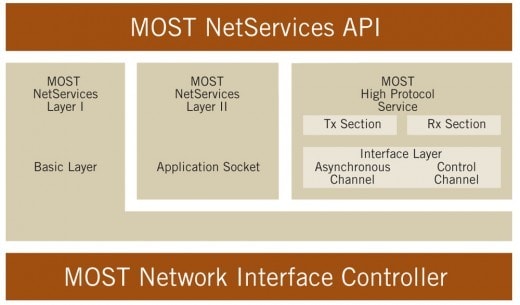
MOST High Protocol Service (MHP)
The MHP provides an alternative transmission path for packet data transfer, including an additional security layer. It allows large data packets of up to 64 KB to be sent and received. An acknowledgment mechanism provides a security layer to ensure data integrity.
MHP consists of a separate transmit and receive section, allowing for reduced code when only one section is needed. The transmit and receive sections can also be combined to enable full duplex transmissions. Configuration files allow the MHP to be adapted to different application and platform requirements.
MHP interfaces to the Control Message Service (V1.x only: CMS), as well as to the Asynchronous Data Transmission Service (V1.x: ADS; V2.x/V3.x: WADS). Transmission can be done via the control channel or the asynchronous channel of a MOST network. Note: V2.x/V3.x supports asynchronous data transmission only.
Packetizer 4 MOST High Service
Packetizer 4 MOST High Service (PMHS) provides an alternative transmission route for application messages. Sending application messages in a packet on the asynchronous data channel results in faster transmission speeds and reduces the load on the control channel. Packetizer 4 MOST High Service is the best solution for devices sending large application messages.
Product Selector and Version Information
NOTE: The MOST specifications are available on the MOST Cooperation's website.