
Making Every Port Count: How Meta-DX2+ and XpandIO Bridge the Ethernet Speed Gap
Discover how our META-DX2+ with XpandIO bridges the Ethernet speed gap, enabling seamless aggregation and rate adaptation for legacy and high-speed networks.
Imagine chartering a massive cargo ship—capable of carrying hundreds of containers—just to deliver one. It's not just overkill; it's wasteful. Yet this is exactly what happens in modern networks when legacy-speed endpoints—such as 1 GbE, 10 GbE or 25 GbE—are connected directly to ultra-high-speed switch ports designed for 400 GbE or 800 GbE. The result? Severely underutilized bandwidth, inflated infrastructure costs and inefficient network operation.
Background and Industry Trends
As data centers evolve to accommodate explosive growth in AI/ML training, cloud services, video streaming and edge computing, operators are aggressively upgrading to higher-speed fabrics. In fact, by Q2 2025, 400G and 800G transceivers made up a combined 84% of all transceiver revenue at 100G+ speeds, according to Lightwave. Yet while the backbone of the network is accelerating rapidly, the reality on the ground is very different: many enterprise servers, storage devices and edge nodes continue to operate at much lower Ethernet speeds.
This mismatch—between the speeds that endpoints can support and the capacity of the switch ports that serve them—is one of the most pressing challenges in network design today. Connecting a 25 GbE client directly to a port supporting 100 GbE per lane effectively wastes 75% of that port’s capacity. Multiply that across racks and rows in a data center, and the inefficiency becomes untenable.
Bridging Legacy and High-Speed Networks with XpandIO
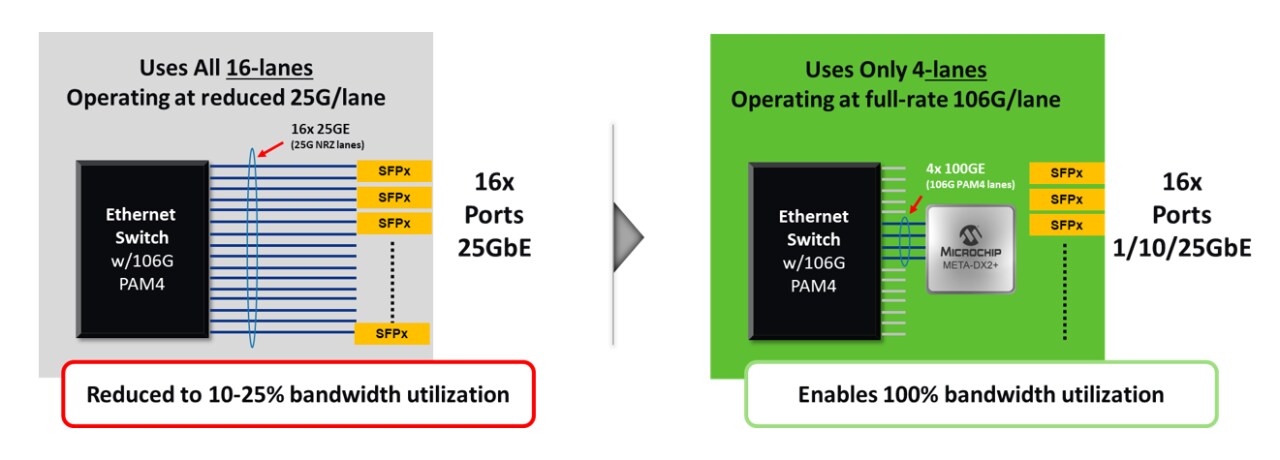
Enter XpandIO, a key capability of Microchip’s META-DX2+ Ethernet PHY, designed precisely to efficiently bridge the gap between the latest generation of devices optimized for the highest Ethernet rates, and systems operating at lower rates. Just as an efficient cargo handler consolidates containers into a ship before sending it off, XpandIO efficiently aggregates lower-speed client connections (such as 1 GbE, 10 GbE or 25 GbE) into highly utilized 100 GbE, 400 GbE or 800 GbE ports. Traditional methods for aggregating ports or mixing speed classes often require pre-aggregation using additional Ethernet switching equipment, which adds cost, power, latency and management challenges to the overall switching solution. XpandIO, by contrast, leverages industry-standard technologies to enable Ethernet switches and processing devices that lack sufficient SerDes or do not support lower MAC rates, to expand their effective port count. Figure 1 demonstrates that when 25 GbE clients are connected directly to a 106 Gbps per lane PAM4 Ethernet Switch (left diagram), only 25% of the available bandwidth is utilized. By contrast, with XpandIO port aggregation (right diagram), all 25 GbE clients can be efficiently combined, enabling full 100% utilization of the packet processor’s bandwidth. Because XpandIO is built on industry-standard protocols, the META-DX2+ can seamlessly interface with standard, off-the-shelf Ethernet compliant devices.
Figure 1: META-DX2+’s XpandIO Enables Fully Utilized Ports on Standard Ethernet Devices
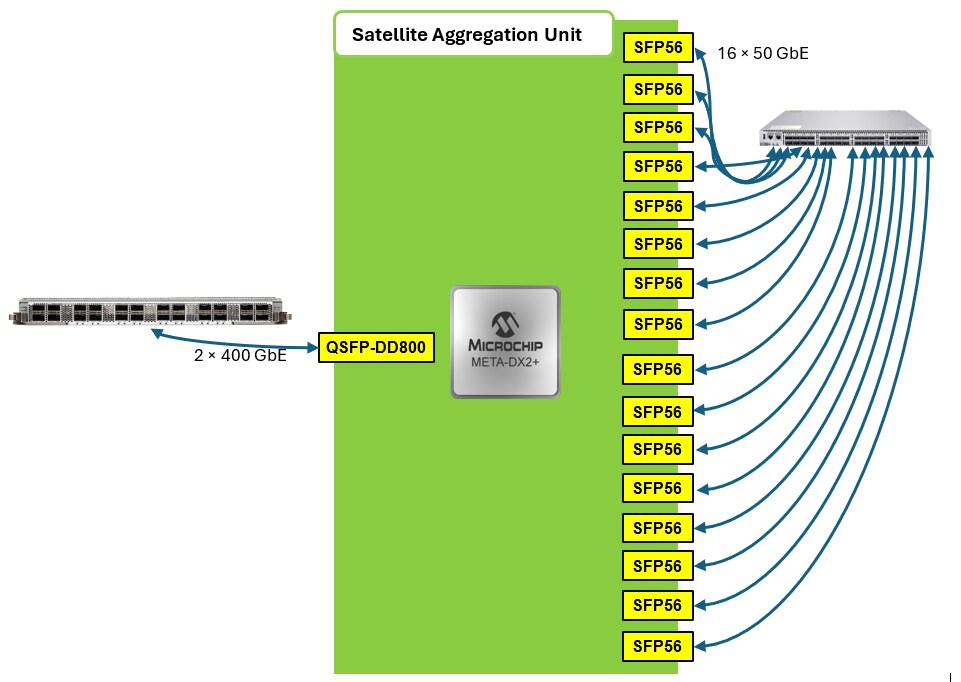
Consider a scenario in which a cloud provider deploys a next-generation 64 × 800 GbE switch to support their server fleet, which includes a mix of legacy 10 GbE, 25 GbE, 50 GbE and 100 GbE endpoints. Instead of dedicating valuable 800GbE switch ports to low-speed connections or investing in costly breakout cables, the provider deploys a META-DX2+–based satellite aggregation unit. With XpandIO technology, this unit consolidates multiple client links—such as 16 × 50 GbE—into a fully utilized 800G uplink, streamlining traffic into the core switch without requiring a large-scale aggregation chassis (Figure 2), representing an improvement of 50% throughput capacity, when compared to an Ethernet PHY that lacks XpandIO support. This approach preserves high-capacity switch ports for high-throughput services, and as a result, operators can maximize per-slot bandwidth efficiency.
Figure 2: META-DX2+’s XpandIO Enabled Satellite Aggregation Unit
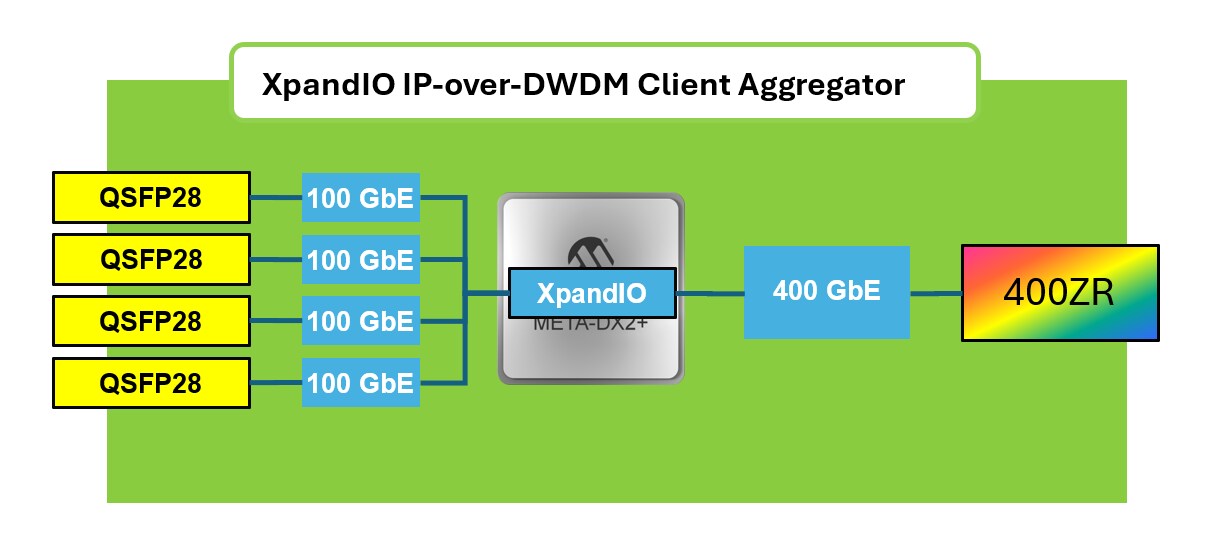
In another related use case, ZR-class coherent optics—such as 400ZR and 800ZR—are designed to support 400 GbE and 800 GbE client interfaces only. Although 100 GbE remains common in legacy networking gear, these lower rate clients cannot directly connect to the “basic” ZR coherent implementations. XpandIO bridges this gap by aggregating up to eight 100 GbE clients into a single 800 GbE stream, or four 100 GbE clients into a single 400 GbE stream, allowing operators to leverage low-cost optics while servicing ubiquitous 100 GbE deployments (Figure 3).
Figure 3
Seamless Interoperability With Rate Adaptation
If client aggregation is not required, but there remains a need to bridge the speed gap between the client and the switch, META-DX2+ provides an alternative solution. Next-generation switch ASICs and NPUs increasingly omit support for lower-speed client rates such as 1 GbE and 10 GbE, despite the continued presence of legacy equipment. This is where the Rate Adaptation capability in our META-DX2+ Ethernet PHY plays a critical role.
Rate Adaptation enables lower-speed Ethernet interfaces to operate seamlessly with higher-speed switch ASICs without requiring dedicated hardware for each rate. By converting the data rate of the incoming signal to match the rate supported on the switch ASIC, META-DX2+ simplifies network design, supports staged infrastructure modernization and preserves efficient port utilization—allowing operators to integrate legacy and next-generation equipment while maintaining both performance and cost-effectiveness.
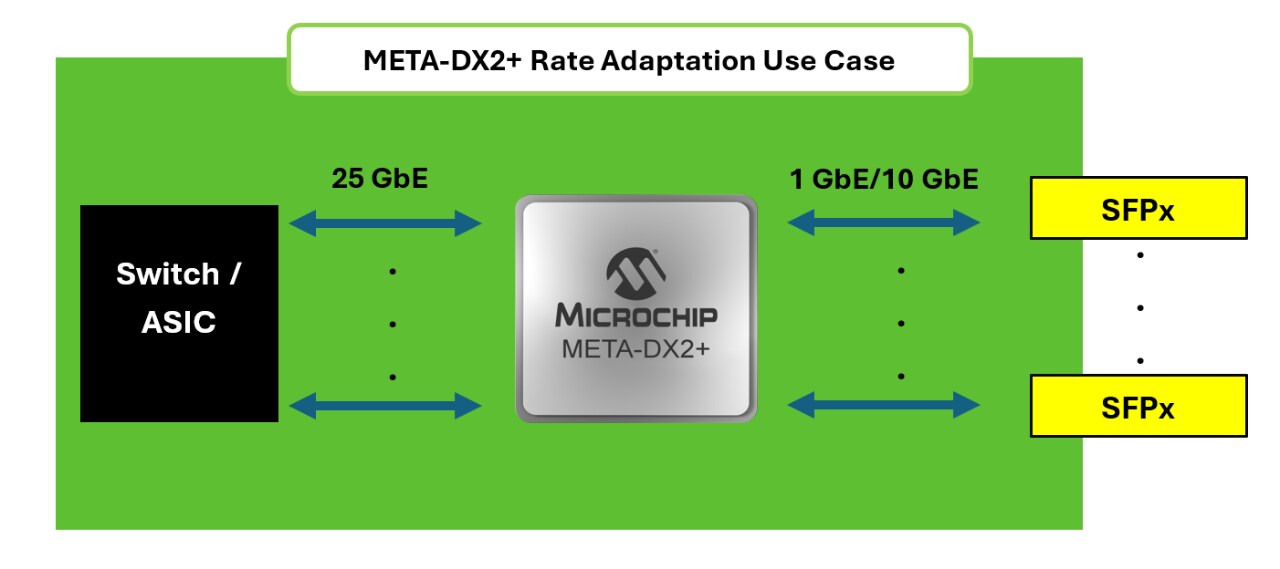
Consider a real-world example: a service provider is migrating to an 800 GbE-class switch. These devices support Ethernet port interfaces down to 25 GbE, but not below. Yet the operator still needs to connect legacy 1 GbE and 10 GbE systems. META-DX2+ bridges this gap by rate adapting those lower-speed links—converting 1 GbE and 10 GbE speeds to 25 GbE—so operators can fully leverage next-gen switch performance without sacrificing backward compatibility with valuable legacy services (Figure 4).
Figure 4
Conclusion
Together, XpandIO and Rate Adaptation form a powerful solution to a fundamental networking problem: how to scale bandwidth efficiently in an environment of fragmented device speeds. They allow operators to confidently deploy ultra-high-speed infrastructure—400 GbE and 800 GbE—without leaving behind the vast ecosystem of low-rate clients that still make up a large portion of the edge and enterprise landscape.
In this new scaling paradigm, every port counts—and with META-DX2+, every port can deliver.
For additional information:
- Watch our META-DX2+ introduction video
- Please visit our META-DX webpage
- Schedule a call and be sure to indicate your product of interest
- For pricing and availability, contact Microchip Local Sales
- Connect with the author