
MPU Security Features for Critical Infrastructure Protection
Discover how our PIC64GX microprocessors deliver advanced security, robust cryptography and tamper protection to safeguard mission-critical intelligent edge applications against evolving cyber threats and the quantum computing era.

Data security threats in mission-critical intelligent edge environments are intensifying as these systems handle sensitive data and perform real-time processing outside traditional data centers. Operating at the edge—often in remote, industrial or mobile settings—these systems are exposed to physical tampering, unsecured networks and limited oversight, making them attractive targets for cyberattacks. Threat actors may exploit vulnerabilities in edge devices to intercept data, inject malicious code or disrupt operations, potentially compromising safety-critical functions.
The cost of these cyberattacks is soaring. As reported by Statista, the cost of cybercrime in 2018 was $860 billion, climbing to over $8 trillion in 2023, and is expected to surpass $15 trillion in 2029—a CAGR of over 30%.
The decentralized nature of intelligent edge deployments also complicates consistent policy enforcement and threat detection. As edge computing becomes more embedded in critical sectors, providing robust data security through encryption, secure boot mechanisms and continuous monitoring is essential to protecting both operational integrity and sensitive information.
Threats to Mission-Critical Intelligent Edge
Different mission-critical intelligent edge sectors are experiencing new and increasing threats. The following are some examples of such threats in different industries:
Industrial: Traditionally, embedded systems in industrial applications (industrial automation, utilities and so on) were organized as isolated Operational Technology (OT) networks, distinct from the more familiar Information Technology (IT) networks that form the backbone of the corporate network with connectivity to the internet. However, there has been a trend towards OT-IT convergence. This convergence creates security risks that hackers, including nation-states, are trying to exploit.
Aerospace: As internet connectivity and in-flight entertainment options onboard commercial airlines increase, the opportunity for malicious activity has also increased. In 2015, a security researcher onboard an aircraft claimed to have taken control of flight operations by installing new software, which allowed the researcher to issue commands to have the aircraft climb and alter its course. It was claimed that all of this was accomplished through the inflight entertainment system.
Telecommunications: The telecommunications industry is facing a surge in data security threats as it becomes increasingly central to global digital infrastructure. With the rapid expansion of 5G networks, the proliferation of Internet of Things (IoT) devices and the growing reliance on cloud-based services, telecom providers are now prime targets for cybercriminals and state-sponsored actors. These threats range from sophisticated ransomware attacks and supply chain vulnerabilities to data breaches that compromise sensitive customer information. Additionally, the complexity and scale of modern telecom networks make it challenging to detect and respond to intrusions in real time. As a result, the industry must continuously evolve its cybersecurity strategies to safeguard critical infrastructure and maintain customer trust.
Automotive: The automotive industry is encountering a growing wave of data security threats as vehicles become more connected and software-controlled. Modern cars now integrate advanced technologies such as autonomous driving systems, over-the-air updates and vehicle-to-everything (V2X) communication, all of which expand the attack surface for cybercriminals. Hackers are increasingly targeting vulnerabilities in infotainment systems, telematics and even electric vehicle charging infrastructure to gain unauthorized access to personal data, disrupt vehicle functionality or manipulate critical systems. Additionally, the rise of connected fleets and mobility services introduces new risks related to data privacy and operational continuity. As a result, automakers and suppliers must prioritize cybersecurity by embedding robust protections throughout the vehicle lifecycle and collaborating across the industry to stay ahead of evolving threats.
Quantum Computers
Asymmetric cryptography is a fundamental cornerstone of any system that uses security. Algorithms such as Rivest–Shamir–Adleman (RSA) and Elliptic Curve Cryptography (ECC) are in extensive use for digital signatures and key exchange. However, quantum computers are on the horizon. It is possible that within the next 5–10 years, cryptographically relevant quantum computers (those with enough Qubits) will be available to nation-based and other well-funded groups. The danger posed by such quantum computers is their ability to run Shor’s algorithm for factoring a prime number. Such an algorithm running on a quantum computer reduces the time required to break RSA or ECC from billions of years to under one day.
Layered Approach to Securing Critical Infrastructure
An effective approach to securing critical infrastructure using microprocessors (MPUs) involves embedding hardware-based security features directly into the processors that power essential systems. These microprocessors can include secure enclaves or trusted execution environments (TEEs) that isolate sensitive operations and data from the rest of the system, protecting them even if the main operating system is compromised. Additionally, hardware root of trust mechanisms can verify the integrity of firmware and software during boot-up, allowing only authenticated code to run on the device. Microprocessors can also support real-time encryption and decryption of data, secure key storage and tamper detection, all of which are vital for defending against both physical and cyber threats. By integrating these capabilities at the silicon level, organizations can establish a foundational layer of security that is resilient, scalable and essential for protecting mission-critical infrastructure from increasingly sophisticated attacks.
Securing the Hardware
Objectives
The primary objectives for security subsystems are to:
- Provide security services to the application and support securing application code and data in transit and at rest.
- Provide platform security and protect platform integrity as well as the confidentiality and availability of critical assets where needed.
- Protect cryptographic keys from software attacks by moving the control over critical assets (in particular, cryptographic keys) from the application domain into a separate domain.
A microprocessor system with a security subsystem splits into two domains: the application domain and the security subsystem domain. The application domain consists of an environment that provides common resources, such as one or more application processors, RAM, flash and peripherals. The security subsystem domain hosts or controls security-related assets and services.
Comprehensive security services provided by the subsystem include encryption and decryption of data, verification of message authenticity and integrity and robust key management by storing cryptographic keys in dedicated memory regions. It supports various encryption schemes, data authentication through MAC tags or digital signatures and entity authentication with secure key agreement and storage. The subsystem also offers high-entropy random number generation, monotonic counters for trusted state values and platform security to safeguard critical assets. System architecture aspects involve monitoring and controlling the application environment to enforce security policies, which are configured during device provisioning, updates or at runtime. During system bring-up, the subsystem validates platform integrity and securely initializes hardware units, while secure boot ensures firmware authenticity via cryptographic validation. To maintain security post-boot, runtime integrity protection mechanisms are employed and security sensors defend against physical attacks on the microprocessor or security subsystem.
Introduction to the PIC64GX Family of Microprocessors
Our PIC64GX family is designed with advanced security features for applications requiring robust protection against various security threats.
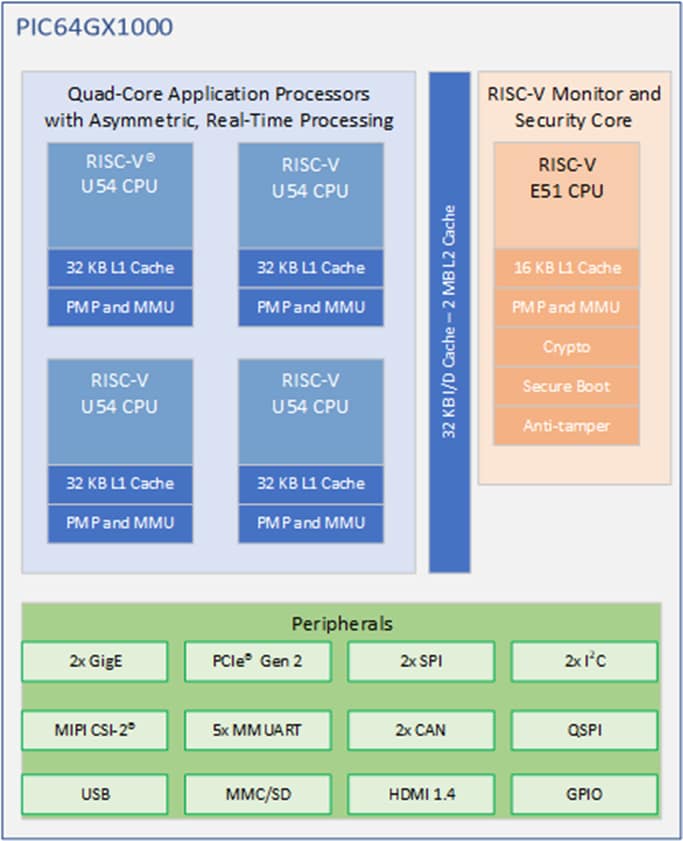 |
The security architecture of the PIC64GX MPU is designed to protect both the application design and sensitive information. It includes several components such as the system controller, SRAM Physically Unclonable Function (SRAM-PUF), Secure Non-Volatile Memory (sNVM) and Private Non-Volatile Memory (pNVM). These components work together to provide a secure environment for the device's operation.
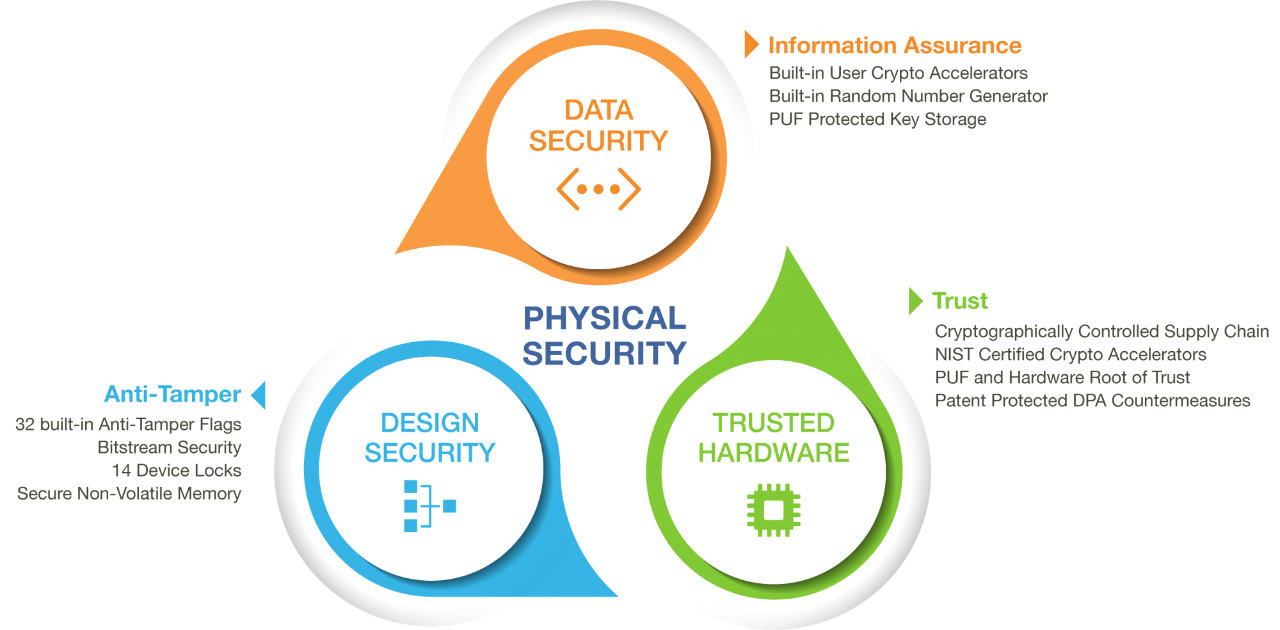
PIC64GX devices also include a number of built-in tamper detection and response capabilities that can be used to enhance security. These features include voltage, frequency and temperature monitors, as well as an anti-tamper mesh that detects physical tampering attempts. The devices also incorporate DPA countermeasures for all built-in design security protocols.
Conclusion
Cyberattacks are increasing and exacting an increasing cost. Importantly, mission-critical intelligent edge applications are a key target of both private and nation-state aligned attackers. Embedded system developers must select microprocessors that incorporate a complete set of functions, cryptographic algorithms and countermeasures to fortify their systems against malicious actors. Furthermore, with the approaching dawn of the quantum computing era, the microprocessors used must integrate post-quantum cryptographic algorithms. Our PIC64GX MPUs provide system developers with the high-performance compute, interface integration and fault-tolerance to unlock their highest potential. By integrating a comprehensive set of defense-grade security functions, PIC64GX devices answer the call for security in mission-critical intelligent edge applications.