
Implementing a Radiation-Tolerant OBC With 6×1Gb Ethernet Using PolarFire® SoC FPGA
As space systems become more connected, CAVU Aerospace turned to our PolarFire® SoC FPGA to power a reliable, network‑centric On‑Board Computer. Explore how this platform helps enable robust, adaptable computing for today’s satellites and spacecraft.

As spacecraft architectures evolve toward distributed, high-throughput systems, the On-Board Computer (OBC) is no longer just a controller—it is the central data router, processor and reliability backbone of the mission.
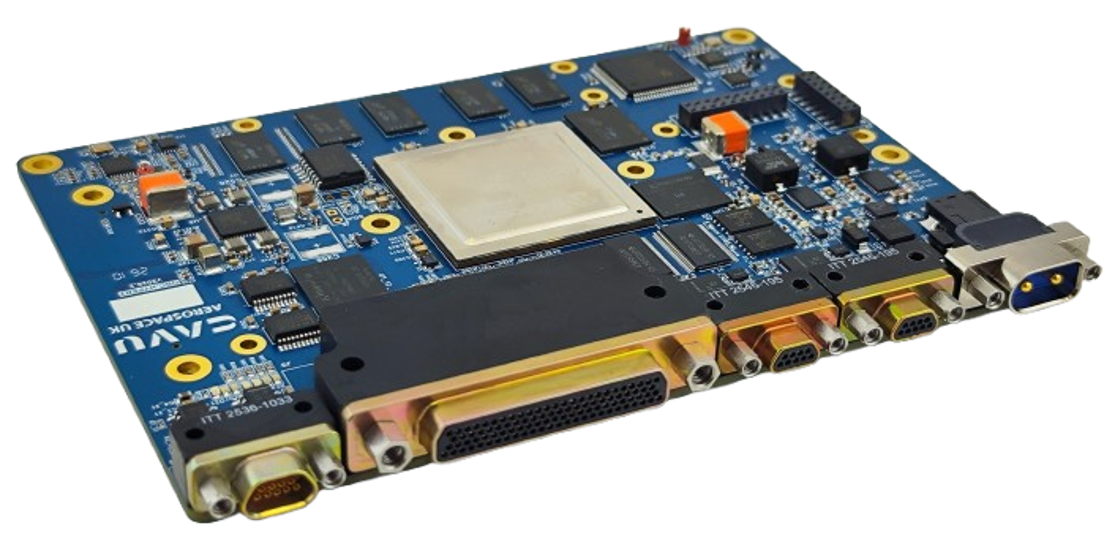
The OBC-Hyper-Polar, developed by Cavu Aerospace UK, is designed around this philosophy. By combining a PolarFire® SoC FPGA with six 1Gb Ethernet interfaces and a high-reliability power subsystem using Glenair Micro-D connectors, the system achieves both performance and mission-grade robustness. Cavu Aerospace is a Microchip Mi-V partner and manufactures onboard computer for satellites, rockets and spacecrafts.
The OBC-Hyper Polar is built based on Microchip’s PolarFire SoC FPGA, which integrates:
- Multi-core RISC-V processors for software-defined control
- FPGA fabric for deterministic, parallel data handling
- Low-power architecture ideal for space platforms
- Radiation-tolerant design suitable for LEO and deep-space missions
This hybrid approach allows:
- Hardware-accelerated Ethernet switching and packet handling
- Real-time payload interfacing
- Software flexibility for mission updates
 |
High-Speed Networking: 6× Independent 1Gb Ethernet Ports
The OBC-Hyper-Polar provides six isolated Gigabit Ethernet interfaces including Eth on the OBC board and peripheral boards connected via High-speed interfaces, enabling:
- Distributed Spacecraft Architectures
Each subsystem (payload, ADCS, communications, storage) can operate as a network node, reducing centralized bottlenecks. - Redundancy and Fault Tolerance
Multiple Ethernet links allow cross-strapping between subsystems, ring or mesh redundancy and graceful degradation under failure - FPGA-Based Networking
Using the PolarFire FPGA fabric, the OBC can implement deterministic Ethernet switching, custom packet routing and Time-Sensitive Networking (TSN)
Multi-Interface Support
Beyond Ethernet, the system integrates:
- LVDS for high-speed sensor interfaces
- Serial I/O for legacy subsystems and housekeeping
- ADC interface for analog telemetry acquisition
- JTAG-USB debug for development and diagnostics
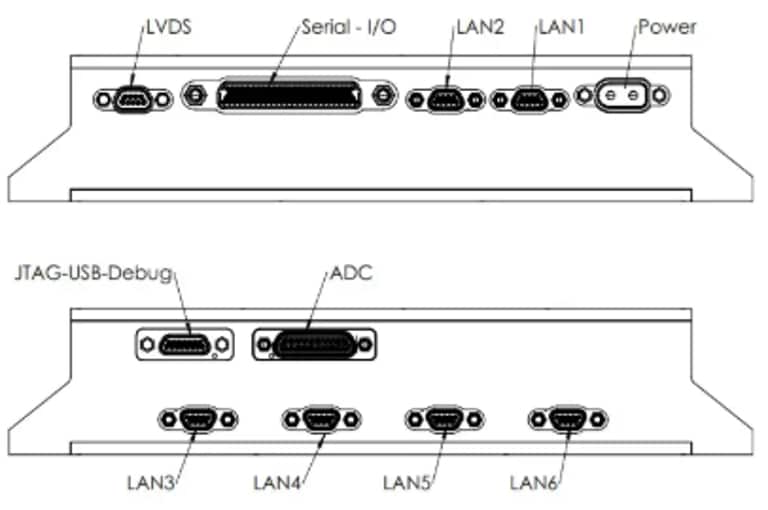 |
This ensures compatibility across a wide range of spacecraft subsystems.
FMEA-Driven Reliability Engineering
Improving OBC reliability without incurring a major cost increase requires a structured systems engineering approach. A comprehensive Failure Modes and Effects Analysis (FMEA) is essential to identify failure paths that could lead to loss of mission or loss of spacecraft. The resulting Critical Item List (CIL) highlights components where radiation-induced failures have the highest operational impact.
Experience across multiple LEO programs shows that the most critical contributors to unrecoverable radiation events in OBCs typically include:
- Volatile memory (SEUs, SEL-induced corruption)
- Non-volatile memory (SEFI events, stuck bits, accelerated wear-out)
- Power management ICs (single-event latch-up and single-event burnout)
- High-speed interface PHYs (link loss or permanent degradation)
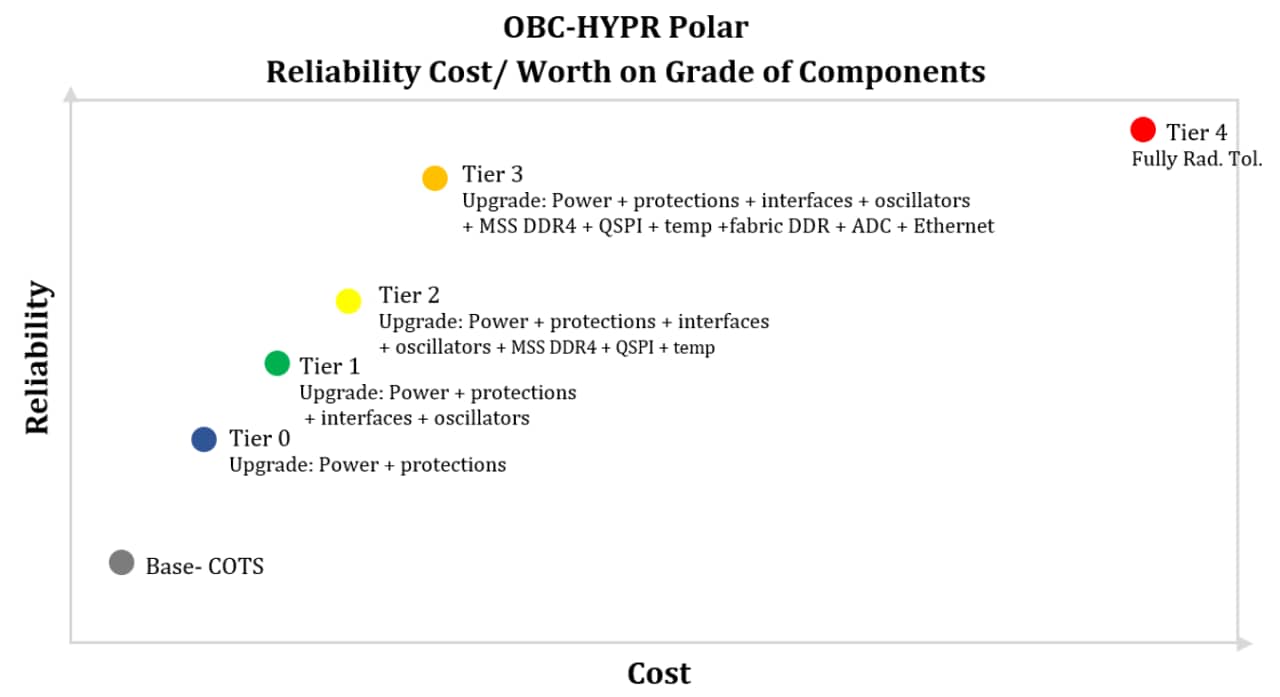
For flight models, a trade-off between reliability and cost is required. OBC-Polar is available in multiple configurations, including COTS-based, partially radiation-tolerant and fully radiation-tolerant variants. The PolarFire SoC is inherently latch-up immune. For each configuration, component part numbers are shared and a detailed FMEA is performed to identify critical components and assess reliability versus cost, providing full visibility of the available options to space missions.
Options:
- Baseline: All COTS components
- Tier0: Upgraded parts: Power + protections
- Tier1: Upgraded parts: Power + protections + interfaces + oscillators
- Tier2: Upgraded parts: Power + protections + interfaces + oscillators + MSS DDR4 + QSPI + temp
- Tier3: Upgraded parts: Power + protections + interfaces + oscillators + MSS DDR4 + QSPI + temp + fabric DDR + ADC + Ethernet
- Tier4- Fully Radiation Tolerant
Selective Integration of Radiation Tolerant Components
A highly cost-effective mitigation strategy is to selectively upgrade only these high-impact components to radiation-tolerant alternatives with specifications such as:
- Radiation-Tolerant SRAM / DDR
- TID tolerance of ≥ 30–50 krad(Si)
- SEL immunity up to LET ≥ 60 MeV·cm²/mg
- SEU rates compatible with ECC-based mitigation schemes
- Radiation-Tolerant Flash / MRAM
- TID tolerance of ≥ 50 krad(Si)
- Reduced susceptibility to SEFI events
- Improved data retention under proton exposure
- Radiation-Tolerant Power Regulators and Supervisors
- SEL-free operation up to LET ≥ 60 MeV·cm²/mg
- SEB-hardened MOSFET structures
- Stable output during transient radiation events
- Radiation-Tolerant Interface PHYs (CAN, SpaceWire, Ethernet)
- TID tolerance of ≥ 30 krad(Si)
- Reduced risk of latch-up or permanent link failure
These targeted upgrades dramatically reduce the probability of unrecoverable faults while introducing only a modest cost increase compared to fully radiation-hardened OBC solutions.
Power Sub-System: FMEA-Driven Reliability Engineering
Power subsystem is identified as the highest-risk element in the OBC. Failures in power delivery can result in complete system shutdown, FPGA latch-up or reset or data corruption or mission loss. To mitigate these risks, the OBC-Hyper-Polar incorporates:
- Radiation-Tolerant DC/DC Conversion
- Stable operation across temperature extremes
- Protection against transients and single-event effects
- High efficiency to reduce thermal load
- High-Reliability Power Interconnect with Glenair Micro-D Connector (IGMPM2-B112R-CBRT-SU-.109)
The OBC uses a Glenair Micro-D combo connector, specifically designed for power and signal integration in harsh environments. The reason this connector matters is listed here:
- High Current Capability in Compact Form
- Approximately 13A per contact
- Enables reliable power delivery without bulky connectors
- Ideal for compact spacecraft avionics
- Combo Micro-D Architecture
The connector combines:
- Power contacts
- Signal contacts
- Compact Micro-D footprint
- Ruggedized PCB Mount Design
- Right-angle PCB mounting with encapsulation support
- Epoxy-sealed contacts improve resistance to vibration and resistance to thermal cycling
- Ensures mechanical integrity during launch conditions
- Space-Grade Materials
- Beryllium copper contacts for high conductivity and durability
- Gold plating for corrosion resistance and low contact resistance
- Aluminum alloy shell with protective finish for strength and EMI shielding
- Wide Operating Temperature Range
- Typically −55°C to +150°C
- Suitable for Low Earth Orbit thermal cycling and deep space missions
- Mechanical Reliability
- High mating cycle durability
- Secure locking mechanism
- Strong resistance to vibration and shock
- High Current Capability in Compact Form