
Save Pins, Simplify Complex Designs—Mastering Virtual Input/Output Pins of dsPIC33 DSCs
Learn how virtual I/O pins in dsPIC33C and dsPIC33A DSCs help you save pins, simplify routing and build faster, deterministic control loops. This post explores what virtual pins are, how they work and real-world use cases in motor control, digital power and advanced sensing designs.
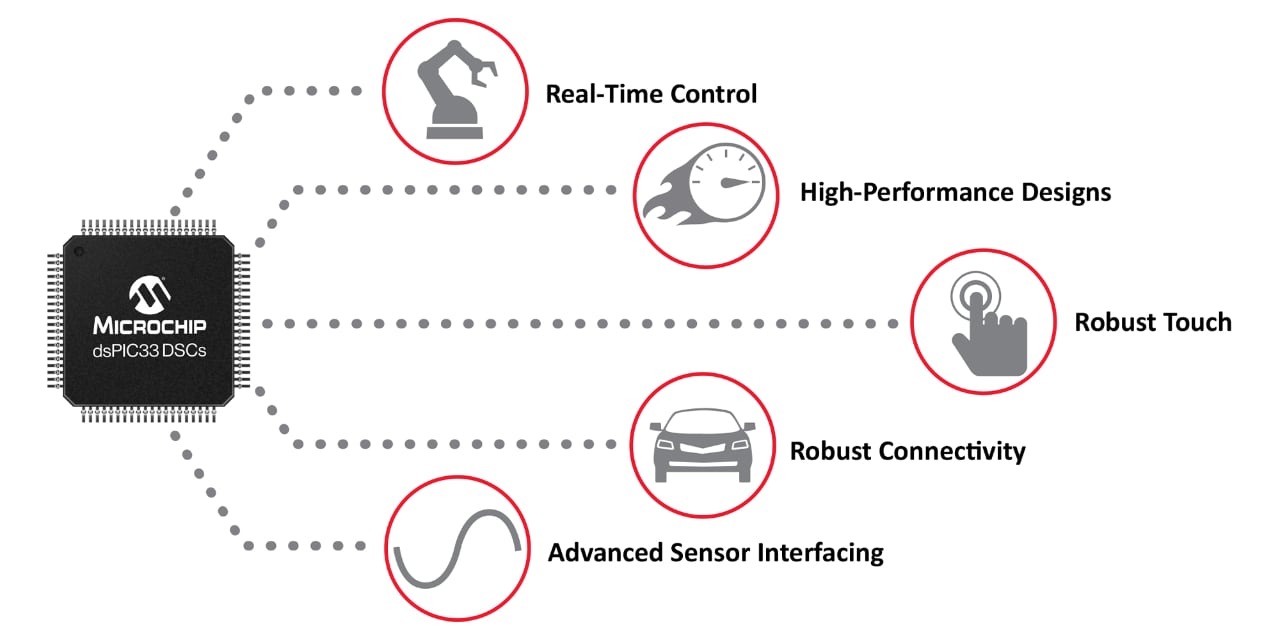
Microcontrollers are the heart of embedded systems, and managing their Input/Output (I/O) is fundamental to any project. While most pins map directly to physical hardware, the new high-performance dsPIC33C and dsPIC33A Digital Signal Controllers (DSCs) introduce a powerful concept—virtual input/output pins.
If you're working on advanced, real-time control applications like motor control and digital power, or advanced sensing applications, understanding this feature is key to maximizing your design's efficiency and reliability across the applicable dsPIC® families.
What Exactly Are Virtual Input/Output Pins?
In a nutshell, a virtual pin is an internal, software-configurable feature that behaves like a physical I/O pin but doesn't necessarily have a direct, dedicated physical connection to the outside world.
Instead of directly controlling a physical pin, a peripheral can be configured to use a virtual pin as its input/output. This allows the system to monitor or utilize the input/output state of a peripheral without requiring a dedicated physical pin or consuming a valuable Peripheral Pin Select (PPS) resource.
Beyond simplifying pin management, virtual pins enable techniques like creating combinatorial triggers from internal peripheral events, including gating input signals and performing windowed signal processing. This capability allows engineers to implement complex, hardware-driven logic paths without adding latency or burdening the CPU, which paves the way for faster, deterministic control loops and streamlined system architectures.
Real-World Applications and Challenges Solved Using Virtual Pins
The complexity of modern embedded designs demands reduced board design complexity, redundancy and efficiency in utilizing the valuable physical IO pins, where dsPIC virtual input/output pins shine.
- High-Frequency Motor Control
- Challenge: In applications like high-speed robotics and electric vehicle motor drives, you need to implement fast, hardware-based fault shutdowns to protect the power electronics, such as MOSFETs and IGBTs, from overcurrent. The signal path from the sensor to the Pulse-Width Modulation (PWM) device shutdown must be immediate and bypass slow software loops.
- Application of Virtual Pins: The output of a fast analog peripheral like a high-speed comparator that detects an overcurrent condition is routed to a virtual pin. This virtual pin is then used as a direct, internal hardware input to the PWM fault module. This results in low latency shutdown, which enables safe operation under fault conditions.
- Digital Power Supply Synchronization
- Challenge: Modern digital power converters require complex sequences where one stage's operation must precisely trigger the next stage, such as how the end-of-conversion from an Analog-to-Digital Convertor (ADC) needs to initiate a new PWM cycle
- Application of Virtual Pins: The ADC end-of-conversion signal is mapped to a virtual pin. This virtual pin is then configured as the synchronization input for a timer or another PWM module. This creates a tight, hardware-locked control loop to enable precise synchronization and minimize control-loop latency, which is critical for high-efficiency power delivery
- Advanced Sensing Application
- Challenge: In sensor systems such as ultrasonic Time-of-Flight (ToF) measurement, precise timing between the excitation signal and the receiver input window is critical. Traditional software-based sequencing introduces latency and jitter, making it difficult to open the receiver window immediately after the transmit pulse. This can lead to missed echoes, increased noise and non-deterministic timing under varying CPU loads
- Application of Virtual Pins: Virtual pins provide a hardware-driven solution for deterministic timing. For example, the event marking the end of the excitation burst, such as a PWM edge or timer compare can be routed to a virtual pin. This virtual pin then triggers the sensor input window or enables the receiver path without involving the CPU. In ultrasonic ToF applications, the same approach ensures the receiver window opens exactly when valid echoes are expected, improving signal-to-noise ratio and measurement accuracy. By eliminating software overhead, this method guarantees low latency response and consistent acquisition timing
- Safety-Critical Redundancy (Dual-Core Architecture)
- Challenge: In systems requiring high reliability, such as medical devices, automotive Electronic Control Units (ECUs) and redundant industrial control, the primary core needs to know the exact state of the real-time control signals being generated by the secondary core without introducing any communication latency or overhead
- Application of Virtual Pins: The critical fault flags or the final PWM-enable state from the secondary core's control peripherals are exported to dedicated virtual pins. The primary core constantly monitors these virtual pins. This provides a lightweight, hardware-assisted redundancy check for improving overall system integrity
Key Benefits for Embedded Developers
- Enhanced Debugging and Visibility:
- By routing internal peripheral states to a virtual pin, developers gain visibility into real-time operations that would otherwise be hidden. You can monitor complex internal logic by simply reading the virtual pin's register
- Conservation of Physical I/O and PPS Resources:
- Physical pins and the flexible PPS remapping system are finite resources. Virtual pins allow peripherals to communicate internally without consuming a physical pin, freeing up those pins for external connections like LED indicators, buttons and communication ports.
- Fast and Deterministic Control
- Since the connection is internal and often handled by hardware logic, the signal propagation between the source peripheral and the destination (the virtual pin) is incredibly fast and predictable. This enables deterministic behavior, which is essential for high-frequency control loops
Conclusion
The virtual input/output pins available on the dsPIC33C and dsPIC33A DSCs are an abstraction feature that moves beyond simple, one-to-one pin mapping. It's a key enabler for advanced dsPIC DSC architectures, providing a robust, high-speed and resource-efficient mechanism for inter-core communication, system redundancy and internal peripheral synchronization.
For developers pushing the limits of real-time performance and system reliability, leveraging virtual pins is a crucial step in harnessing the full power of dsPIC33 DSCs.
Explore the virtual input/output pins in our dsPIC33C and dsPIC33A DSCs to unlock low latency performance and system redundancy in your next project.
Visit our dsPIC DSCs web page to learn more.