
Future-Proofing Security: Hardware-Based Hybrid Cryptography and Implementation on Microchip’s PolarFire® FPGAs
Xiphera’s PQC solutions are standardized, CAVP validated and optimized for Microchip’s PolarFire® FPGAs.

Quantum computers and Post-Quantum Cryptography (PQC) are no longer just theoretical. They’re more like buildings that have moved from the blueprint stage into active construction. While quantum computers could unlock breakthroughs in medicine, AI and beyond, they also threaten to crack the encryption that protects everything from your emails to national security. On top of that, unfriendly parties can already exploit the so-called “harvest now, decrypt later” strategy, where adversaries store encrypted data today to decrypt it in the future using quantum computers.
The solution? A smooth, strategic transition from classical cryptography to quantum-resilient PQC. Enter hybrid cryptographic models—the best of both worlds. By blending classical algorithms with PQC, hybrid systems offer a practical, future-proof path forward. They let organizations upgrade security without ripping and replacing existing infrastructure, making the shift to quantum-resistant encryption not just possible, but seamless.
Xiphera offers a wide range of PQC solutions, all standardized, CAVP validated and optimized for Microchip’s PolarFire FPGAs.
The Role of Evolving PQC Standards in Modern Cryptography
The first official Post-Quantum Cryptographic Standards were finalized and released in 2024 by the National Institute of Standards and Technology (NIST).
The standardization project was officially initiated in 2016 to develop, evaluate and standardize quantum-resistant public-key algorithms, which means 2026 marks the 10-year anniversary of PQC Standardization. The release of the standards marked a significant milestone for ensuring that today’s communications remain secure in a future, where quantum computers can break some of the traditional encryption algorithms.
Creating new security standards to protect against quantum computers wasn’t simple:
- 2016: NIST launched a global competition, inviting experts worldwide to submit their best ideas for quantum-resistant encryption.
- 2016-2017: NIST received 69 promising proposals.
- 2018-2024: NIST carefully reviewed and narrowed down the options. Three algorithms stood out as the best choices for real-world use: ML-KEM, ML-DSA and SLH-DSA. A fourth algorithm, FALCON, was selected for standardization; however, no drafts related to its standardization process have been released to date.
- 2024: First finalized Post-Quantum Cryptographic Standards were released.
- 2025: The addition of HQC marked the end of the competition that started in 2016. Development of the standards is ongoing.
To this day, NIST is exploring new methods to keep our digital world safe, aiming to diversify its portfolio and further secure systems against future quantum threats. As PQC standards continue to evolve, the reconfigurability of Microchip’s PolarFire FPGAs makes them particularly well-suited for hardware implementations.
The Advantages of Hardware-Based Cryptography
While software depends on the computer’s processors and operating system, hardware-based encryption operates independently of the operating system, without relying on the CPU for cryptographic operations. By embedding PQC algorithms directly into FPGAs, hardware solutions can deliver faster, more energy-efficient encryption—especially critical for resource-constrained environments like IoT devices or high-performance computing.
Hardware also provides an added layer of physical security, as cryptographic operations are isolated from potential software vulnerabilities. This separation protects against operating system-level malware, rootkits and memory-based attacks. Advanced implementations can detect tampering attempts and automatically wipe encryption keys.
Hardware’s transparent operation eliminates user intervention after initial setup. The encryption process operates invisibly without impacting user experience, ensuring seamless integration into daily workflows. This approach not only simplifies security management for end-users but also reduces the risk of human error, which is often a weak link in data protection. By handling encryption and decryption at the hardware level, the system maintains high performance and reliability, even under heavy workloads.
For scenarios where tamper resistance, speed and efficiency are top priorities, hardware implementation shines as a robust and reliable option. In fact, as quantum-resistant solutions become increasingly important, the adaptability of our PolarFire FPGAs will likely add to their value.
Xiphera’s hardware-based PQC algorithms are optimized for FPGA implementation and offer easy system integration with PolarFire FPGAs, without embedded CPU or software components.
Migration Made Safe With Hybrid Solutions
The rise of quantum computing isn’t just a technological leap. It’s a potential threat to the cryptographic systems that protect our data today. While PQC is crucial for future-proofing security, classical cryptography still has a vital role to play. Here’s why a hybrid approach, blending the old and new, is the most practical path forward.
Why Classical Cryptography Still Matters
Quantum computers pose the biggest risk to public-key cryptography, which secures everything from encrypted emails to secure web connections. However, symmetric cryptography, the kind used for bulk data encryption, remains resilient. By simply increasing key lengths, symmetric algorithms can stay secure even against quantum adversaries. This means we don’t need to replace all classical systems, just reinforce them where necessary.
Hybrid Cryptography: The Best of Both Worlds
So, how do we prepare for a quantum future without abandoning proven security methods? The answer: hybrid models. By combining classical algorithms with PQC, we create a dual-layer defense that offers:
- Long-term security: If a vulnerability is found in a PQC algorithm, the classical layer keeps data safe.
- Quantum resistance: When quantum computers become powerful enough to break classical encryption, the PQC layer steps in.
- Modular flexibility: Hybrid models are very agile as they are modular combinations of different blocks. In the event of a block becoming faulty, it can be replaced by another block from the same algorithm family.
Think of it as a safety net within a safety net. For example, in TLS 1.3 handshakes, a traditional algorithm like Elliptic Curve Diffie-Hellman (ECDH) can be paired with a PQC algorithm like ML-KEM. An attacker would need to break both to compromise the connection.
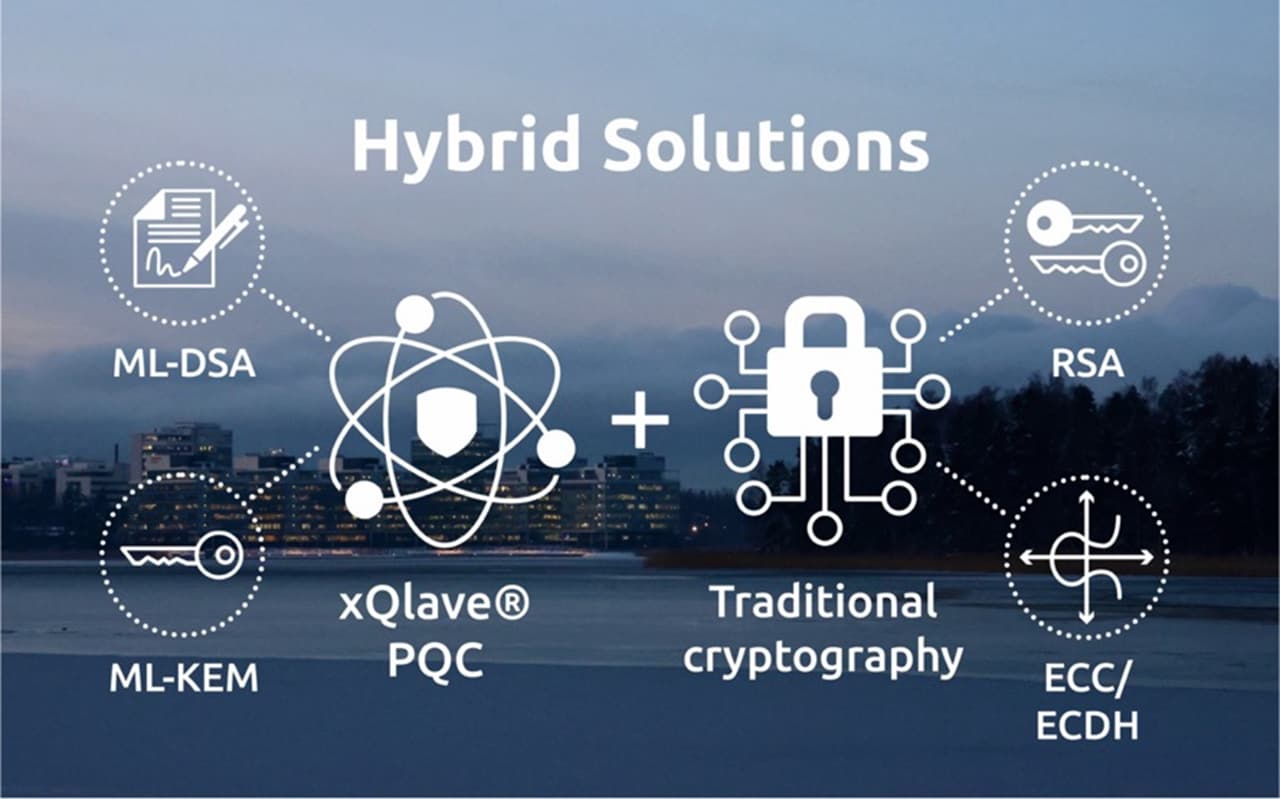
Xiphera provides a wide range of post-quantum and traditional cryptographic algorithms. These can be combined to create hybrid security solutions. xQlave® is Xiphera’s own product family of post-quantum algorithms.
What if a PQC Algorithm Fails?
No system is perfect, and PQC is still evolving. If a flaw is discovered in a PQC algorithm, here’s what happens:
- The vulnerable algorithm is disabled immediately.
- The system falls back to classical encryption while experts assess the situation.
- NIST and the cryptographic community spring into action and release a patched version.
- The updated PQC algorithm is redeployed, stronger than before.
This agility of hybrid cryptography ensures minimal disruption and keeps data secure even in worst-case scenarios.
Optimizing Hybrid Solutions for the Real World
Researchers and engineers are currently working to optimize hybrid implementations. Early results show that parallelizing classical and PQC operations can significantly boost performance, especially on specialized hardware. Organizations like NIST and the Internet Engineering Task Force (IETF) are leading the charge to standardize best practices for algorithm agility, key management and interoperability.
The goal? To make the transition from classical to post-quantum as smooth as possible.
Hybrid Cryptography: A Bridge, Not a Final Destination
Hybrid models aren’t meant to last forever; their purpose is to be an intermediate step in the migration from classical to post-quantum. They allow organizations to start adopting PQC today while still relying on the battle-tested security of classical cryptography. Over time, as PQC becomes increasingly reliable, we’ll see a gradual shift toward full post-quantum implementations.
This is where reconfigurable hardware, like our PolarFire FPGAs, shines. Their flexibility makes them fit for seamless transitions, whether you’re moving from classical to hybrid or eventually to full PQC implementation.
Xiphera: Your Partner in Hybrid Security
At Xiphera, we understand that the future of encryption is hybrid. Our portfolio includes CAVP-validated, standardized and optimized solutions for Microchip’s FPGAs, ensuring you have everything needed for secure, efficient and future-ready cryptography. We pay close attention to the evolution of PQC standards, and plan to implement any notable new algorithms to our existing portfolio.
Transitioning to Post-Quantum Cryptography
Migrating to PQC is complex and time-consuming, involving updating encryption algorithms across IT environments. Most major economies have already established deadlines regarding the implementation of post-quantum cryptography. The United States, the United Kingdom and the EU all aim to complete the transition, meaning full migration to PQC for all federal and national security systems, by 2035, as do most other economies.
Experts often describe the transition in waves:
Wave 1: Experimentation and Early Adoption (2024-2026)
Focus: Assessing risks and the ability to update systems quickly. Early adoption of the first NIST-standardized PQC algorithms.
Wave 2: Hybrid Implementation (2026-2030)
Focus: Combining classical algorithms with PQC algorithms to ensure a safe transition from classical cryptography to quantum-resistant cryptography. Testing to make sure PQC does not introduce excessive latency or breaking issues with critical infrastructure.
Wave 3: Full Implementation of PQC (2030-2035+)
Focus: Full migration to pure PQC and the decommissioning of legacy systems. Widespread adoption and reaching a point where most new systems and devices support PQC by default.
Bottom Line
Quantum computing isn’t just changing how we think about technology—it’s shaking up the world of cybersecurity, too. One could argue that one of its biggest perks is forcing us to rethink encryption. As we race to build quantum-resistant algorithms, we’re learning more than ever about the future of cryptography.
With quantum computers advancing at an accelerated pace, the clock is ticking on traditional asymmetric algorithms. We don’t have to wait for a crisis to act. Hybrid encryption gives us time, flexibility and confidence to transition smoothly into a post-quantum world, without sacrificing security today.
Innovations like Xiphera’s cryptographic solutions and Microchip’s PolarFire FPGAs are stepping up, offering the flexibility needed to adapt as quantum threats evolve. The question isn’t if we’ll need quantum-resistant security, but how soon we can make the switch.
Are you ready to future-proof your encryption? Head to Xiphera's site to learn more about our PQC solutions.