
Complete Solutions for PIC64-HPSC Spaceflight Computing Designs
PIC64-HPSC microprocessors (MPUs) deliver a 100× leap in spacecraft compute—but the processor is only part of a mission-ready design. Learn how Microchip’s space-grade power, timing, memory and interface components help you build a proven, validated solution faster.

Designing a spaceflight computer is like building an expedition vehicle for extreme terrain: the engine matters, but you don’t travel on an engine alone. You need reliable fuel delivery, dependable navigation and timing, rugged communications links and storage that won’t fail when conditions get harsh. In spacecraft electronics, the “engine” might be a high-performance processor—but without qualified supporting components around it, performance can’t translate into mission success.
This post highlights how Microchip’s space-grade component portfolio complements PIC64-HPSC High-Performance Spaceflight Computing (HPSC) system designs. You’ll see how radiation-hardened or radiation-tolerant building blocks—spanning memory, timing, networking interfaces and power—help jump-start development with a pre-engineered comprehensive system approach.
The PIC64-HPSC series of High-Performance Spaceflight Computing microprocessors and accompanying software development environment provide a 100× improvement in the computational capacity of spacecraft computers when compared with traditional solutions. PIC64-HPSC MPUs also feature advanced technologies such as virtualization, Artificial Intelligence (AI), Ethernet Time Sensitive Networking (TSN), Remote Direct Memory Access over Converged Ethernet (RoCE) v2, PCIe®, Compute Express Link® (CXL®) 2.0 and post-quantum cryptography—supporting applications extending from Low Earth Orbit (LEO) to deep space.
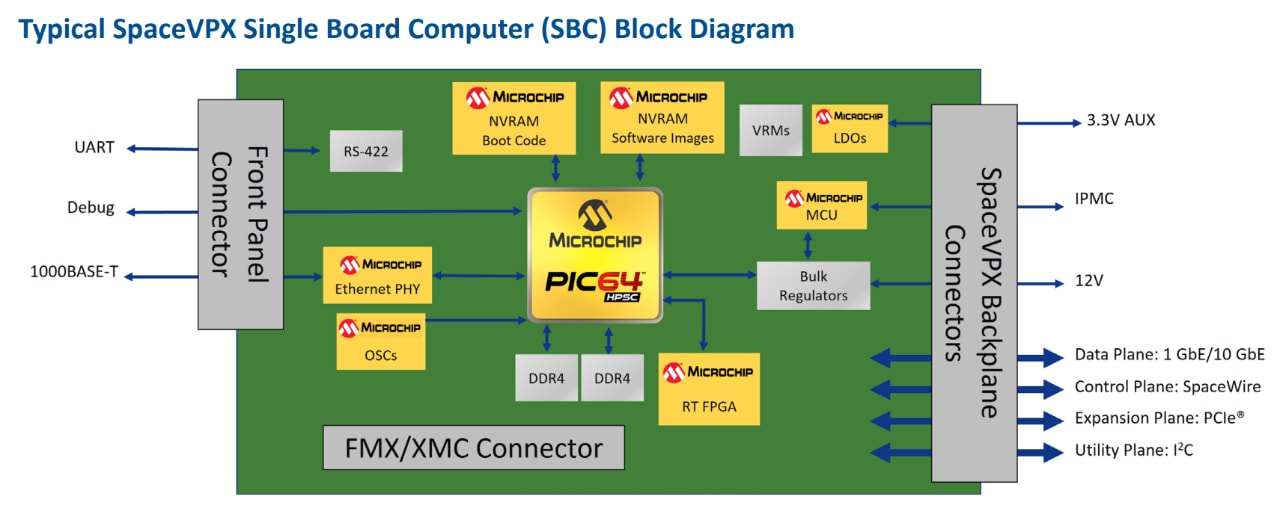
To help jump-start designs around PIC64-HPSC devices, we offer a pre-engineered space system solution that includes radiation-hardened or radiation-tolerant components intended to support design requirements such as power management, timing and front-panel/backplane interfaces used to convey sensor data or control actuators remotely. This approach is positioned as a “Proven, Validated, Ready Solution,” helping teams focus immediately on delivering designs on time.
- A pre-engineered complete solution around PIC64-HPSC
Microchip positions its comprehensive broadline portfolio as a way to reduce integration friction by pairing PIC64-HPSC MPUs with companion components selected for space applications. The intent is to provide building blocks that support key spacecraft computing needs—power management, timing and robust connectivity—so designers can move from concept toward implementation more quickly.
- Space-grade memory options for boot/code storage and fast access
We recommend multiple space-grade memory devices for PIC64-HPSC designs:
- NOR Flash: SST26LF064RT (radiation-tolerant 64 Mbit serial Quad I/O Flash) and SST38LF401RT (radiation-tolerant 64 Mbit parallel Flash). Both list –55 to 125°C operation plus SEL/TID performance highlights.
- SRAM: AT68166H radiation-hardened SRAM option also lists –55 to 125°C operation plus SEL/TID highlights.
- Timing/clocking designed to support high-speed interfaces like PCIe
For clocking needs such as PCIe, we list radiation-hardened/radiation-tolerant 100 MHz oscillators, including:- 1603x100M000B(RH)
- 1203x100M000B(RX)
- Connectivity building blocks: Ethernet PHYs and SpaceWire routing
PIC64-HPSC systems often require reliable connectivity across subsystems:- Ethernet PHYs: VCS8540/41RT copper PHYs; VC8574RT four-port dual media QSGMII/SGMII Gigabit Ethernet PHY
- SpaceWire Router: AT7910 supports “10 SpaceWire links from 2 to 200 Mbps”
These parts help enable front-panel/backplane interface needs commonly found in spacecraft compute platforms such as typical SpaceVPX SBC architectures referenced in the document.
- Power architecture support—from regulation through isolated conversion
We also recommend space-grade power components:- MIC6930RT radiation-tolerant 3A LDO regulator
- SAS0-28/SAS0-120 “50 Watts series” radiation-hardened isolated DC‑DC converters, with note that devices can be paralleled up to four chips for ~200W capability depending on configuration
For more information, visit our PIC64-HPSC page or contact your local Microchip sales representative.
Want More?
If you’re starting a new PIC64-HPSC-based design, review Microchip’s recommended companion parts across memory, clock/timing, connectivity and power so you can align your architecture early with components intended for space applications. Check out our pre-engineered space system solution brochure for PIC64-HPSC. Visit our PIC64-HPSC page or contact your local Microchip sales representative for additional details on evaluation platform offerings including HB1301-KIT/HB1302-KIT base kits plus expansion/add-on options referenced alongside PIC64-HPSC reference designs.