Key Features
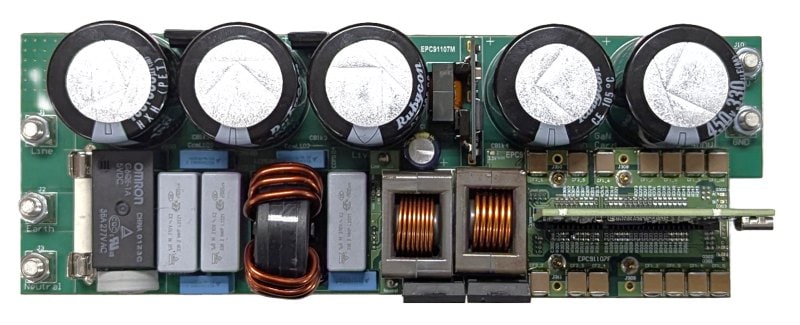
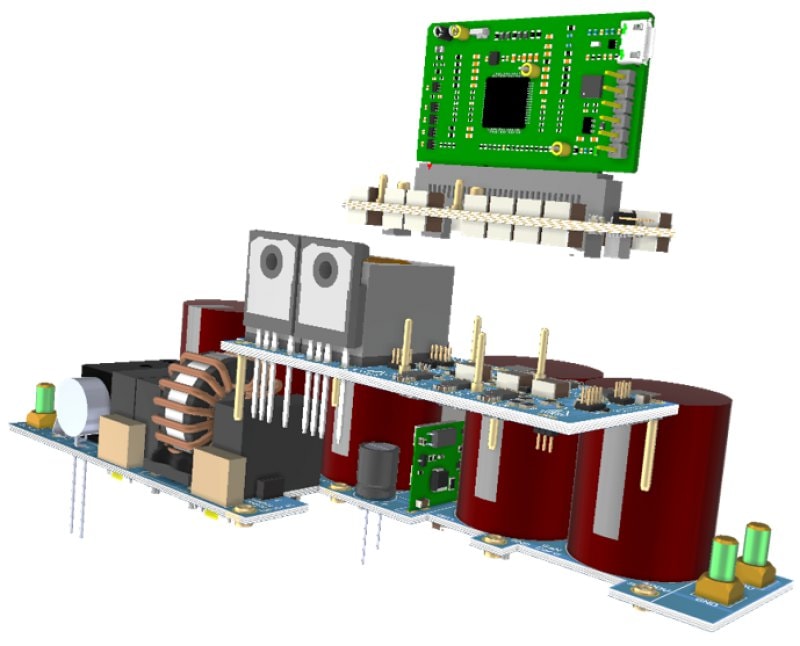
The EPC91107KIT evaluation board, developed in close collaboration with Efficient Power Conversion (EPC) Corporation, is a four-level Flying-Capacitor Multi-Level (FCML) Totem-Pole (TTP) bridgeless Power Factor Correction (PFC) converter power stage evaluation board. This evaluation board meets the Open Compute Project (OCP) M-CRPS and Open Rack v3 (ORv3) standards for Common Redundant Power Supplies (CRPS) units in the latest 33 kW power shelf applications in data center data racks. The EPC91107KIT can draw up to 25 A (RMS) continuous current from the input. The system includes an EMI filter, in-rush current limit startup circuit, housekeeping power supply and our high-performance dsPIC33 Digital Signal Controller (DSC).
The EPC91107KIT includes many critical features for detailed performance evaluation, including measurement of ports and access to critical circuit nodes. It can be extended with the EPC91119 additional boost converter power stage, which is commonly used in data rack applications to extend the hold-up time of the output voltage after AC power loss for > 20 ms at full load.
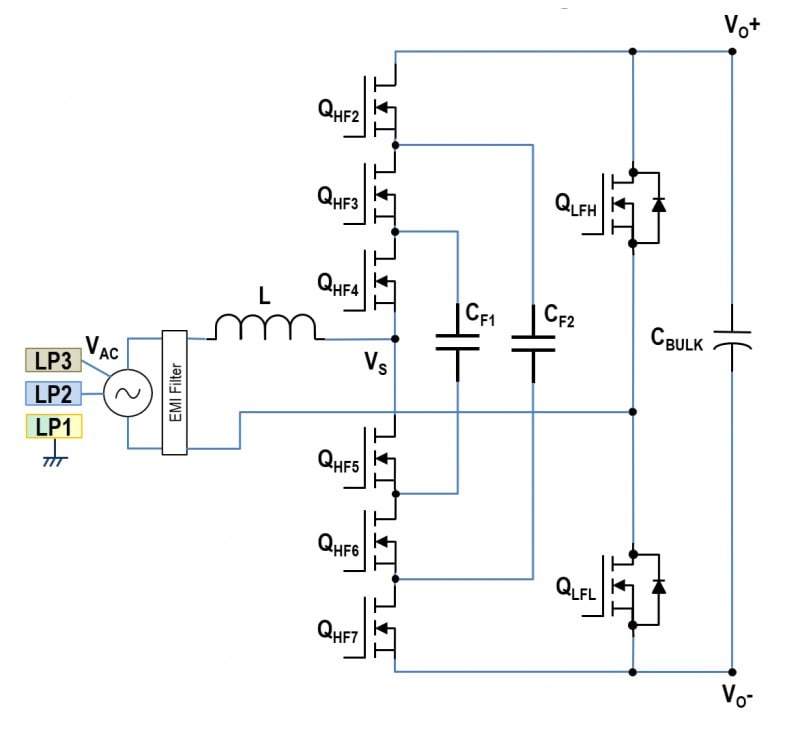
Flying-Capacitor Multilevel (FCML) Converters
Multilevel converters offer an effective method to multiply the ripple current in magnetic components of the main power train of a converter which keeping the switching frequency constant. This results in a significant reduction in component size without increasing the overall power losses. Multiplying the ripple current also divides its peak-to-peak value and increases the amount of power that can be processed in a single-converter phase. When applied in PFC stages, the inductor ripple frequency multiplication affects all magnetic components in the input path (EMI filter and main inductor) simultaneously.
The EPC91107 evaluation board demonstrates these effects in a 5 kW PFC stage achieving a power density of over 180 W/in³ at a peak efficiency of > 99%, making it an excellent solution for extremely high power density applications, such as data center AC/DC power supplies.
FCML TTP PFC Architecture design features the EPC2304 eGaN FET, rated at 200V, 3.5 mΩ (typical). Although the total number of FETs is higher compared to a conventional two-level TTP PFC stage, the utilization of low-voltage eGaN FETs reduces Rds(on)-related conduction losses by over 40% and switching losses by more than 30% in comparison to equivalent high-voltage GaN FET devices under equivalent operating conditions.
Digital Control Implementation and Firmware* Variants
A dsPIC33 DSC communicates with the FCML bridge and control the input current and output voltage.
The simplified evaluation firmware* provided incorporates robust start-up, current and voltage limiting; fault detection and auto-recovery, which allows safe and robust operation during evaluations. This reduced firmware version simplifies the analysis of the DSP control algorithm implementation and peripheral utilization of the dsPIC33 DSC.
*Hardware files are immediately available from EPC but firmware delivery requires signing into your myMicrochip account. Complete our request form for design files and you will be contacted by a Microchip representative.
For more information on hardware and enhanced Gallium Nitride (eGaN)-related documentation, design support and purchasing information, please visit EPC’s complementary reference design page.
Product Features
- Input voltage: 190V–274 VAC (305 VAC non-operational)
- Input current: 25 A (RMS)
- Power density: 180 W/in³
- Peak efficiency: > 99%
- Dimensions: 172 × 70 × 40 mm (including terminals)
- Input frequency: 45 Hz to 64 Hz
- Meets OCP M-CRPS input specifications
- Output voltage: 390–430 VDC (programmable/dynamic)
- Output current: 15.5A (max.)
- Constant switching frequency: 140 kHz
- Main inductor ripple frequency: 420 kHz
- Full digital control
Applications
- AI factories and data centers
- Telecom and 5G power supplies
- High-power, low-noise audio power supply