
Loading
Log in to myMicrochip to access tools and benefits. Sign up in just one minute.
Maximize Your Experience: Reap the Personalized Advantages by Completing Your Profile to Its Fullest. Update Here
Stay in the loop with the latest from Microchip. Update your profile while you are at it. Update Here
Complete your profile to access more resources. Update Here
1.62V, Entry-Level MCUs for Capacitive Touch Interface Applications
The AVR LA MCU family delivers robust performance and flexibility for a wide range of applications. These microcontrollers support a supply voltage range of 1.62V to 5.5V and are suitable for both low-power and standard voltage environments.
- Peripheral Touch Controller (PTC) supporting up to 27 self-capacitance touch channels
- 1.62V to 5.5V operations
- Configurable Custom Logic (CCL)
- Event System
- Program and Debug Interface Disable (PDID)
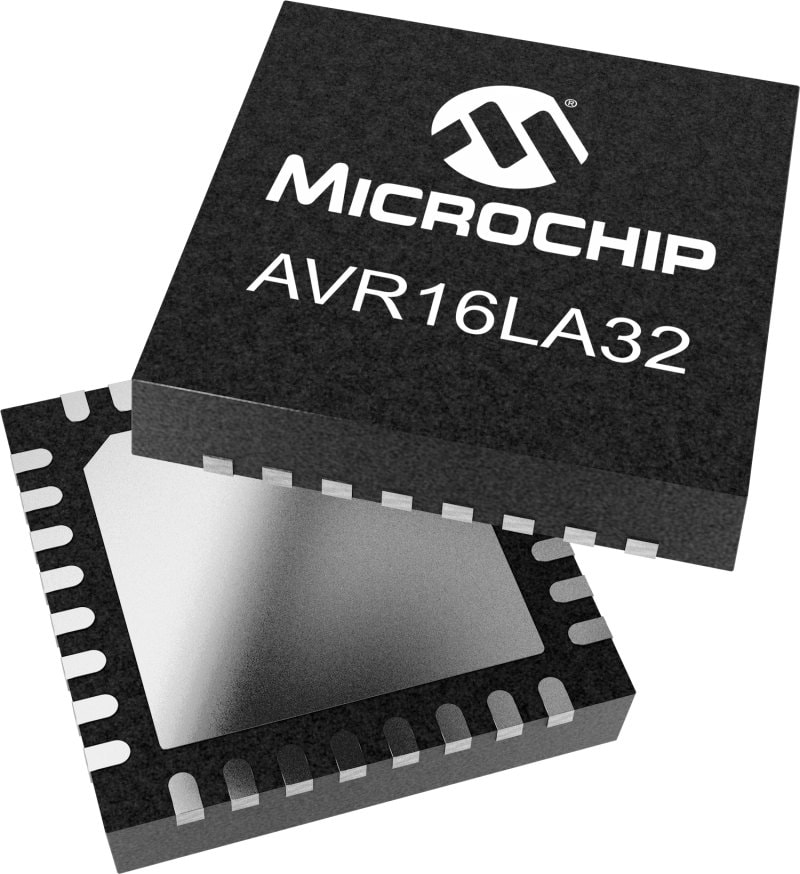
Create State-of-the-Art Applications With Capacitive Touch
The Peripheral Touch Controller (PTC) offers built-in hardware for capacitive touch measurement on sensors that function as buttons, sliders, wheels and 2D surfaces. It enhances noise suppression capabilities, ensuring reliable touch sensing even in challenging conditions. Additionally, the family boasts a high pin-to-touch channel ratio having touch capabilities on almost every pin, enabling efficient utilization of available pins for touch functionality and maximizing design versatility.

Key Features
Target Applications
The AVR LA MCU family is fully operational from 1.62V to 5.5V, small footprint, robust touch and high number of touch channels and is well-suited for a wide range of applications, such as:
- Wearable devices: smart watches, fitness bands and health monitors
- Consumer electronics: remote controls, headphones and earbuds
- Home automation: touch panels and smart appliances
- Industrial and medical devices: touch interface for equipment control on diagnostic devices
- Battery-powered sensors: IoT devices and key fobs
- Automotive Human-Machine Interface (HMI) applications
The AVR LA MCU family provides a robust, reliable and flexible platform for implementing modern, touch-based user interfaces and controls to meet stringent automotive standards and support the trend toward more intuitive and aesthetically pleasing vehicle interiors.
System Features
Human-Machine Interface
Peripheral Touch Controller (PTC)
The Peripheral Touch Controller (PTC) is an autonomous unit that acquires and processes capacitive touch signals. It supports buttons, sliders, wheels and 2D surface configurations in addition proximity sensing , and it requires no additional external components. This CIP offers a broad range of touch-enabled features, such as mutual and self capacitance, noise filtering, moisture tolerance, auto calibration over temperature and voltage, as well as wake-up upon touch and/or proximity from sleep mode.
Real-Time Response
Event System (EVSYS)
The EVSYS allows peripherals to communicate directly with each other without involving the CPU or bus resources. This means that different triggers at the peripheral level can result in an event, such as a timer’s interrupts triggering an action in another peripheral. The EVSYS has three independent channels for direct peripheral-to-peripheral signaling. This deterministic signaling method is an excellent fit for real-time applications. The events are handled at the peripheral level even if the CPU is occupied handling interrupts or in sleep mode.
Safety First
CRC, WWDT, BOR, POR, VLM
You can use the built-in features that support safety-critical applications to add robustness and reliability to your design. These include the Windowed Watchdog Timer (WWDT) for system supervision, the Cyclic Redundancy Check (CRC) for scanning Flash memory, and the Event System for fault detection. Other features include a Voltage Level Monitor (VLM), a Brown-Out Reset (BOR) and Power-On Reset (POR) for monitoring the supply voltage.
Hardware Customization
Configurable Custom Logic
The Configurable Custom Logic (CCL) peripheral is a programmable logic peripheral that can be connected to the device pins, events or other internal peripherals. Each Lookup Table (LUT) consists of three inputs: a truth table, an optional synchronizer and a filter and edge detector. An LUT can generate an output to be routed internally or to an I/O pin. This eliminates the need for external logic and reduces BoM cost.
Integrated Analog
12-bit Differential ADC With PGA, Analog Comparator
The on-board 12-bit, 300 ksps differential Analog-to-Digital Converter (ADC) features selectable internal voltage references with minimal temperature drift, and Programmable Gain Amplifier (PGA) supporting up to 16× gain making it possible to retrieve small signals in noisy environments. Using the Event System, the on-board Analog Comparators (ACs) can be connected to trigger autonomous operation in other peripherals, which is ideal for real-time control and closed-loop operations.
Power-Conserving Functionality
Idle, Standby, Power-Down
Idle and Standby low-power modes allow you to optimize your application for device performance and power consumption. The Power-Down allows unused peripherals to be turned off individually, further reducing power consumption.
- Getting Started
- Software
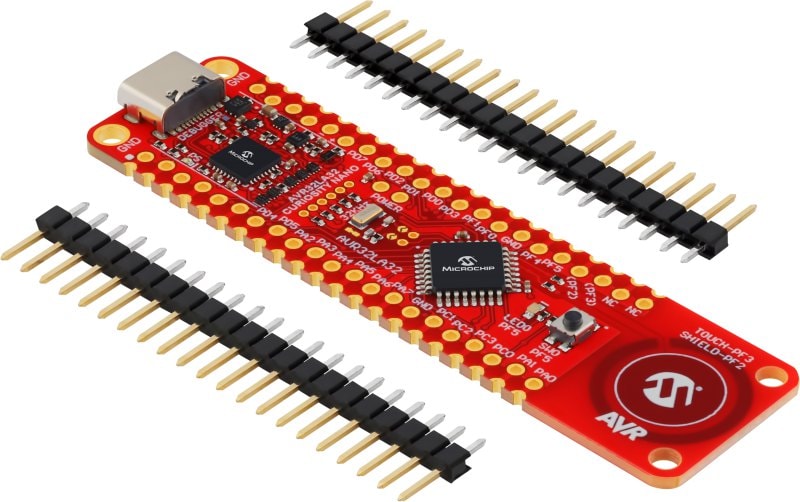
AVR LA Curiosity Nano Board
Part Number: EV24D63A
The Curiosity Nano Evaluation Kit makes it remarkably easy to get started. The combination of plug-and-play hardware, powerful development tools, touch library and robust support resources ensures you move from evaluation to concept and prototype in no time.
The AVR LA MCUs are supported by our MPLAB®X IDE and MPLAB Extensions for Microsoft® Visual Studio® Code (VS Code®) as well as IAR Embedded Workbench Integrated Development Environment (IDE).

Discover Code Examples
Reference Designs, Learning Resources and Development Kits
Find detailed project examples with GitHub code repositories, helpful tips and tricks, application notes, data sheets and more. Get started quickly with code examples demonstrating basic peripheral functions or explore reference designs to accelerate your own development projects.
MPLAB® Tools for VS Code®
Jump-start your projects with our MPLAB Tools for Microsoft® Visual Studio® Code (VS Code) that offers a user-friendly interface and robust features tailored for Arm® Cortex®-M0+ core MCUs. Benefit from seamless project imports, intuitive debugging tools and the innovative MPLAB AI Coding Assistant.
MPLAB AI Coding Assistant
This AI-powered MPLAB Tool provides real-time code generation, error detection and direct access to our data sheets so that you spend less time troubleshooting and more time innovating.
MPLAB Code Configurator (MCC) Melody
MCC Melody provides libraries, drivers, Peripheral Libraries (PLIBs) and Hardware Initializers (HWIs) for the development of embedded software for our PIC® and AVR® MCUs and dsPIC® Digital Signal Controllers (DSCs).