
Defending Against Side-Channel Attacks With PolarFire® FPGAs
Security goes beyond encryption. Learn how our PolarFire® FPGA and SoC devices help defend against side-channel attacks while simplifying secure system design.
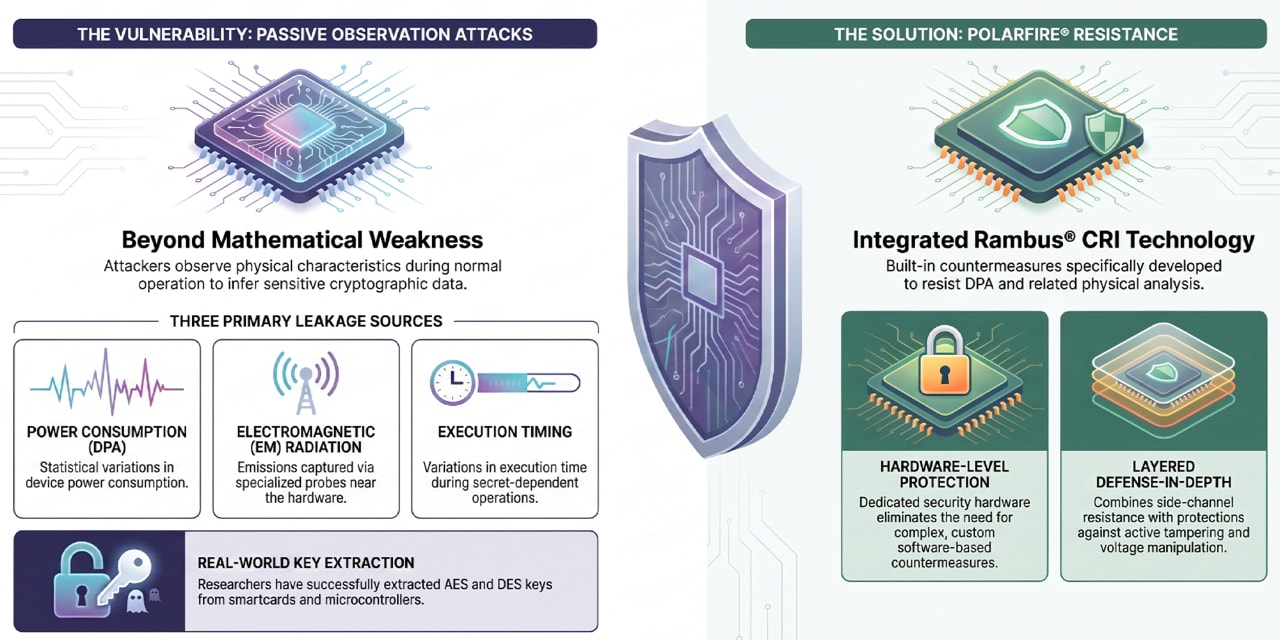
Side-channel attacks present a unique challenge to hardware security. Unlike fault injection, clock glitches, voltage manipulation or physical tampering, these attacks do not attempt to disrupt system operation. Instead, attackers observe physical characteristics of a device while it operates normally and use that information to infer sensitive data such as cryptographic keys, credentials or proprietary algorithms.
As cryptographic algorithms have become increasingly robust, attackers have shifted their focus toward implementation-level weaknesses. This has made side-channel resistance an important consideration for systems deployed in industrial, defense, communications, aerospace and other security-sensitive applications.
Understanding Side-Channel Attacks
Side-channel attacks exploit information unintentionally emitted during normal device operation. Common sources of leakage include power consumption, electromagnetic (EM) radiation and execution timing.
Differential Power Analysis (DPA): DPA uses statistical techniques to analyze subtle variations in power consumption during cryptographic operations. Even when cryptographic algorithms are mathematically secure, these correlations can reveal secret key material.
Simple Power Analysis (SPA): SPA involves direct observation of power traces to identify execution patterns, operation sequences or key-dependent behavior.
Electromagnetic (EM) Analysis: Rather than monitoring power rails, attackers capture electromagnetic emissions generated by device activity using specialized probes. EM analysis can provide localized visibility into cryptographic operations and is often used when direct power measurements are impractical.
Timing Analysis: Differences in execution time may expose information about secret-dependent operations, allowing attackers to infer sensitive values.
Advanced adversaries may combine multiple techniques, including power analysis, EM analysis and other physical attack methods, to improve the likelihood of recovering sensitive information.
Real-World Impact of Side-Channel Attacks
Side-channel attacks are not theoretical. Over the past two decades, researchers have repeatedly demonstrated successful key extraction attacks against a wide range of security devices.
- Smartcard Key Extraction: Early DPA attacks demonstrated full AES and DES key recovery by statistically analyzing power traces during encryption operations.
- AES Key Extraction from Embedded Devices: Researchers have shown that AES keys can be recovered from microcontrollers and embedded systems through statistical analysis of power traces collected during cryptographic operations.
- Electromagnetic Analysis of Cryptographic Hardware: Studies have demonstrated the recovery of sensitive information using electromagnetic probes that capture emissions generated during cryptographic operations. Because EM measurements can focus on specific regions of a device, they can expose leakage that may not be visible through power analysis alone.
These attacks show that correct cryptography is not enough if its physical implementation leaks information.
Why Implementation Matters
Modern cryptographic algorithms including AES, RSA, ECC and SHA-based functions have undergone extensive mathematical analysis. However, side-channel attacks focus on how these algorithms are implemented rather than the algorithms themselves.
A secure implementation must minimize the information that can be learned from the physical behavior of a device while cryptographic operations are being performed. Without appropriate countermeasures, an attacker may be able to recover sensitive information even when approved and industry-standard cryptographic algorithms are used.
PolarFire® and Side-Channel Resistance
PolarFire® FPGA and PolarFire SoC devices incorporate security technologies designed to help protect sensitive cryptographic operations from side-channel attacks.
A key element of this protection is the integration of Rambus® CryptoManager Infrastructure (CRI) technology within the security architecture. Rambus CRI includes side-channel countermeasures specifically developed to help resist Differential Power Analysis and related forms of side-channel analysis targeting cryptographic functions.
These protections are implemented in dedicated security hardware, allowing designers to leverage proven countermeasures without developing and validating their own side-channel-resistant cryptographic implementations in software or FPGA fabric.
Through Microchip's CRI pass-through licensing model, customers can benefit from these protections as part of the device security ecosystem, reducing development complexity, cost and security risk for applications requiring strong cryptographic protection.
Part of a Layered Security Architecture
Side-channel countermeasures are one component of a broader hardware security strategy.
PolarFire devices also include protections against active attacks such as clock glitching, voltage manipulation and physical tampering. These mechanisms help detect, prevent or respond to attempts to actively interfere with system operation, while side-channel protections address passive observation attacks. Together, these security capabilities provide a defense-in-depth approach that helps safeguard cryptographic assets across multiple threat vectors.
Conclusion: Silence the Side Channel
As attackers continue to target the physical implementation of security mechanisms, resistance to side-channel attacks have become an increasingly important requirement for secure hardware systems.
By combining side-channel-resistant cryptographic technology with broader hardware security protections, PolarFire FPGA and PolarFire SoC devices help designers build systems that are better protected against both passive observation attacks and active physical threats.
Learn more about PolarFire security on our web page.