
Single Pair Ethernet for Smart Factories and Edge Connectivity
Modern factories demand flexible, efficient communication networks. Discover how Single Pair Ethernet enables streamlined connectivity between sensors, controllers and edge devices while helping reduce infrastructure complexity in industrial IoT applications.
Smart Factories Demand a Unified Communication Infrastructure
Smart factories are a central element of Industry 4.0, combining automation, real‑time data exchange and digital integration to enable more flexible, efficient and responsive manufacturing. Technologies such as intelligent sensors, distributed actuators, robotics and data analytics are now deeply embedded across the production floor, continuously generating and consuming data.
Despite this progress, connectivity within industrial environments remains a fundamental challenge. At the operational technology (OT) level, factories still rely on a diverse mix of legacy fieldbus systems and industrial Ethernet variants. Analog and digital interfaces such as HART (4–20 mA), 0–10 V, CANopen, PROFIBUS, Modbus RTU and IO‑Link operate alongside Ethernet‑based protocols including PROFINET, EtherCAT®, Modbus TCP and others. Each technology was optimized for a specific use case, but together they form a fragmented communication landscape.
To interconnect all these legacy fieldbus systems and to provide Ethernet access, gateways are commonly deployed. These devices translate between fieldbus protocols and Ethernet networks, enabling data from sensors and actuators to reach higher‑level control systems, SCADA (Supervisory Control and Data Acquisition) platforms or enterprise IT infrastructure. While gateways play an important functional role, they also introduce additional system complexity. They add hardware software and test cost, require configuration and maintenance, can become single points of failure and often limit transparency and real‑time data availability across the network.
As OT and IT systems continue to converge, this gateway‑centric architecture becomes increasingly difficult to scale. From a cybersecurity perspective, protocol translation can complicate the implementation of consistent security mechanisms, monitoring and updates, an issue that is gaining importance as manufacturers work to comply with evolving regulatory frameworks such as the European Cyber Resilience Act (CRA).
At the same time, harsh industrial environments with long cable runs, electromagnetic interference and the challenge of retrofitting existing installations place further demands on the communication infrastructure.
These pressures are driving the industry toward simpler, more unified networking approaches that reduce protocol diversity, minimize the need for gateways and extend secure, Ethernet‑based communication closer to the field level. Ethernet already dominates the IT domain and is well established in industrial control networks, but traditional Ethernet cabling and topologies are not always well suited for sensors and actuators at the very edge.
This is where Single Pair Ethernet (SPE) emerges as a key enabling technology allowing Ethernet to be extended efficiently and cost‑effectively to the edge of smart factory networks.
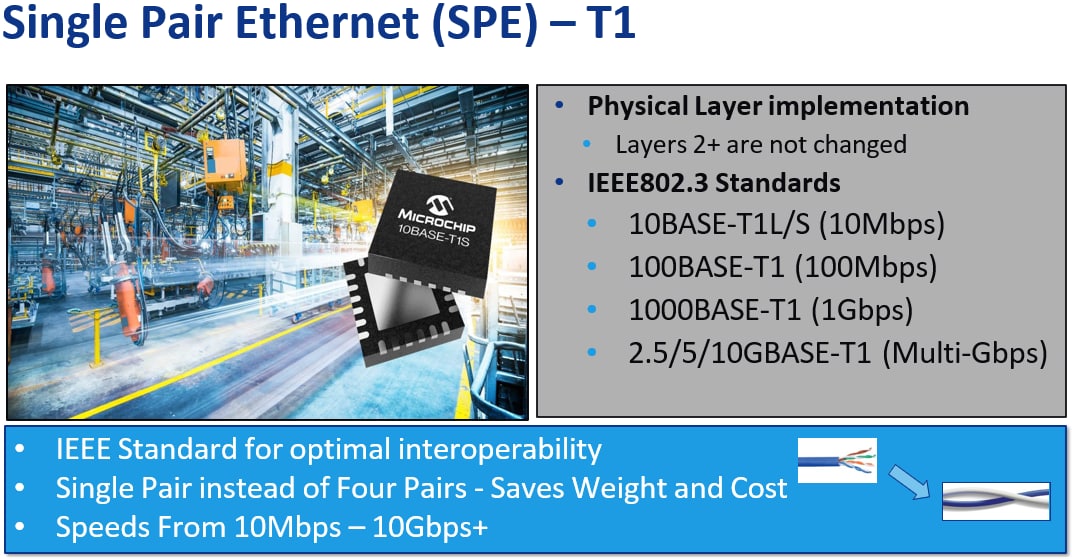
Figure 1: Single Pair Ethernet specifications. Multi-Gbps solutions are specified, but not implemented yet
10BASE‑T1S: Ethernet for Multidrop Industrial Networks
Among the SPE variants, 10BASE‑T1S, specified in IEEE Standard 802.3™-2022, is particularly well suited for smart factory environments. It operates at 10 Mbps in half‑duplex mode and is the only SPE option that supports multidrop bus topologies, allowing multiple devices to share a single cable segment.
This capability is especially valuable for:
- Distributed sensor networks
- Actuators and motor control
- Retrofit of legacy equipment
- Edge‑level industrial IoT devices
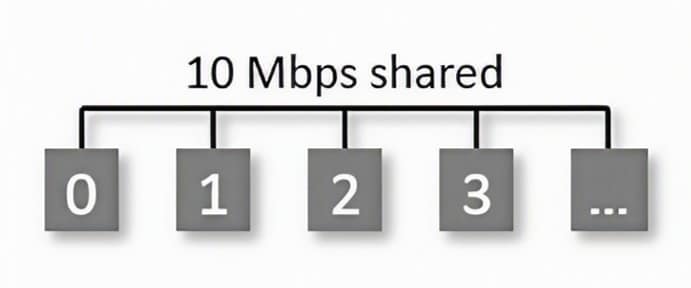 |
Figure 2: Bus Topology connectivity with 10BASE-T1S
To deliver reliable and deterministic communication on a shared medium, 10BASE‑T1S incorporates Physical Layer Collision Avoidance (PLCA). PLCA assigns transmission opportunities to each node in a repeating cycle, coordinated by a designated coordinator node. This mechanism provides bounded latency and predictable behavior, which are essential for time‑sensitive industrial applications. If PLCA coordination is lost, the network can automatically fall back to CSMA/CD operation.
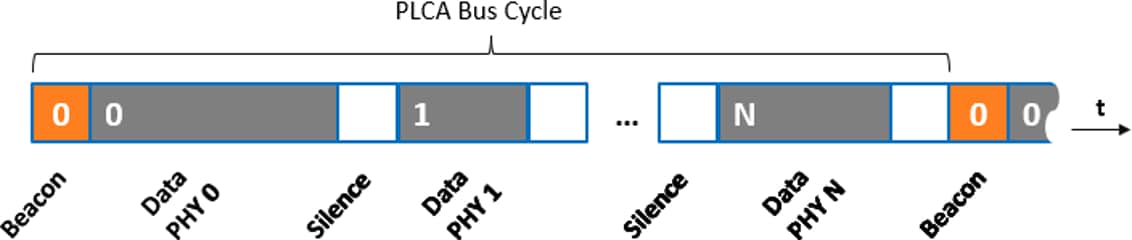 |
Figure 3: PLCA Bus Cycle in a 10BASE-T1S Network with N nodes
Physical Layer Collision Avoidance (PLCA) enables deterministic and collision‑free communication in 10BASE‑T1S multidrop networks. As shown in Figure 3, network access is divided into N transmit slots, one for each connected node. A coordinator node—typically node 0—starts each cycle by sending a beacon, which synchronizes all devices and marks the beginning of the cycle.
Each node is assigned a unique identifier and may transmit data only during its designated slot. If no data is available, the slot is skipped and passed to the next node. This controlled, sequential access prevents collisions and provides bounded latency, which is essential for time‑sensitive industrial applications.
If a node joins late or misses its slot, it simply waits for the next beacon. Should the coordinator become unavailable, 10BASE‑T1S maintains communication continuity by automatically reverting to CSMA/CD operation after a defined timeout.
While the IEEE specification indicates baseline requirements for distance and node count, practical implementations demonstrate that longer bus lengths and higher node count are achievable when signal integrity is maintained, making 10BASE‑T1S a flexible option for real‑world factory layouts.
Benefits of 10BASE‑T1S in Smart Factory Applications
By bringing Ethernet directly to the field level, 10BASE‑T1S helps address several challenges in modern industrial systems:
- Reduced cabling and installation complexity
A single twisted pair lowers material usage and simplifies routing, especially in space‑constrained environments.
- Support for multidrop topologies
Multiple devices can share one cable, reducing the need for switch ports and simplifying network design.
- Ethernet interoperability
Devices connect seamlessly to standard Ethernet networks, supporting IT/OT convergence and scalable architectures. No need to have a gateway between 10BASE-T1S and other Ethernet standards.
- Deterministic communication
PLCA enables bounded latency suitable for industrial control and monitoring.
- Power over Data Line (PoDL)
Data and power can be delivered over the same cable, reducing the need for separate power wiring.
- Cybersecurity readiness
Ethernet‑based communication supports modern security mechanisms required to meet evolving regulatory expectations.
Name | Speed | Maximum Distance | Multidrop | Main Applications |
10BASE-T1S | 10 Mbps | Up to at least 25 meters | YES | Sensor networks, IoT devices, actuators, motors, racks, automotive, industrial automation, home automation |
10BASE-T1L | 10 Mbps | Up to 1000m | No | Process automation, building automation |
100BASE-T1 | 100 Mbps | Up to 40 meters (STP) | No | Industrial devices, transportation, automotive |
1000BASE-T1 | 1 Gbps | Up to 40 meters (STP) | No | High-speed industrial devices, advanced automotive |
Table 1: Comparison between different SPE implementations
As we can see from the comparison in Table 1, 10BASE-T1S is the only SPE implementation that supports multidrop. An Ethernet connection with multidrop capabilities is essential to take Ethernet to the edge and to connect the smart factory using a single standard technology.
Microchip PHY and MACPHY Solutions for 10BASE‑T1S Implementation
Microchip offers a portfolio of standards‑compliant 10BASE‑T1S solutions designed to support a wide range of smart factory use cases.
PHY Solutions for MCUs With Integrated Ethernet MACs
For microcontrollers and processors that already include an Ethernet MAC, we provide 10BASE‑T1S PHY devices that connect via MII, SC‑MII or RMII interfaces. These devices enable multidrop SPE connectivity while supporting advanced diagnostics to help identify cable faults, signal integrity issues and network conditions.
This approach allows designers to extend existing Ethernet‑based architectures to the field level with minimal changes to their processing platform.
Product | Key Features | Applications/Notes |
LAN8670/1 |
|
|
Table 2: 10BASE-T1S PHY products from Microchip
MAC‑PHY Solutions for MCUs Without Ethernet MACs
For simpler edge devices or legacy designs, we also offer integrated MAC‑PHY solutions that combine the Ethernet MAC and 10BASE-T1S PHY in a single device. These components interface to a host microcontroller via SPI. This component enables even low‑cost microcontrollers to participate in Ethernet‑based industrial networks, supporting applications such as sensors, actuators and distributed control nodes without requiring a built‑in MAC.
Product | Key Features | Applications/Notes |
LAN8650/1 |
|
|
Table 3: 10BASE-T1S MACPHY products from Microchip
Enabling Ethernet‑Based Smart Factory Architectures
As manufacturers modernize production facilities and retrofit existing equipment, there is growing demand for simpler, more unified communication infrastructures. Single Pair Ethernet —and 10BASE‑T1S in particular—provides a practical path to extend Ethernet connectivity to the very edge of industrial automation systems.
By reducing cabling complexity, supporting multidrop topologies and maintaining compatibility with standard Ethernet technologies, 10BASE‑T1S helps bridge the gap between legacy field devices and modern, secure, data‑driven factory networks.
Microchip’s SPE portfolio is designed to support this transition, enabling scalable, standards‑based solutions for smart factory applications today and in the future.
For more information, check out our Product Page for 10BASE-T1S Ethernet Products.