
VelocityNET™ Industrial Ethernet Solutions
Designing for harsh industrial environments demands more than standard Ethernet. This blog post explores industrial Ethernet fundamentals, including TSN and network redundancy, and highlights our VelocityNET™ solutions that help engineers build low-latency, reliable and scalable automation networks.
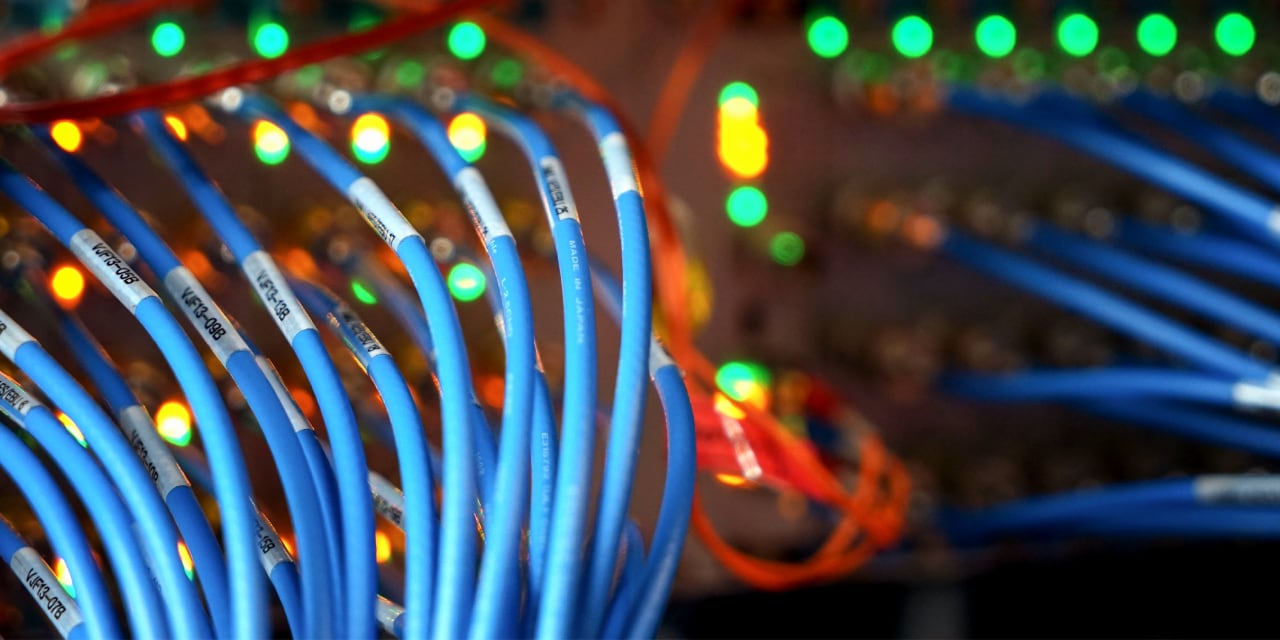
You can find Ethernet just about everywhere, and most people are familiar with seeing it in offices and homes. When you hear the term Industrial Ethernet, you may wonder whether it is the same thing as regular Ethernet. In short, yes—but with two distinct differences. Industrial Ethernet is ruggedized and designed specifically for harsh environments such as dusty, noisy and hot factory floors and processing plants. The other difference is that industrial Ethernet relies on protocols that handle time sensitivity and real-time performance between controllers and devices such as a robotic arm or a bottle-filling machine on a conveyor belt. Specialized industrial protocols such as Ethernet-IP, PROFINET® or EtherCAT® are used to support integration with automation equipment.
The primary use of industrial Ethernet is to connect a wide range of devices on the factory floor, including Programmable Logic Controllers (PLCs), sensors, actuators, robots and Human-Machine Interfaces (HMIs). This connectivity enables real-time control and monitoring of manufacturing processes, efficient data acquisition and machine-to-machine communication. Industrial Ethernet also plays a crucial role in process control systems and Distributed Control Systems (DCS). In addition, it supports remote monitoring and maintenance, allowing engineers to troubleshoot and optimize equipment from virtually anywhere.
Now that we understand what industrial Ethernet connectivity is and how it is used, let’s explore some of its key features.
Time-Sensitive Networking
Time-Sensitive Networking (TSN) is a set of standards under development by the Time-Sensitive Networking task group of the IEEE 802.1 working group to achieve deterministic communication. TSN brings significant advantages to industrial networks, particularly through its emphasis on interoperability and open standards. By utilizing non-proprietary IEEE 802.1-based specifications, TSN reduces the need for protocol translators and gateways, allowing devices from different vendors to communicate seamlessly. This vendor neutrality not only simplifies integration but also encourages widespread adoption, which in turn lowers overall costs for organizations as the technology becomes more prevalent.
Another key benefit of TSN is its support for deterministic Ethernet, which enables low latency communication and allows both critical and non-critical traffic to be transmitted reliably over the same network. This capability is important for real-time control and monitoring in industrial environments. Precision timing is essential for industrial networking and TSN helps enable robust and cost-effective communication.
Redundancy
Another essential feature of industrial Ethernet networking is redundancy. Redundancy is critically important in industrial networks because it helps maintain continuous operation even in the event of equipment failures, network faults or unexpected disruptions. Industrial environments often involve automated processes, real-time control systems and safety-critical applications where any downtime can result in financial losses, production delays or safety risks.
By incorporating redundant network paths and fail-safe mechanisms, industrial networks can maintain communication between devices and systems while issues are identified and resolved. This level of reliability supports uptime requirements, helps protect valuable assets and contributes to the safety and efficiency of industrial operations.
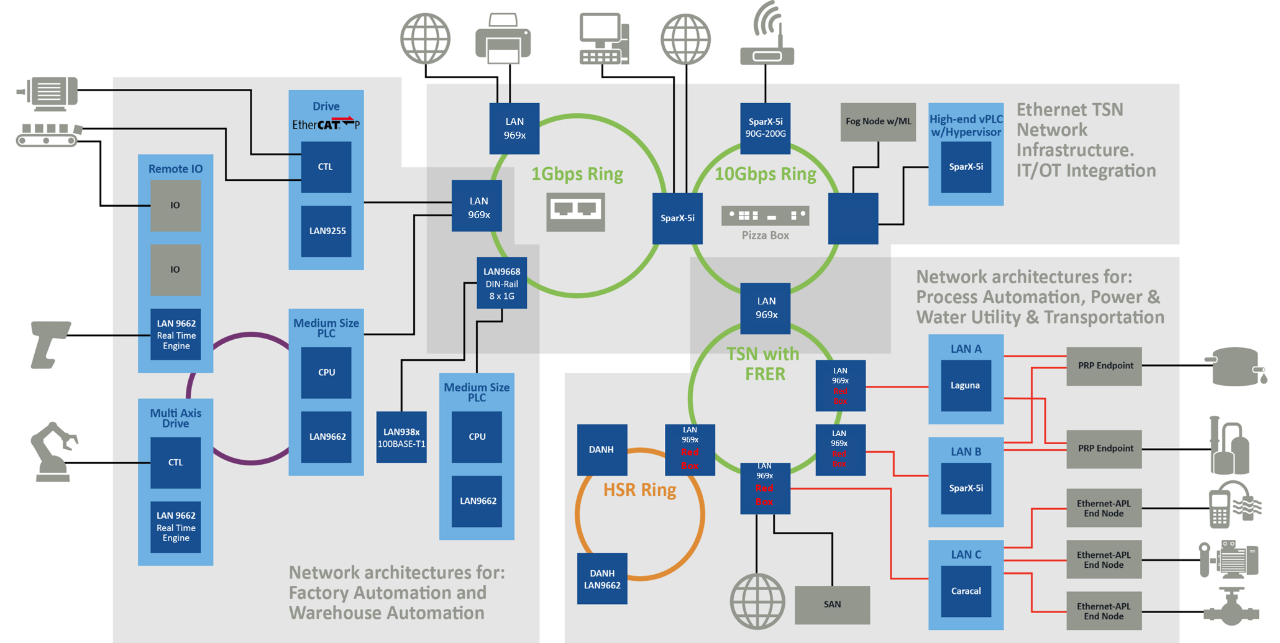
Below is a diagram of a typical industrial Ethernet network for factory and warehouse automation. It includes Ethernet TSN network infrastructure and network architectures for process automation, power, water and transportation. The diagram illustrates the complexity of industrial networking and highlights the importance of low latency and reliable Ethernet connectivity for uninterrupted communication between controllers and devices.
Our VelocityNET™ Industrial Ethernet Solutions
We offer a broad portfolio of Ethernet PHYs, switches and Single‑Pair Ethernet (SPE) solutions designed for industrial applications. Depending on application requirements, VelocityNET industrial Ethernet products support a wide range of features and protocols, including Time‑Sensitive Networking, redundancy, EtherCAT and PROFINET.
Key VelocityNET Products include:
- The LAN96455, LAN96457 and LAN96459 are advanced multi-port Ethernet switches with integrated PHYs, supporting TSN and robust security features. These devices can operate in a stand-alone unmanaged system configuration or in managed mode with full Linux Distributed Switch Architecture (DSA) support on a connected host.
- The LAN9694, LAN9696 and LAN9698 are high-port-count managed switches that offer flexible interfaces and advanced diagnostics. Their support for industrial protocols and redundancy mechanisms helps enable reliable operation in harsh environments.
- The LAN8840 and LAN8842 are single-port Gigabit Ethernet PHYs, optimized for Time Sensitive Networks. These devices integrate IEEE 1588v2 time-stamping which enables an add-on solution to processors and switches which do not have time stamping built-in. These devices are well-suited for edge devices and compact industrial controllers, delivering reliable deterministic connectivity.
- The LAN9371 and LAN9381 are multi-port Ethernet switches with integrated T1 PHYs that support TSN and advanced security features. Their compact designs and rich feature sets make them suitable for space-constrained applications and next-generation industrial IoT devices.
Want More?
For more information about VelocityNET and how we can help you design and implement your industrial network, please visit our Ethernet web page.