
Why ASA-ML Chose Time Division Duplexing (TDD)
As automotive systems become more connected, engineers need flexible ways to manage growing data demands. Learn how ASA-ML helps enable efficient, scalable camera networking for next-generation vehicle platforms.
Introduction: A Duplexing Choice With System‑Level Consequences
At first glance, the choice between time‑division duplexing (TDD) and frequency‑division duplexing (FDD) can look like a narrow physical‑layer decision. In practice, that choice has far‑reaching implications for bandwidth flexibility, power delivery, PHY reuse and overall system architecture.
In ASA‑ML, the Automotive SerDes Alliance made a deliberate decision to use TDD as the foundation of its asymmetric SerDes standard. This was not an incremental optimization of earlier camera links, but a system‑level design choice influenced by how automotive camera systems actually behave in the field.
The Reality of Asymmetric Camera Traffic
Automotive camera links are inherently asymmetric. Cameras generate large volumes of downstream video data flowing from the sensor to the ECU, while upstream traffic consists primarily of:
- Control commands
- Configuration data
- Status and monitoring information
Historically, proprietary camera links addressed this by using FDD, transmitting upstream (US) and downstream (DS) data simultaneously at different frequencies over the same cable.
While functional, this approach locked key system characteristics such as frequency allocation and power coupling design into relatively inflexible patterns.
Why ASA‑ML Moved Away From FDD
When ASA re‑examined automotive camera connectivity, it became clear that FDD‑based designs imposed several practical constraints as systems scaled:
- Fixed upstream and downstream frequency allocations
- Increasing complexity in power‑over‑cable coupling circuits
- Separate PHY requirements for different upstream and downstream rates
These challenges become more pronounced as vehicles integrate more cameras with diverse data‑rate requirements, and as architectures evolve toward zonal aggregation.
TDD: Sharing the Cable in Time Instead of Frequency
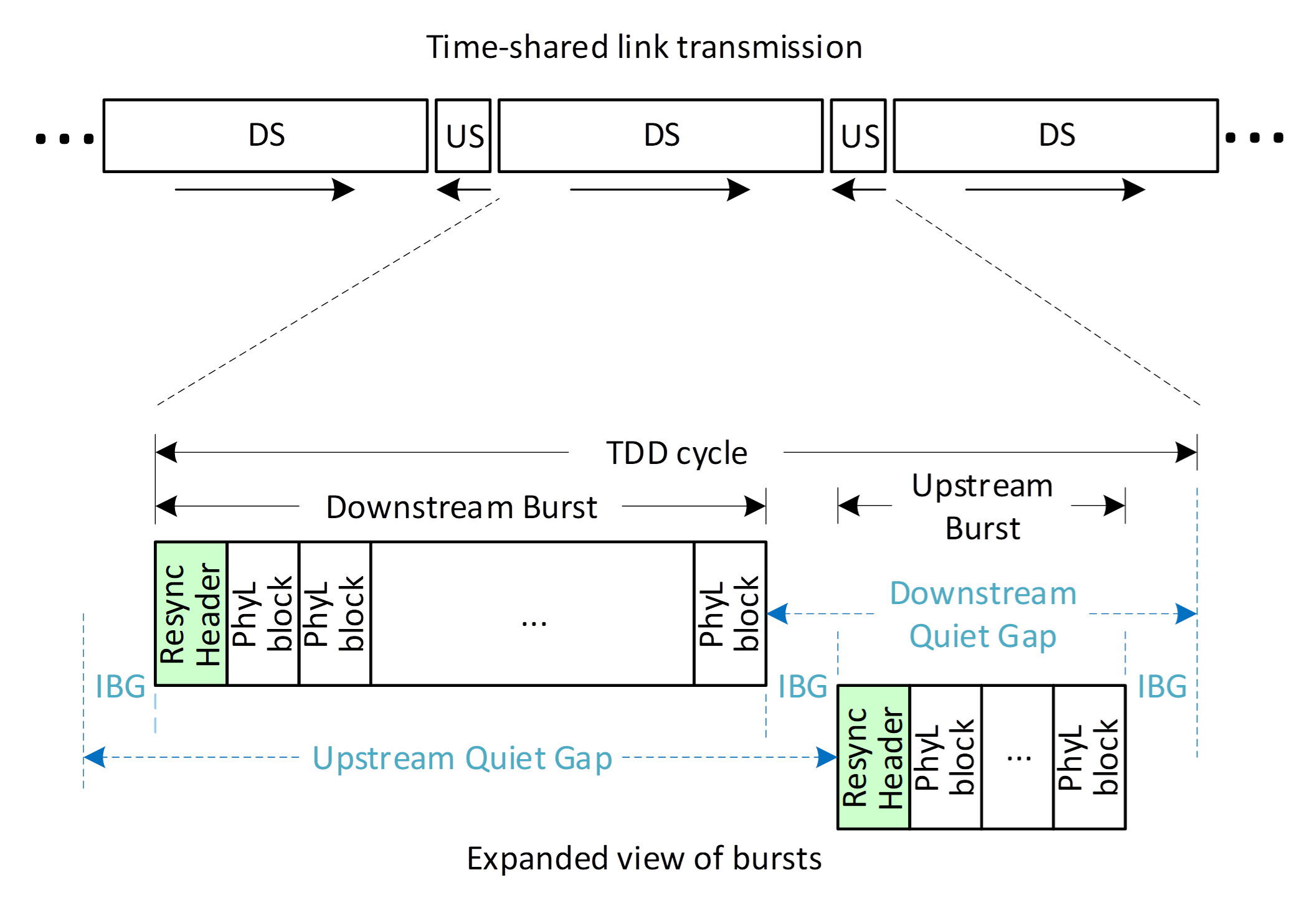
ASA‑ML uses time‑division duplexing, where upstream and downstream transmissions share the same cable but occupy different time slots.
In this model:
- The link alternates between downstream and upstream transmission
- Each transmission occurs in a defined burst
- Bandwidth allocation can be adjusted by changing burst length and cycle timing
This structure mirrors proven time‑shared communication approaches used in other cost‑sensitive, high‑reliability environments, while being optimized for automotive SerDes use cases.
TDD Overview Illustration
 |
Flexible Bandwidth Allocation for Real‑World Cameras
One of the most practical advantages of TDD in ASA‑ML is bandwidth flexibility.
Cameras vary widely in:
- Resolution
- Frame rate
- Output data rate
Instead of over‑engineering every link for worst‑case conditions, TDD allows the system to:
- Allocate more time to downstream traffic for high‑data‑rate cameras
- Reduce upstream bandwidth where only minimal control traffic is required
ASA‑ML formalizes this through defined speed grades, specifying downstream and upstream payload data rates appropriate for common camera scenarios.
For architects, this means bandwidth becomes a configurable system parameter, rather than a fixed physical constraint.
Implications for Power‑Over‑Coax (PoC) Design
Power delivery is a critical concern for camera modules, which are often located in confined, thermally challenging environments. Excess power consumption directly impacts sensor temperature and image quality.
ASA‑ML’s use of TDD simplifies power‑over‑coax (PoC) design in several important ways:
- The same higher baud rate is used in both directions
- A single, optimized power‑coupling network can be designed
- The need for wideband or multiple inductive elements is reduced
In contrast, FDD solutions must block different upstream and downstream frequencies simultaneously, increasing component count, size and design compromise.
While subtle at the link level, these differences accumulate across multi‑camera systems.
PHY Flexibility and Universal Ports
Another consequence of TDD is PHY commonality.
In ASA‑ML:
- Upstream symbol rates are a subset of downstream symbol rates
- Certain speed grades share the same symbol rate, differing only in modulation
This enables:
- Universal ECU ports capable of interfacing with different camera types
- Reduced SKU complexity at the silicon and system level
- Greater reuse of PHY designs across platforms
For OEMs and Tier‑1s managing complex supply chains, this flexibility has architectural and logistical value well beyond the physical layer.
Architectural Fit: From Star to Zonal Systems
ASA‑ML’s TDD approach aligns naturally with the network topologies supported by the specification:
- Star architectures with point‑to‑point links
- Zonal architectures where local controllers aggregate multiple sensors
Because bandwidth allocation is configurable in time rather than frequency, architects can adapt link behavior as system roles evolve without redesigning the physical interface.
Optional features like the link aggregation sublayer further extend this flexibility by allowing multiple physical links to be combined when higher aggregate bandwidth is required.
Why This Matters Beyond the PHY
The decision to use TDD in ASA‑ML illustrates a broader design philosophy: connectivity choices should reflect system behavior, not just signal transport efficiency.
For modern camera systems, this means:
- Accommodating asymmetric traffic patterns
- Simplifying power delivery in thermally constrained modules
- Supporting architectural evolution without breaking compatibility
TDD was selected because it best supports these system‑level requirements not because it offers a marginal improvement in one isolated metric.
Closing the Series
Across this three‑part series, we’ve explored:
- Why the industry needed a new camera connectivity standard
- What ASA‑ML defines at the protocol‑stack level
- How TDD enables scalable, flexible system design
Taken together, these elements explain why ASA‑ML is positioned as a foundation for next‑generation automotive camera architectures.
Want More?
Download the ASA‑ML Blueprint Tutorial (DS50004072) for the complete technical explanation of TDD, speed grades, power delivery and architectural considerations.