
Resilient Timing Services for 5G Networks
High‑Precision Timing Architecture for Resilient 5G Networks
5G communications networks rely on high-precision source clocks that lock to the Global Navigation Satellite System (GNSS). If the GNSS timing reference is lost or impaired, calls will drop and data services will dramatically slow down or stop altogether. Highly dense 5G architectures often require a 10× increase in the number of nodes and GNSS traceable source clocks, but ideally, operators could avoid the expense and security exposure of installing GNSS receivers in every clock node.
The virtual Primary Reference Time Clock (vPRTC) timing architecture uses a secure fiber network to provide bi-directional east and west timing flows to local source clocks in aggregation sites with 100 ns of accuracy. The protected PTP southbound timing flow is then sent to the 5G Remote Radio Heads (RRHs). A key benefit of this architecture is that the GNSS receivers are only required in the core enhanced Primary Reference Timing Clock (ePRTC) sites where they can be protected and monitored to shield the network from the risk of GNSS jamming or spoofing threats.
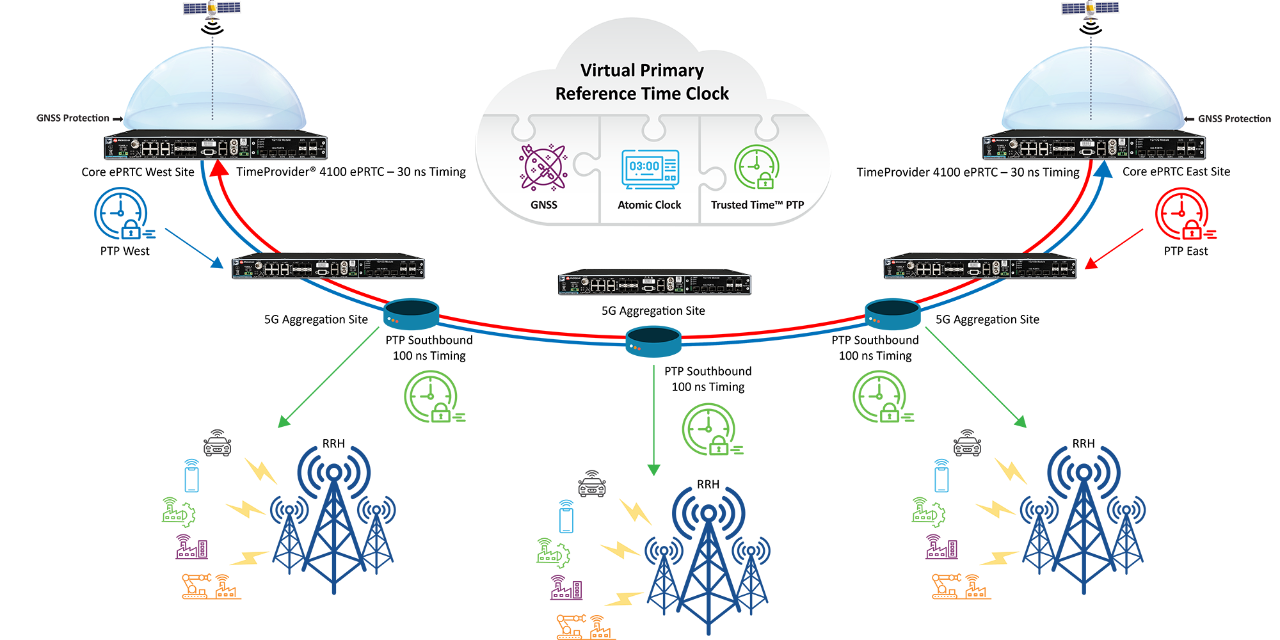
Enhancing 5G Reliability Through GNSS Visibility and vPRTC Protectio
Design Help
- Client Support Team
- Sales Support
- Support Portal
Request a Quote
Contact our Client Success Team to get more information about our clock and timing products or to request a quote.

Find Local Sales and Support
We have an extensive network of highly trained clock and timing experts. Go to our listing to locate a sales and support representative in your country.

Access Our Support Portal
Visit our Frequency and Time Systems support portal to download technical documents and other resources, enter support tickets or open RMA service requests.