
From Control to Connectivity: This Month’s New Development Platforms
This month’s Microchip development tool releases enable early subsystem validation—helping engineering teams reduce integration risk and accelerate time to market.
Embedded Control Evaluation
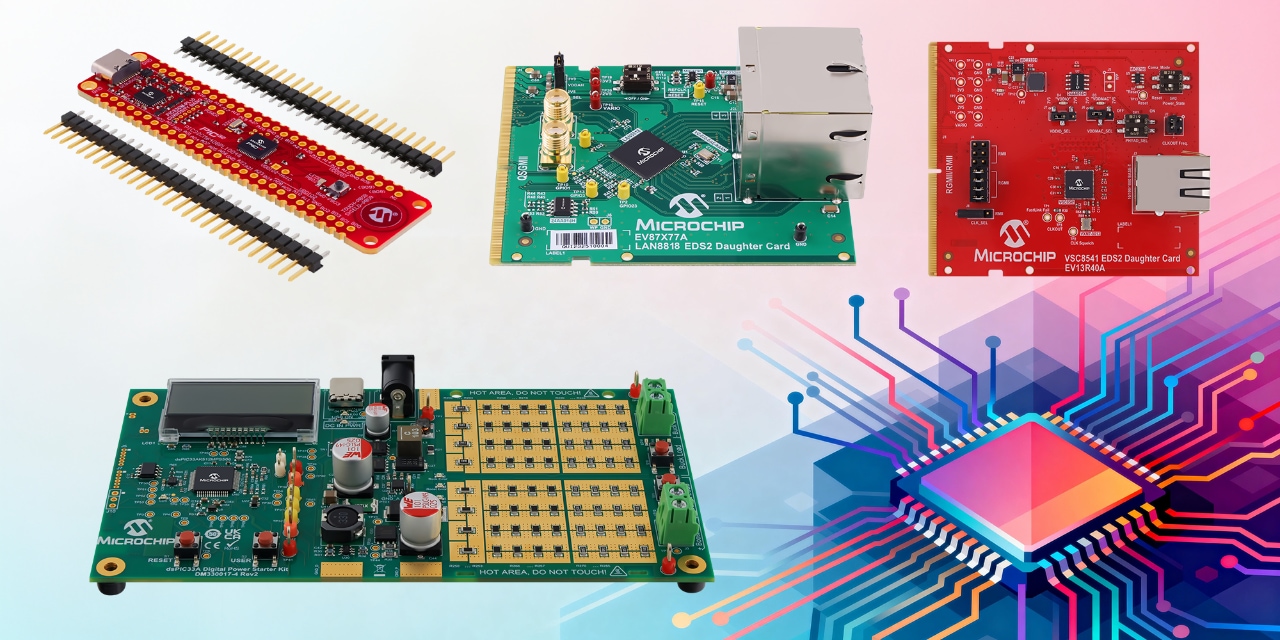
EV10P22A — PIC32CM CNANO Platform
The PIC32CM CNANO platform provides a compact evaluation environment for firmware development and peripheral configuration before custom PCB hardware is available. Engineers can prototype control algorithms, task scheduling, communication peripherals and protocol stacks while hardware schematics and layouts are still in progress.
Why it matters: Application software can be validated before final hardware availability, reducing schedule risk and enabling earlier firmware maturity.
Digital Power Control Evaluation
DM330017-4 — dsPIC33A Digital Power Starter Kit
The dsPIC33A Digital Power Starter Kit includes a ready-to-use power stage and dsPIC33A Digital Signal Controller, enabling evaluation of digitally controlled switched-mode power supply (SMPS) behavior. Engineers can prototype control algorithms, compensation loops and fault handling strategies using real hardware without designing a custom power stage.
Key advantages: Control loop tuning and firmware validation can occur parallel with mechanical and electrical system design.
Industrial Ethernet Evaluation
EV87X77A — LAN8818 EDS2 Daughter Card
The LAN8818-based daughter card enables evaluation of Ethernet networking behavior when paired with compatible switch base platforms. Engineers can bring up communication stacks and evaluate time-sensitive networking (TSN) features supported by the associated switch architecture before production hardware integration.
Why it’s important: Networking issues are often system-level. Early evaluation allows firmware, networking and system teams to validate integration ahead of final hardware builds.
Physical Layer Validation
EV13R40A — VSC8541 Ethernet Interface Platform
The VSC8541 evaluation platform enables independent validation of Ethernet PHY behavior prior to full system integration and compliance testing.
Benefit: Separating PHY validation from higher-layer firmware development streamlines bring-up and reduces integration complexity.