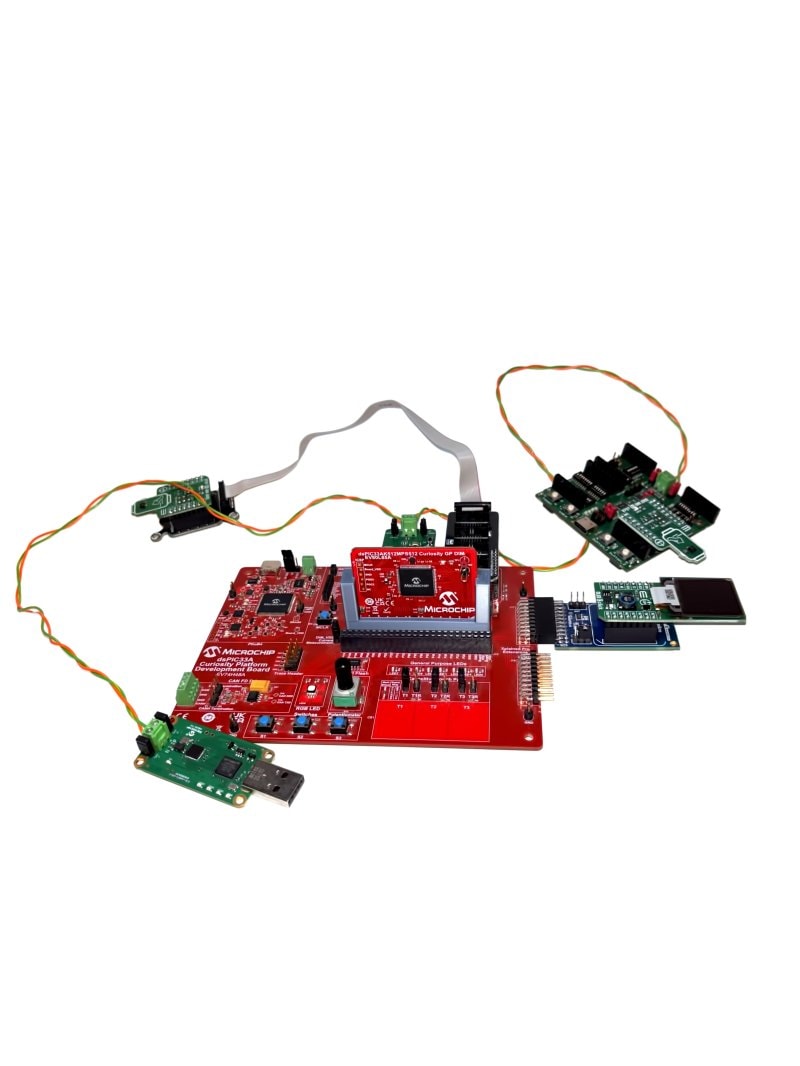
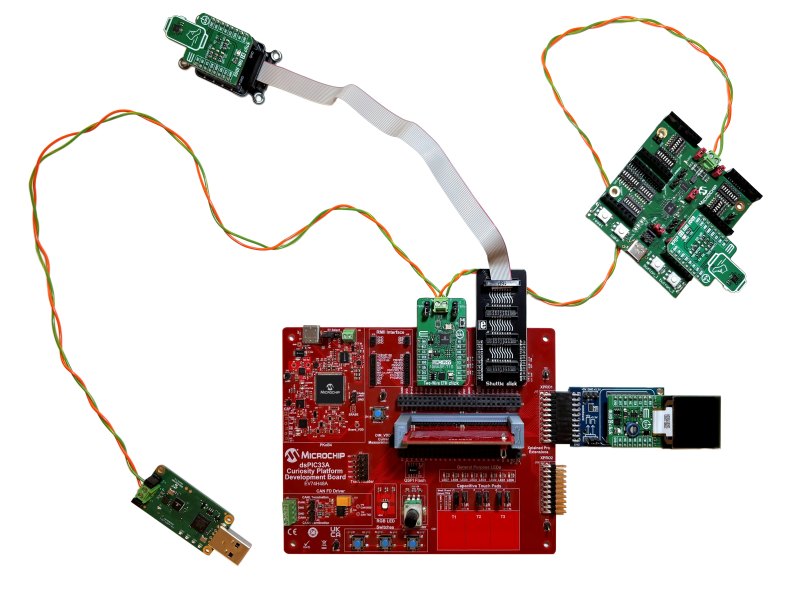
All processing on one device. A 200 MHz 32-bit core with a DSP engine and a double-precision FPU handles filtering, sensor fusion, feature extraction, ML inference and the network stack on one DSC.
Fast ML math. Single-cycle multiply-accumulate (MAC) instructions and the hardware FPU speed up the vector and matrix calculations used in feature extraction and inference.
Low latency from sensing to action. Tightly coupled peripherals and multi-context interrupt registers keep the sensing-decision-action loop short, which matters for responsive robots and machines.
Sensing and control in one node. Integrated 40 Msps 12-bit ADCs, 100 MHz op amps, fast comparators and high-resolution PWMs let the same DSC add analog sensing (current, position, vibration) or close a local motor or actuator loop next to the motion sensor.
Precise motion data at the source
The InvenSense ICM-42688-P 6-axis IMU combines a 3-axis gyroscope and a 3-axis accelerometer and provides low-noise motion data for downstream algorithms.
Edge machine learning: gesture recognition as the example workload
The node fuses accelerometer and gyroscope data, extracts features and classifies gestures on the device in real time. Only classified results go onto the network.
The same pipeline can be retrained for other motion-pattern tasks such as tool-state detection, anomaly detection or operator-intent recognition.
Wired connectivity: 10BASE-T1S
10BASE-T1S: Multidrop Ethernet over one twisted pair. Physical Layer Collision Avoidance (PLCA) gives collision-free, bounded-latency access to the shared segment.
{"SalesForceSecurePath":"https://microchip.my.salesforce-scrt.com","EmbeddedServiceName":"Messaging_For_Microchip","SalesForcePath":"https://microchip.my.site.com/ESWMessagingForMicrochi1755319480924","AgentAvailableHeader":"No problem. Chat with our engineering experts or schedule a call that's convenient for you.","ScheduleCallUrl":"https://microchip.my.site.com/schedulemeetingportal/s/","SalesforceOrgId":"00Do0000000KAkK","JsUrl":"https://microchip.my.site.com/ESWMessagingForMicrochi1755319480924/assets/js/bootstrap.min.js"}