
Linux® Ultra-Fast Boot
Linux® Ultra-Fast Boot Support
- Linux Ultra Fast Boot
- Standard Linux Fast Boot Introduction
- Traditional Linux Boot Sequence
- A new methodology based on snapshot image rather than optimization-based
- Key differentiator that sets it apart in the market
- Instead of optimizing each boot stage, Ultra-Fast Boot bypasses the traditional boot process by restoring a pre-saved snapshot image
- The snapshot is generated via Backup Self-Refresh (BSR) mode or JTAG
- Snapshot image is stored in a specified flash partition and quickly restored on restart
- Delivers faster boot time
- The system can achieve a cold-start boot time of less than 5s, compared to 5–10s using an optimized approach
Standard Linux Fast Boot achieves fast boot by optimizing:
- Software Linux components (AT91Bootstrap, Linux kernel, root filesystem)
Flash storage access times and remove unused kernel features and system services
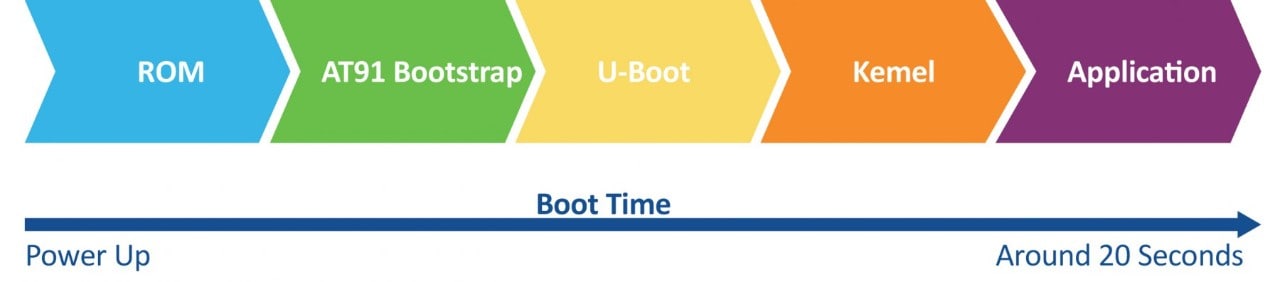
- Linux will boot following the standard stage
bootstrap -> kernel -> mount rootfs -> start App
Each stage has been optimized for boot faster; U-Boot has been removed; used for small Linux image size (~ 20 MB)
The boot process begins with the MPU’s Power-On Reset, reads binary files from the external Nonvolatile Memory (NVM) and loads them into internal SRAM and external DRAM.
- ROM code: First stage bootloader
- AT91Bootstrap: Second stage bootloader
- Universal bootloader: U-Boot
- Loading kernel and root filesystem (rootfs)
Embedded applications require faster, more responsive startup, especially for graphics application.
Linux Ultra-Fast Boot Overview
Linux Ultra-Fast Boot accelerates system startup by restoring a previously saved Linux memory snapshot instead of running the complete conventional boot sequence. The snapshot image is compressed and optimized before being stored in Flash memory, with support for SD card, eMMC, QSPI and NAND Flash storage devices.
The implementation is based on:
- BSR availability on SAMA5D2 and SAMA7 series devices
- JTAG-based snapshot generation, supported on all MPUs and required for SAM9X60 and SAM9X7 series devices
- Several advanced capabilities including secure boot with snapshot image encryption managed by AT91Bootstrap, debugging features such as CRC-32 validation and configuration dumps, and image-size optimization by excluding zero-filled memory pages
- A MemMap tool is also available to generate optimized pre-saved snapshots through JTAG
- Ultra-Fast Boot supports three operating modes:
- Manual save and restore of snapshot images using BSR (Mode1)
- Automatic save and restore of snapshot images using BSR (Mode2)
- Loading of pre-generated snapshot images created through JTAG (Mode3)