
Loading
Log in to myMicrochip to access tools and benefits. Sign up in just one minute.
Maximize Your Experience: Reap the Personalized Advantages by Completing Your Profile to Its Fullest. Update Here
Stay in the loop with the latest from Microchip. Update your profile while you are at it. Update Here
Complete your profile to access more resources. Update Here
Power-Efficient Logic Meets Built-in Security
The PIC16F132 series combines a low-power MCU with an integrated Configurable Logic Block (CLB) for custom digital logic, fixed-latency signal processing and real-time control in a single device.
Building on the PIC16F13145, it adds expanded logic capabilities, automotive-ready features and drop-in compatibility with existing PIC16 designs. The CLB replaces discrete logic components to streamline PCB design and enable deterministic hardware responses.
Protect against unauthorized access by using the Programming and Debugging Interface Disable (PDID) peripheral, with anti-tampering functionality, for automotive and industrial applications.
Getting Started
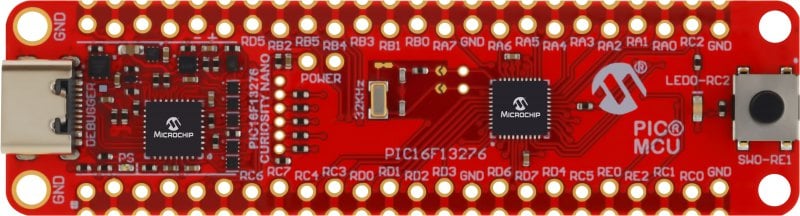
PIC16F13276 Curiosity Evaluation Kit
Part Number: EV18Z11A
The PIC16F13276 Curiosity Nano Evaluation Kit provides a compact, cost‑effective platform to build and test your next innovation. This evaluation kit integrates seamlessly with MPLAB® Tools for Visual Studio® Code (VS Code®) and MPLAB® X Integrated Development Environment (IDE), which includes MPLAB® Code Configurator (MCC), to offer fast access to the CLB and a broad range of Core-Independent Peripherals (CIPs).
The PIC16F13276 Curiosity Nano Evaluation Kit (Part No. EV18Z11A) provides full programming and debugging support to accelerate development and reduce time to market.

CLB Synthesizer
Configure Without Code
Integrated within MCC, the CLB Synthesizer tool features a user-friendly drag-and-drop graphical interface, built-in simulation, timing analysis and dedicated hardware debugging pins that allow you to verify logic functionality; monitor real-time operations and enable precise, deterministic performance. LUT mapping tools optimize routing and logic timing, so your custom logic runs fast and clean. Reduce debug time, avoid timing violations and accelerate development with reliable custom logic built directly into your MCU.
Core Peripherals
Configurable Logic Block (CLB)
Advanced Logic Customization
This is a flexible digital logic block for rapid customization of logic functions within embedded systems that reduces component count and time to market and supports automatic configuration loading at boot so that critical functions run independently of the CPU for improved reliability in safety-critical applications.
Configurable Analog
10-bit ADCC
PIC16F132 MCUs feature a high-speed Analog-to-Digital Converter with Computation (ADCC) that automates signal analysis and data acquisition, simplifying real-time control and capacitive sensing designs by offloading threshold detection and averaging directly in hardware.
Memory Protection
Programming and Debugging Interface Disable (PDID)
The PDID permanently locks a device against erasure or reprogramming via the serial programming and debugging interface, configuring it as either a One-Time-Programmable (OTP) device or updatable only through a bootloader. This protects intellectual property and prevents unauthorized readback or firmware modification in production and field-deployed devices.
Multiple Voltage Domain Support
MVIO
The Multi-Voltage IO (MVIO) feature enables seamless interfacing between devices that operate at different voltage levels, which simplifies system integration and design flexibility. This feature allows MCUs and peripherals to communicate reliably across multiple voltage domains without external level shifters to reduce component count and board complexity.
Key Applications

Industrial Automation
Control Systems, Monitoring Devices and Factory Automation
Why PIC16F132 MCUs?
- CLB enables deterministic control independent of CPU
- High-resolution ADC processes temperature, pressure and current sensors
- Sub-microsecond control loops for motors and safety systems
- I2C, SPI, dual UART interface

Consumer Electronics
Smart Home Devices, Appliances and Personal Gadgets
Why PIC16F132 MCUs?
- Capacitive Voltage Divider (CVD) touch sensing enables buttonless interfaces
- Low-power modes extend battery life in wireless devices
- Dual PWM for precise motor and LED control
- Serial interfaces connect to Wi-Fi®, Bluetooth® and the cloud

Automotive Electronics
Body Modules, Sensor Systems and Infotainment Systems
Why PIC16F132 MCUs?
- PDID security prevents firmware tampering
- CLB implements custom LIN bus protocols
- Analog suite interfaces with sensors and actuators
- Serial + timers