VectorBlox™ Accelerator SDK for PolarFire® and PolarFire SoC FPGAs
VectorBlox™ Accelerator SDK: AI/ML Inference for PolarFire® FPGAs and SoCs
FPGA designers choose VectorBlox Accelerator for its key capabilities that include:
- Software-based implementation enables AI deployment without reprogramming the FPGA
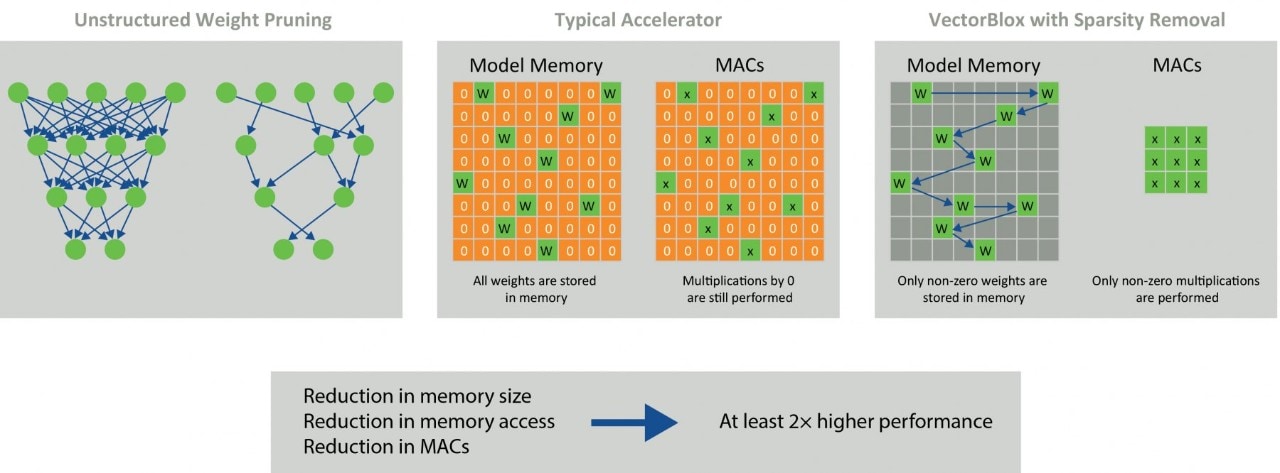
- Support for sparse networks using structured and unstructured compression
- Power-efficient inference and video pipelines delivering less than 5W power consumption
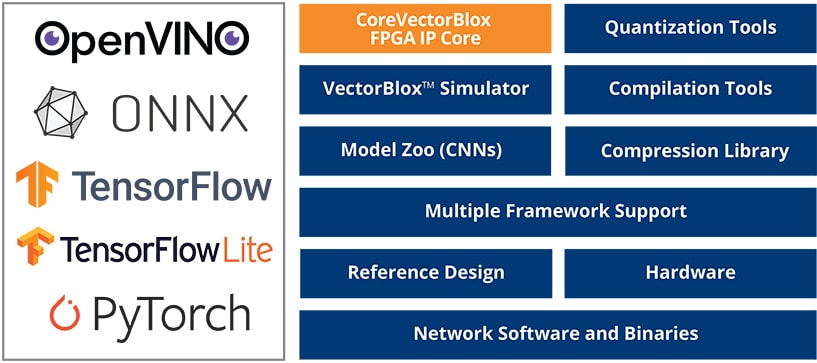
- Broad AI model support for TensorFlow®, TensorFlow Lite, ONNX® and OpenVINO®
- Fast prototyping and evaluation using pre-optimized Convolutional Neural Networks (CNNs) and simulation tools
- Configurability that balances performance and low power consumption
VectorBlox With Compression to Reduce Memory Usage and Data Movement
VectorBlox 3.0 compression reduces memory usage and data movement by supporting both structured and unstructured compression techniques. Structured compression targets regular data such as weights, activations and feature maps with known layouts, enabling deterministic compression and low‑overhead decompression in hardware. Unstructured compression supports sparse and irregular data patterns by storing only nonzero values and their indices. Together, these approaches allow larger models and higher resolution data to operate within fixed memory and bandwidth constraints on edge and embedded systems.
Five Things You Need to Know About the VectorBlox™ 3 Accelerator SDK
Discover five key enhancements in the VectorBlox™ Accelerator SDK 3.0, and see how the latest release helps developers deploy AI more efficiently on PolarFire® FPGAs and SoCs.
Follow these steps to begin using the VectorBlox Accelerator SDK:
Step 1: Install VectorBlox Accelerator
Install the VectorBlox™ SDK and review the Programmer’s Guide.
Step 2: Convert Your CNN
Convert your CNN using one of the tutorial scripts found in our tutorials section. If you have successfully converted your CNN without any errors, proceed to the next step; otherwise, reach out to us.
Step 3: Procure the Kit
The PolarFire SoC FPGA is supported by the VectorBlox SDK. To get started quickly, purchase the PolarFire SoC Video Kit and visit the video kit demo on GitHub.
Step 4: Install Libero® SoC Design Suite
Install the Libero SoC Design Suite to view or rebuild the referene design components.
Step 5: Merge licenses
Click on the “Request Free License” link below to generate the free Libero SoC Design Suite Silver and CoreVectorBlox licenses. Then merge the two licenses*.
*Refer to section 7.3 of the Libero software quick-start guide to learn how to merge these licenses.
- The CoreVectorBlox IP
- Demo Flow
- Reference Design on the PolarFire SoC Video Kit
Key features of the CoreVectorBlox IP include:
- Multiple size configurations
- Overlay architecture supporting multiple networks on a single core with dynamic switching
- Configurable 64-bit to 256-bit AXI4 memory master interface
- AXI4-Lite device for control and status
- Memory-based architecture with memory-mapped input and output support
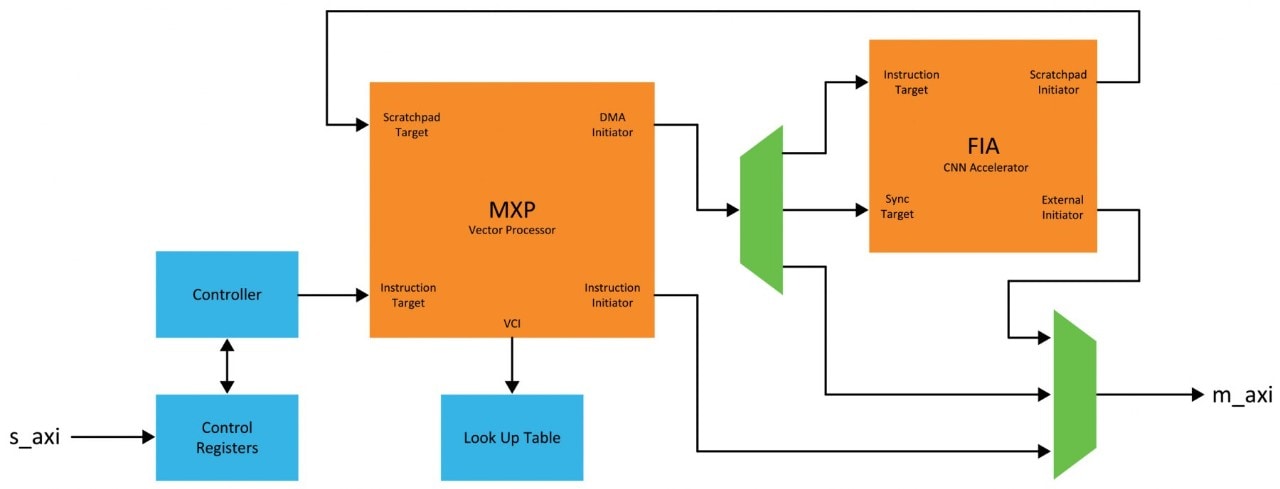
- Internal vector processor for general neural networks
- CNN accelerator for convolutional layers
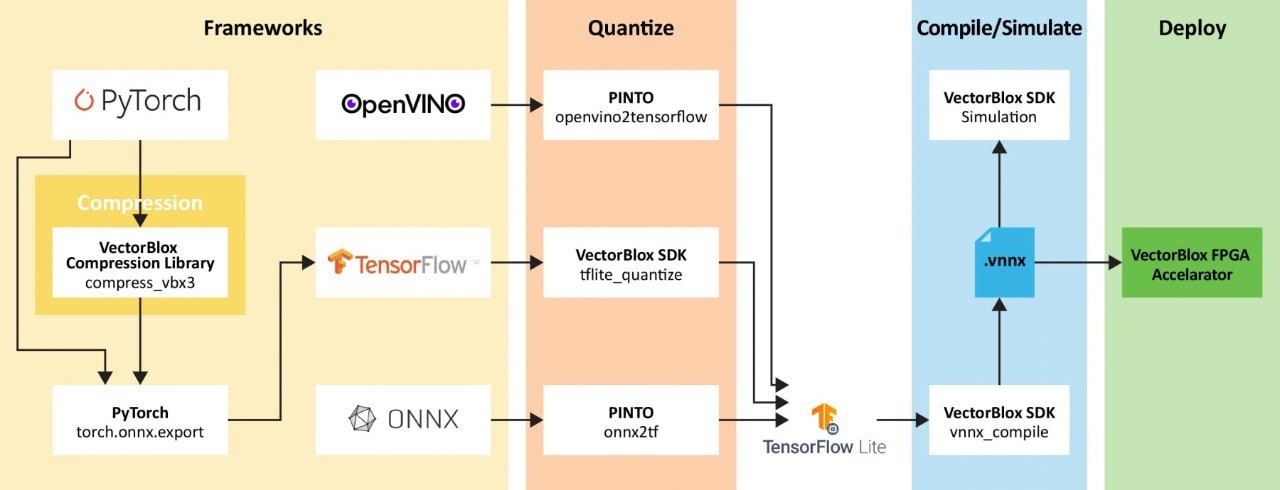
The VectorBlox SDK includes framework-dependent quantization tools that convert FP32 models to INT8, along with compilation tools that generate binaries and weights. These assets are stored in nonvolatile memory, typically Serial Peripheral Interface (SPI) Flash, and loaded into Double Data Rate (DDR) memory when the SoC FPGA powers on.
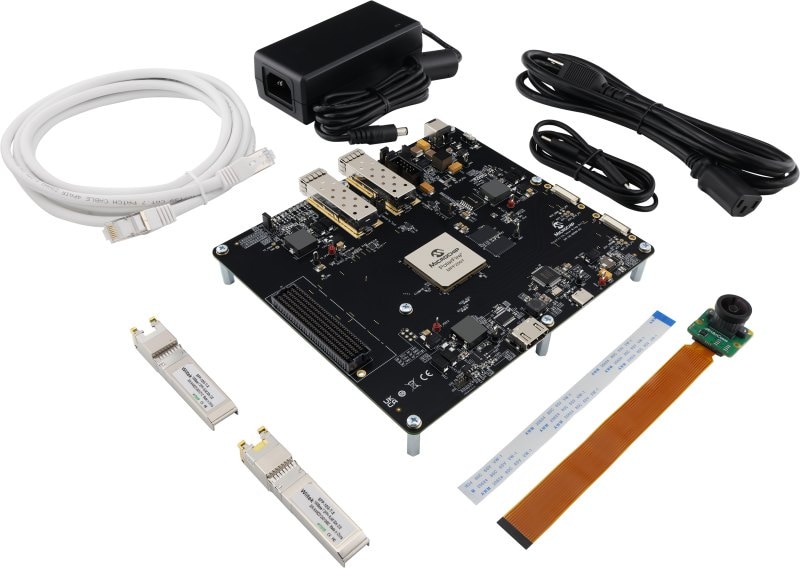
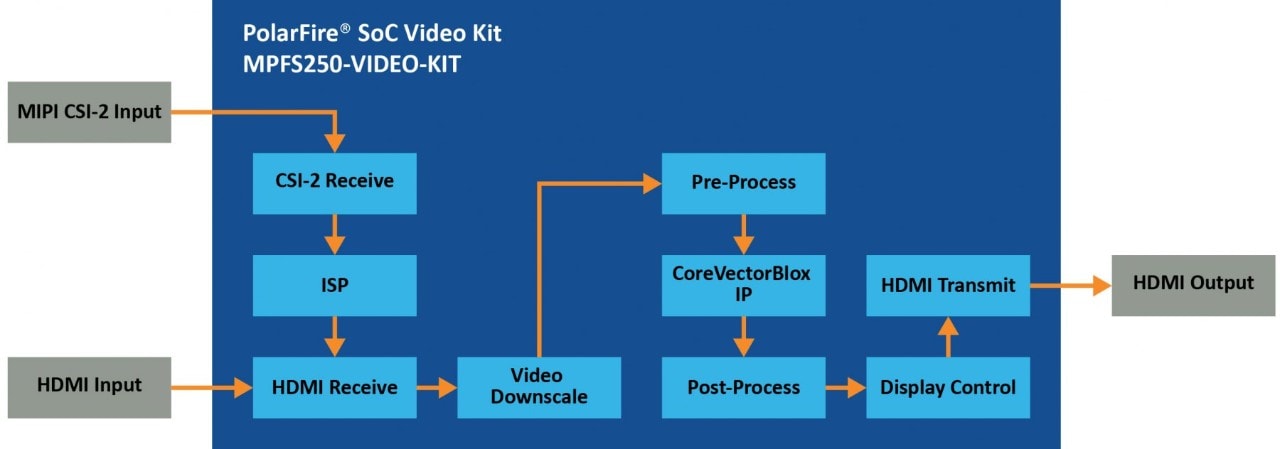
The PolarFire SoC Video Kit is designed to evaluate the VectorBlox SDK. It includes a preconfigured reference design with a MIPI CSI-2®-based camera interface, an HDMI® input, Image Signal Processing (ISP) pipeline, the VectorBlox SDK AI engine and an HDMI output for displaying results.
In this webinar, you'll discover how VectorBlox™ 3.1 streamlines Convolutional Neural Network (CNN) compression, enables direct mapping of sparsity into FPGA hardware and supports the deployment of power-efficient AI inference solutions for intelligent edge applications across industries, such as industrial automation and aerospace.
We will also feature our partner, Atlas Engineering, showcasing their VectorBlox-powered turnkey solutions that help customers deploy mission-critical autonomous systems efficiently and reliably.

PolarFire FPGA Ethernet Sensor Bridge for NVIDIA® Holoscan
Seamlessly integrating high-speed sensor data with NVIDIA's AI-driven Holoscan platform, our Ethernet sensor bridge for NVIDIA Holoscan is an essential solution for industries that use AI. This bridge enables advanced imaging capabilities in medical, industrial, automotive and other sectors.
In healthcare, NVIDIA Holoscan enhances medical imaging and robotic surgery by processing sensor data quickly for accurate diagnostics and interventions. The low-latency communication of the Ethernet sensor bridge allows cloud AI computations closer to data sources, improving system responsiveness and efficiency.