
Discover How To Take Your Designs Further at Enlit Europe 2025
Enlit Europe is where energy professionals come together to explore the innovations, solutions and strategies that are driving the future of the energy sector. The event offers valuable insights into the latest industry developments, including renewable integration and intelligent grid technologies.
We’re here to support your journey with cutting-edge solutions tailored to your needs. Visit us at booth 1.F60 to connect with our experts, ask questions and dive into the technology behind our latest demos.

Microchip Products & Resources

Sustainable Energy Solutions with dsPIC33 Digital Signal Controllers
We are pleased to present our latest innovations in sustainable energy solutions, powered by the dsPIC33C and dsPIC33A Digital Signal Controllers (DSCs). These advanced controllers are integral to our new solar microinverter solution, delivering exceptional performance, efficiency, and reliability for next-generation renewable energy applications. Key features of the dsPIC® DSCs include high-performance digital signal processing, integrated high-speed analog peripherals, sophisticated motor control capabilities and robust security features. By enabling intelligent energy management and supporting the global transition to clean power, dsPIC DSCs are helping to drive a more sustainable future.

Load Disaggregation
Load disaggregation is the process of breaking down the total energy consumption signal into its individual appliance-level components. It aims to determine which devices are running using patterns from a single measurement point, like a household's smart meter.
The machine learning-based load disaggregation solution for smart metering applications showcases an efficient implementation of load disaggregation on an embedded microcontroller, achieving the desired functionality with minimal CPU time and memory usage. This represents a key value-add for designers seeking optimal performance from our system-on-chip solutions for smart E-Metering applications.

Hybrid Connectivity
The Hybrid IoT demo uses the complementary advantages of Power Line Communication (PLC) and Radio Frequency (RF) to create a mesh network for smart energy applications. Communications reliability, coverage and scalability are increased thanks to the combination of wired and wireless communications. Hybrid IoT comprises our PL460 narrowband PLC modem and WBZ451 wireless microcontroller which enable sensing, signalling, measuring and acting in flexible network configurations. Hybrid IoT also provides a seamless integration path of smart energy applications with already deployed Advanced Metering Infrastructure (AMI) solutions.

Multiprotocol Gateway
Gateway platform for Advanced Metering Infrastructure (AMI) applications implementing a high-performance, ultra-low-power CPU-based microprocessor and both broadband and narrowband Power Line Communication (PLC). The gateway can be combined with other communication technologies to route traffic between different types of interfaces, such as cellular and Ethernet.

Energy Efficiency
Our PIC16F17576 family of microcontrollers (MCUs) features a new low-power comparator, voltage reference and Analog Peripheral Manager (APM) for ultra-low-power analog performance.
This MCU family also features up to four operational amplifiers with a dynamic gain ladder, which makes them an excellent choice for high-precision analog designs.

Embedded Wireless Connectivity Products
Designing wireless products requires balancing ease of use with reliable connectivity, but complexities like protocol vulnerabilities, antenna optimization, and software updates can increase time and costs. Choosing the right wireless connectivity partner helps overcome these challenges, ensuring dependable performance and expert support that give you confidence in your product’s success.

Artificial Intelligence at the Edge
At the show, you will have the opportunity to experience the Motor Control Predictive Maintenance Demo powered by Edge AI. This cutting-edge solution demonstrates how artificial intelligence at the edge can transform industrial operations. This demo is just the beginning. Edge AI is revolutionizing industries with real-time insights, smarter automation and increased efficiency.
Interested in learning more? Discover additional Edge AI applications through the links below and explore how these innovations can benefit your business. For further information or to discuss tailored solutions, please use the direct contact option.

Secure Timing for the Power Utilities
The modern smart grid is a highly distributed architecture that is dependent on accurate timing for coordination, protection and control systems. Our portfolio of power utility timing systems (formerly the Tekron portfolio) provides a full selection of Global Navigation Satellite Systems (GNSS) time servers for every substation timing application. Our products are designed to meet stringent environmental-hardening requirements for power utility substation deployment.

An Innovative Architecture for Resilient Timing
Critical infrastructures like communications, transportation, energy, and data centers require precise timing. The Virtual Primary Reference Time Clock (vPRTC) is a secure, resilient, network-based timing system designed for modern needs, including 5G and utilities.
It reduces reliance on satellite-based timing (e.g., GNSS) by using atomic clocks at core fiber-based timing hubs, fully controlled by network operators and protected from jamming or spoofing. The vPRTC architecture is widely deployed and proven through millions of operational hours.
Sustainability Wall
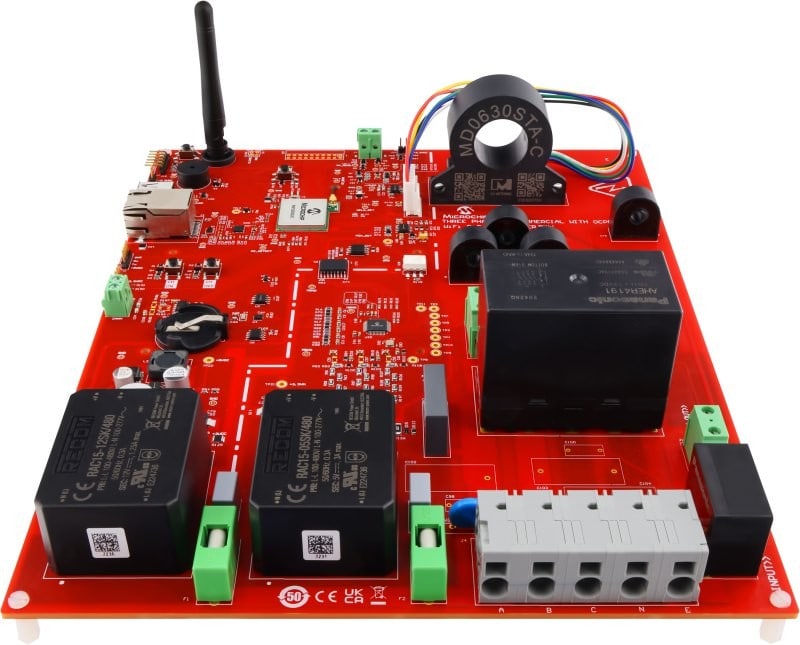
Three Phase EV Charger Reference Design
This EV charger reference design is architected for high-end residential and commercial applications requiring a high level of integration. This solution achieves a lower overall system solution cost by integrating secure communications and OCPP version 1.6 stacks on a Wi-Fi® MCU-based SoC module (WFI32).
It incorporates an AC energy metering function that utilizes the ATM90E32 for enhanced reporting capabilities, thereby reducing the processing load on the SoC and facilitating automated calibration to simplify the manufacturing process. Additionally, the design features an integrated relay and driver, enabling the expansion of charging capacity to 22 kW.

Electricity Meter
The PIC32CXMTC-DB enables fast evaluation and development of smart energy applications using dual 32-bit Arm® Cortex®-M4F processors. Its dual-core architecture integrates application, communication, and metrology functions into one device. Featuring an optimized two-wire interface for connection with the Analog Front End (AFE), it’s ideal for poly-phase shunt smart meters. The board includes a poly-phase (ATSENSE-301) Energy Metering AFE with three voltage and four current channels supporting CTs, Rogowski coils, and shunt sensors, as well as interfaces for PLC and RF communication modules.

High Efficiency Solar Micro-Inverter
Our Grid-Connected Solar Microinverter Reference Design demonstrates the flexibility and power of SMPS dsPIC® Digital Signal Controllers in Grid-Connected Solar Microinverter systems. This reference design has a maximum output power of 215 Watts and ensures maximum power point tracking for PV panel voltages between 20V to 45V DC. High efficiency was achieved by implementing a novel interleaved active-clamp flyback topology with Zero Voltage Switching (ZVS). Ask for more details on our next generation solar microinverter solution, with reactive power compensation, currently in validation stage.

Solar MPPT Battery Charger
This design is optimized to maximize power extraction from solar panels under varying illumination conditions, panel shading, temperature fluctuations and different sun angles. It ensures the safe charging of connected batteries through predefined charging profiles, demonstrating the flexibility to interface with various battery chemistries and solar panel types. This makes it suitable for powering streetlights, road signage, portable generators, cooling fans and consumer electronics in RVs.
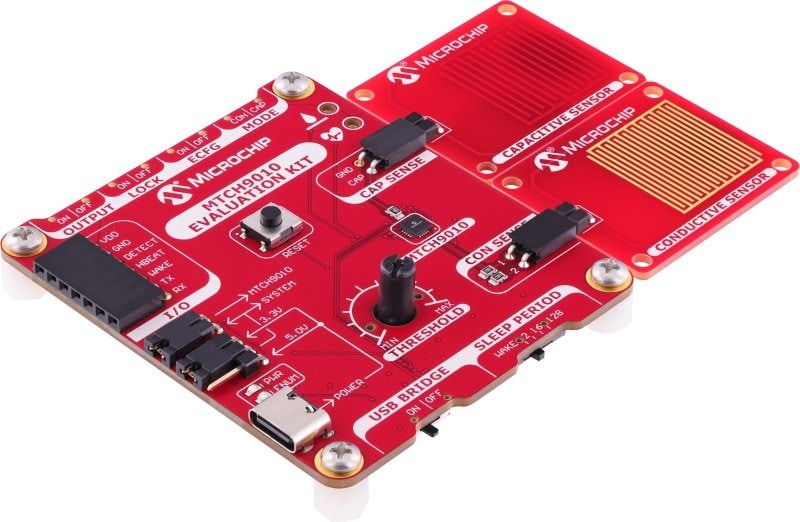
Liquid Detection
Detecting unwanted liquids from leaks or condensation offers broad benefits. In homes and businesses, water detection reduces consumption, costs, and risks like short circuits, corrosion, mold, and slipping. In industrial settings, detecting chemical leaks provides early warnings of toxicity, contamination, and equipment wear.
Our advanced liquid detection technology enables fast deployment using capacitive and conductive sensing. It overcomes the limits of traditional systems with low power use, self-monitoring, and cost efficiency. A streamlined evaluation system simplifies setup and configuration.
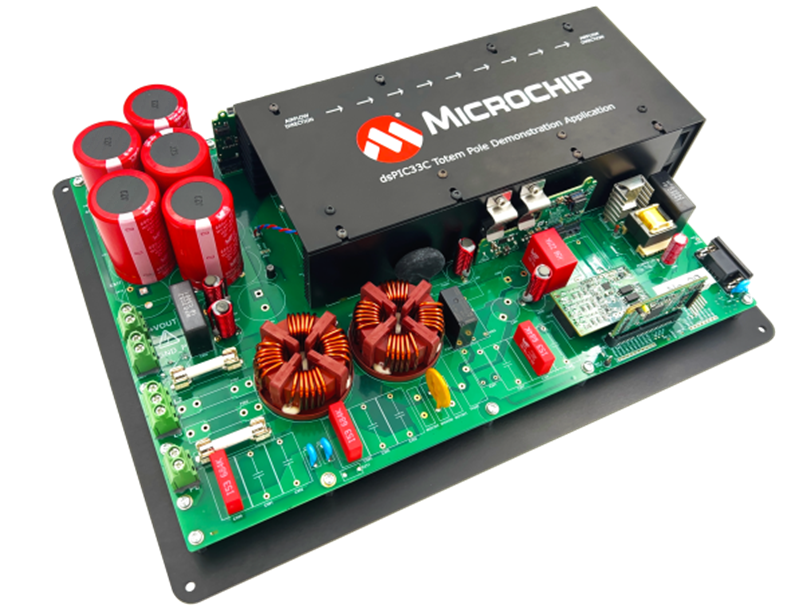
Heat Pump (3.8KW/7.6KW Totem Pole PFC)
Featuring dsPIC® Digital Signal Controllers (DSCs) and Silicon Carbide (SiC) MOSFETs, this demonstration platform can form an integral part of a heat pump application. This reference design also includes an 8-bit microcontroller (MCU), gate drivers, a buck regulator, a Switch-Mode Power Supply (SMPS) controller, push-pull Pulse Width Modulation (PWM) controller, CAN FD transceiver and Low Drop-Out (LDO). The highly modular and configurable hardware with Plug-in-Modules (PIMs) and flexible software supports different modes of operation, including Power Factor Correction (PFC) and inverter.

Matter over Wi-Fi® Light
What if a single technology could unify your different products and ecosystems? Imagine if you could easily create new smart home and building products that plug into existing setups, ensuring your success. Matter technology promises to do that. This new application standard runs on top of existing wireless protocols and allows products from different ecosystems to talk with each other.

Energy Storage (E-Fuse)
Enhance your energy storage systems with our advanced high-voltage auxiliary Electronic Fuse (E-Fuse) technology for superior performance and reliability. This cutting-edge solution utilizes our 700V and 1200V Silicon Carbide mSiC™ products, offering a comprehensive and efficient design. The integrated Time-Current Characteristic (TCC) curve facilitates seamless migration in non-automotive applications, including DC Solid-State Circuit Breakers (SSCB).