
Why Power Efficiency Matters in Enterprise NVMe® SSDs
As storage demands grow, power efficiency is becoming just as important as performance. This blog post explores how enterprise NVMe® SSDs can improve energy use, support sustainability goals and help designers maximize rack density in modern data centers.

As enterprise data centers evolve to support increasingly demanding workloads—particularly the rapid growth of AI—the conversation has shifted beyond performance alone. Throughput, latency and IOPS remain critical, but power efficiency has emerged as an equally strategic priority. With energy costs and sustainability goals under greater scrutiny, the focus is now turning to SSDs as a key lever for optimizing power consumption while continuing to scale storage capacity and feature sets.
Power efficiency in enterprise NVMe® SSDs is the ability to deliver required performance—throughput, IOPS and QoS—while consuming the least electrical power necessary. It is most meaningfully measured as useful work performed per watt, such as GB/s per watt or IOPS per watt, rather than raw low power consumption in isolation. This matters because enterprise SSDs must meet high bandwidth and consistent responsiveness demands while operating within strict power, thermal and rack-density constraints—and as storage capacities grow and PCIe® interfaces get faster, minimizing power consumption has become a key design objective.
 |
The challenge is especially significant because enterprise SSDs rarely operate at peak activity continuously. Drives may spend substantial periods in standby, background processing or lightly loaded conditions. Improving efficiency during these idle and near-idle periods can reduce total energy consumption, cooling requirements and operating costs across an entire storage fleet.
Why Lower Power Matters
Power optimization at the SSD level produces benefits throughout the data center.
- Reduced Operating Cost: Power is a direct operating expense. In large-scale enterprise deployments, even a small reduction in power consumption per drive can create meaningful savings when multiplied across hundreds or thousands of SSDs. For example, by dynamically turning off unused features, power reductions of anywhere from 10–50% can be realized.
Lower device power also helps reduce the energy required by supporting infrastructure, including power delivery and cooling systems.
- Lower Cooling Demand: The power consumed by an SSD ultimately becomes heat. Reducing SSD power therefore reduces the amount of heat generated inside servers and storage systems. This directly lowers the demand for cooling resources—whether electricity-based cooling or water-cooling systems—reducing cooling load, improving overall system efficiency and contributing to lower total operating costs.
- Better Rack-Level Power Utilization: Servers and storage platforms operate within defined power envelopes. More efficient SSDs give system designers greater flexibility to balance performance, capacity and drive count without exceeding platform or rack-level limits.
This is particularly important for high-density enterprise systems and hyperscale environments, where power availability can constrain the number of drives deployed on each server.
- Improved Sustainability: Storage infrastructure contributes significantly to overall data center energy consumption. Improving SSD efficiency supports broader sustainability initiatives by reducing energy use and the associated carbon impact of operating storage fleets.
- Stronger Idle Efficiency: Idle power is an important measurement for enterprise SSDs because drives often spend significant time outside peak activity. A drive may be waiting for new requests, completing background operations or serving a workload that requires only a fraction of its available resources. Optimizing these states can have a substantial impact on total energy consumption over the life of the device.
Flashtec® NVMe 5016 demonstrates how a programmable NVMe controller can balance performance and power by dynamically managing internal resources, including processor cores, application interfaces and clock frequencies.
High Performance Without Excessive Power
The Flashtec NVMe 5016 is a fifth-generation programmable NVMe controller designed for enterprise and hyperscale SSD applications. In a high-performance demonstration, the controller delivered:
- 14.8 GB/s throughput
- Less than 5.5 W of controller power
- 3.5 million IOPS under maximum load
- Approximately >2.5 GB/s per watt
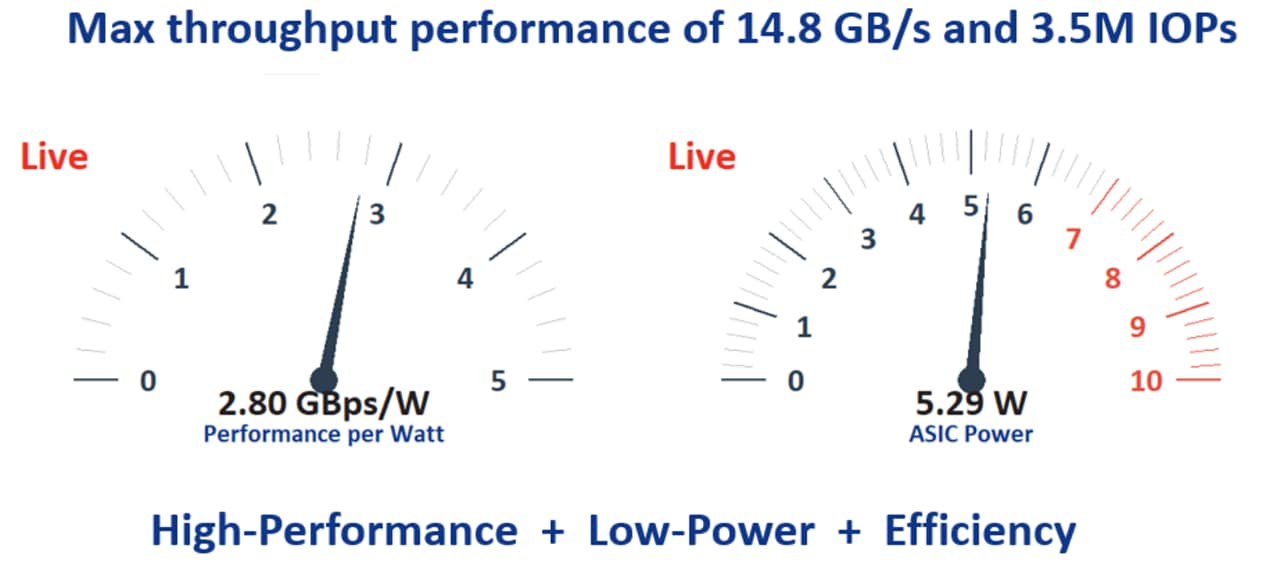
These figures illustrate the importance of evaluating both performance and power together. A controller that delivers high throughput at lower power can help SSD manufacturers and data center operators achieve greater performance density without proportionally increasing thermal and power requirements. In other words, lower power consumption of the controller allows bigger budget for other components in the SSD, which could translate to increased storage capacity by adding more NAND Flash devices.
Techniques for Saving Power in Enterprise NVMe SSDs
Power efficiency depends on more than the semiconductor process or the maximum operating frequency. Modern controllers can reduce consumption by selectively managing internal hardware according to workload demand.
The techniques below represent common approaches used across our SSD controllers. For a detailed look at how these methods are applied in the Flashtec NVMe 5016, refer to the NVMe 5016 Power Optimization Application Note available on myMicrochip.
- Power Gating Unused Cores
Power gating selectively removes power from controller blocks that are not currently required. This reduces leakage and idle-state consumption while allowing active resources to continue operating.
The NVMe 5016 controller includes multiple processing cores. During periods of low activity, cores that are not needed can be placed into a low-power wait state, allowing them to remain responsive to incoming work while consuming minimal energy. This allows the controller to scale compute activity dynamically to match actual workload demand.
Power gating and low-power processor states can provide several benefits:
- Minimize energy wasted by inactive processing cores
- Preserve responsiveness during workload transitions
- Match compute resources to current I/O demand
This approach is particularly valuable for enterprise workloads that alternate between short bursts of intense activity and extended periods of low utilization.
- Power Gating Unused Interfaces and Hardware Blocks
NVMe 5016 includes multiple internal interfaces and functional blocks. Not every subsystem must remain fully powered at all times. When an interface or subsystem is not required for a particular operating mode, powering it down can reduce unnecessary static and idle consumption.
This type of software-configurable hardware power control allows SSD firmware developers to optimize the controller according to the actual configuration and workload requirements of a product.
Benefits include:
- Reduced power consumption from unused subsystems
- Lower static and idle power
- More granular hardware-level power management
- Dynamic Frequency Scaling
Clock frequency has a direct impact on dynamic power consumption. When high-speed processing is not required, reducing the operating frequency can lower power while retaining the ability to return to higher performance when demand increases.
Dynamic frequency scaling can:
- Reduce dynamic power consumption
- Match controller activity to workload intensity
- Improve efficiency in lower-performance operating states
For workloads characterized by bursts of activity followed by idle periods, dynamically scaling clock frequencies can improve average efficiency without limiting peak performance when needed.
Intelligent Power Management Is a System-Level Capability
Power saving in enterprise NVMe SSDs is not simply a matter of slowing the drive down. Effective power management techniques/systems dynamically allocate resources so that the controller uses only the energy required for the current workload.
This approach is increasingly important because:
- Enterprise workloads can vary significantly over time
- SSDs may spend considerable periods in idle or lightly loaded states
- Higher performance increases thermal design challenges
- Rack-level power budgets can limit storage density
- Data center operators need both performance and sustainability
A programmable controller enables firmware developers to fine-tune the balance between performance and power for specific flash configurations, form factors and workload profiles.
NVMe 5016 supports this flexibility through programmable architecture, production-ready PCIe firmware and a software development kit designed to help customers customize their SSD implementations.
Designed for a Faster Path From Evaluation to Production
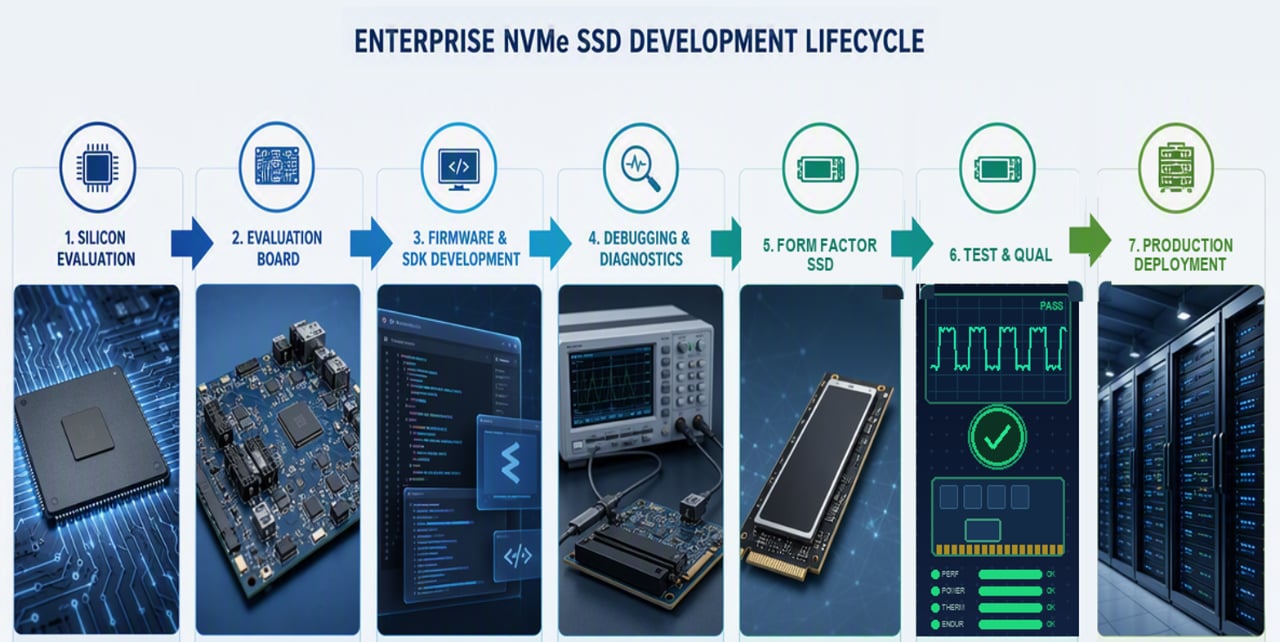
Power optimization is most useful when it can be applied efficiently during product development. The Flashtec NVMe 5016 platform is supported by a customer enablement path that includes:
- Evaluation board: A hardware platform for initial bring-up, testing and experimentation
- Reference SDK: Software tools and development resources for firmware customization
- ChipLink: Advanced debug and diagnostics tool for analyzing controller behavior
- Production firmware: PCIe firmware designed to support commercial SSD development
Together, these resources help customers evaluate silicon, tune power and performance characteristics, develop a working prototype and move toward production.
Conclusion
Power efficiency is essential for enterprise NVMe SSDs because it affects much more than device-level energy consumption. It influences operating costs, cooling requirements, rack density, system reliability and sustainability. Because enterprise SSDs often spend significant time outside peak activity, optimizing idle and near-idle power can deliver meaningful real-world benefits.
Power gating inactive cores, power gating unused interfaces and subsystems and dynamic frequency scaling are well-established techniques that show how a modern SSD controller can reduce energy consumption intelligently and effectively. The Flashtec NVMe 5016 with its 6-nm technology brings these techniques together—demonstrated live at FMS with 14.8 GB/s at under 5.5 W—giving enterprise storage designers a strong foundation for SSDs that are not only fast, but power aware.
For a detailed technical walkthrough of how these power optimization techniques and some advanced, innovative power management techniques are implemented in the Flashtec NVMe 5016, visit the NVMe® 5016 Power Optimization Application Note on myMicrochip.
* | The Flashtec NVMe 5016 is a 5th generation programmable NVMe SSD controller designed for enterprise and hyperscale deployments. Its architecture and SDK enable customers to build power-optimized SSDs while maintaining the performance required by modern data center workloads. |
 |