
Why GPU Alone Is Not a Space Edge AI Computer
CAVU’s latest space edge AI approach combines commercial AI acceleration with Microchip PolarFire® SoC technology to help satellites process data faster, reduce downlink demands and maintain reliable operation in harsh space environments.
You cannot put a commercial edge GPU module on a satellite, attach a fancy heat pipe and call it a space edge AI computer. There is a growing trend in the small satellite industry to take a powerful commercial AI module, place it in a metal box, add a thermal solution and market the result as a “space edge AI computer.” But in orbit, heat is only one part of the problem. Reliability, fault containment, recovery, data integrity and mission continuity are what define whether an AI computer is truly ready for space.
A commercial edge GPU platform can be an excellent AI accelerator. It brings GPU acceleration, computer vision capability, inference runtimes, model-optimisation tools and a mature software ecosystem. For Earth observation, onboard object detection, image prioritisation, compression, autonomy and real-time data reduction, this level of processing is extremely valuable.
The Real Problem Isn’t Heat—It’s Reliability
But a satellite is not a lab bench. In orbit, the problem is not only heat. The problem is system reliability.
Commercial GPU modules are vulnerable at several levels: boot media, eMMC or NVMe® storage, Linux file systems, GPU drivers, caches, memory hierarchy, power regulators, software hangs, kernel panics and silent numerical corruption. Radiation-induced faults are also not always clean single-bit flips. In GPU pipelines, faults can propagate across multiple bits, multiple values or even multiple lanes of execution. The result may not be an obvious crash. It may be a wrong AI output that still looks valid. That is the dangerous case.
A Satellite AI Computer Must Answer More Than One Question
A satellite AI computer must therefore answer more than one question:
Can it run an AI model?
Can it detect when the AI result is wrong? Can it recover from a corrupted boot image? Can it survive a Linux or GPU-driver hang? Can it power-cycle the accelerator without losing the mission? Can it preserve raw payload data if the AI processor fails? Can it continue in degraded mode? Can it prevent an accelerator fault from becoming a spacecraft fault?
CAVU’s Approach: GPU as a Supervised Accelerator
This is the philosophy behind CAVU’s Polar-Edge and Typhoon-Edge computers.
They do not treat the commercial edge GPU platform as the only trusted computer. We treat it as a high-performance AI accelerator supervised by a proven Microchip PolarFire® SoC architecture.
In their approach, the PolarFire SoC is the deterministic control layer. It manages accelerator power, reset, boot supervision, watchdog recovery, payload data routing, storage integrity, telemetry and degraded-mode operation. The commercial edge GPU platform performs the high-throughput AI and image-processing tasks, but the PolarFire SoC remains the system authority.
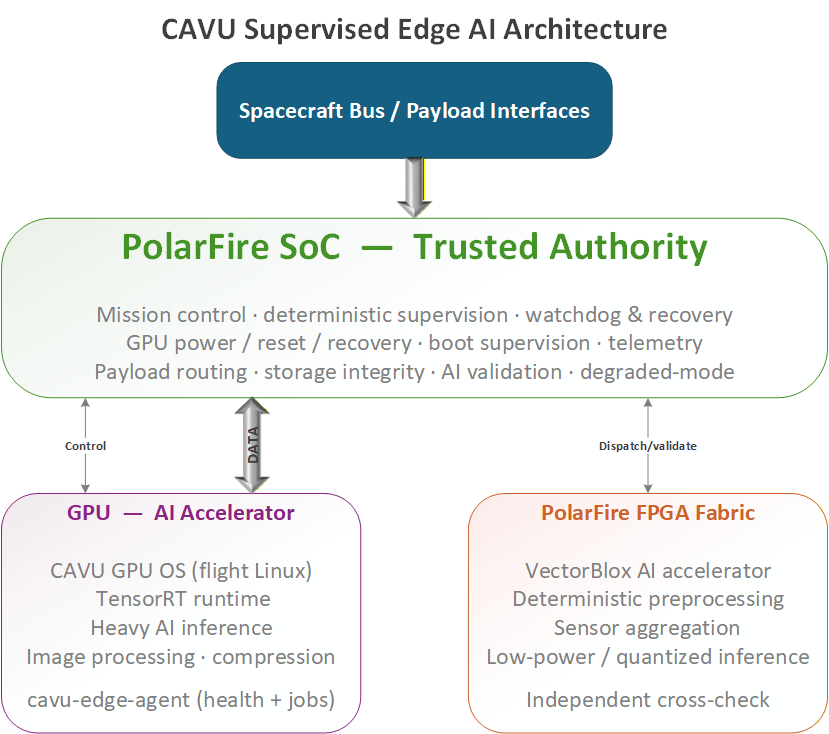 |
The supervised three-layer architecture: PolarFire SoC as the trusted authority over the Jetson accelerator and the FPGA fabric.
This distinction is critical.
The accelerator is allowed to be powerful, to be complex, or to fail.
But it is not allowed to take the mission down with it.
Two Sides of the Architecture
On the commercial edge GPU platform side, their architecture uses a protected CAVU flight Linux concept:
- minimised services
- protected boot objects
- checksum verification
- controlled persistent storage
- reduced flash writes
- read-only or RAM-backed root filesystem operation
- model verification
- a supervised AI execution framework
On the PolarFire SoC side, CAVU implemented the external reliability layer:
- hardware watchdogs
- boot-stage monitoring
- reset and recovery control
- raw data preservation
- fault counters
- power and thermal supervision
- bypass paths when the AI accelerator is unavailable
More Than One Level of Intelligence
The FPGA side also gives another important advantage: AI does not have to live only inside the GPU platform.
With the Microchip VectorBlox AI accelerator in the PolarFire FPGA fabric, part of the inference workload can be moved into a lower-power, more deterministic acceleration path. This is especially useful for smaller, quantised models, pre-classification, cloud screening, anomaly detection, simple object-detection stages or independent cross-checking of GPU outputs.
This creates a very important architectural benefit.
The commercial edge GPU platform can run the large, complex, high-throughput AI models. The PolarFire FPGA can run selected lower-power AI tasks closer to the sensor and closer to the trusted control layer.
That means the system can make intelligent decisions even when the GPU platform is not active, not required, recovering, power-limited, thermally constrained or temporarily disabled. It also allows CAVU to use the FPGA AI path as a validation layer; a smaller model in the PolarFire fabric can check whether the GPU result is plausible before the system accepts, discards, prioritises or downlinks payload data.
This is not about replacing the GPU accelerator.
It is about building an AI computer with more than one level of intelligence.
The commercial edge GPU platform provides the heavy AI engine. The PolarFire SoC provides the trusted supervision. The FPGA fabric provides deterministic preprocessing, data handling and selected AI acceleration.
Together, GPU acceleration, Microchip PolarFire SoC supervision and FPGA AI acceleration form a space edge computer rather than a commercial AI module in a box.
The AI Integrity Layer
Then comes the AI integrity layer.
Because GPU faults can produce silent corruption, it is not enough to check that Linux is still alive. The output itself must be validated. We check for impossible outputs: NaN, infinity, all-zero tensors, invalid confidence values, corrupted bounding boxes, stale frames, invalid checksums, excessive runtime or abnormal memory behaviour. For critical decisions, the system can rerun inference, compare outputs, fall back to a smaller model, use the FPGA AI path for a sanity check or preserve the raw data for ground processing.
This is what separates a real space edge computer from a commercial AI module in a box.

Payload data and AI integrity pipeline: raw data is preserved and every AI output is validated before it is trusted.
Polar-Edge and Typhoon-Edge
Polar-Edge is designed for:
- lower-power onboard AI
- image pre-processing
- object detection
- compression
- cloud screening
- selective downlink
- FPGA-assisted inference
Typhoon-Edge is designed for:
- higher-performance workloads
- multi-camera processing
- advanced AI inference
- segmentation
- data fusion
- more demanding autonomy
Both are based on the same principle: commercial AI performance must be wrapped inside a deterministic, recoverable, flight-oriented architecture.
CAVU has flown these edge computers multiple times, and the lesson is clear: in space, edge AI is not only about TOPS, GPU cores or heat pipes. It is about fault containment, recovery, supervision, data integrity and mission continuity.
A reliable space AI computer is not defined by the accelerator alone. It is defined by what happens when the accelerator misbehaves.
At CAVU AEROSPACE UK, we believe space edge AI should be judged by what happens when the accelerator misbehaves, not by its TOPS. If that’s how you think about onboard autonomy too, I’d welcome the conversation.