
What Makes a USB SmartHub Different?
Connected embedded systems increasingly require more than basic USB expansion to support internal (chip-to-chip) interface requirements. USB SmartHub ICs combine high-speed hub functionality, interface bridging and flexible port management in a single device, helping developers reduce system complexity while supporting evolving automotive and industrial architectures.
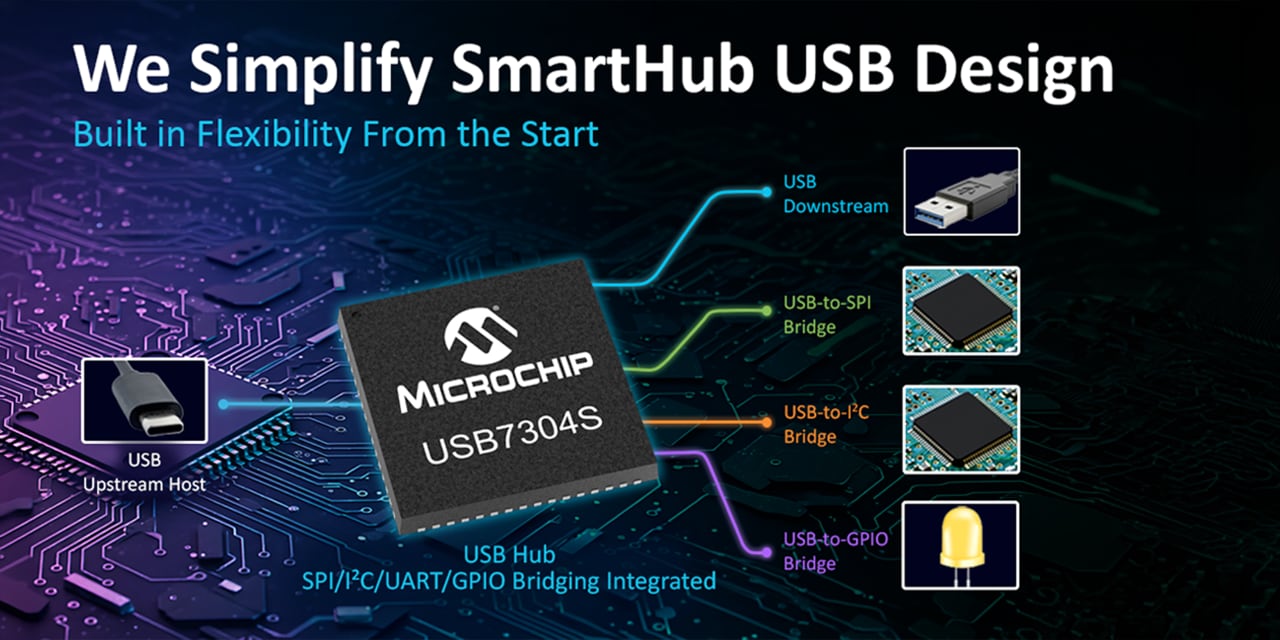
What Makes a USB SmartHub Different?
Connected embedded systems increasingly require more than basic USB expansion. USB SmartHub ICs combine high-speed hub functionality, interface bridging and flexible port management in a single device, helping developers reduce system complexity while supporting evolving automotive and industrial architectures.
A Smarter Way to Manage System Connectivity
Designing a modern embedded system can feel like managing traffic at a busy intersection. Cameras, displays, storage devices, sensors and diagnostic modules all need to move data efficiently, while processors must also coordinate communication across interfaces such as USB, I2C, SPI and GPIO.
In automotive infotainment systems, industrial HMIs, robotics controllers and embedded edge platforms, supporting this level of connectivity with discrete USB hubs, bridge ICs and switching devices can quickly increase PCB complexity, consume valuable board space and add integration effort.
USB SmartHub ICs were developed to simplify this challenge through a more integrated connectivity architecture approach.
Why Embedded USB Architectures Are Changing
USB connectivity requirements have expanded significantly across automotive and industrial applications. Systems now frequently support smartphone integration, diagnostics, software updates, instrumentation, factory automation and embedded edge computing.
As these systems evolve, developers face several recurring challenges:
- Supporting multiple USB peripherals within limited PCB space
- Managing communication with I2C, SPI and GPIO-based peripherals
- Enabling multiple USB host access to internal peripherals
- Reducing redesign cycles across platform variants
- Maintaining reliable high-speed connectivity
Using separate USB hubs, bridge devices and switching logic to address these requirements can increase BOM count and validation effort. As a result, many designers are moving toward more integrated USB subsystem architectures.
What Is a USB SmartHub IC?
A USB SmartHub IC combines multiple connectivity functions into a single device to help simplify embedded system integration.
Our USB SmartHub devices integrate:
- USB 3.2 hub functionality
- USB-to-I2C bridging
- USB-to-SPI bridging
- USB-to-UART bridging
- GPIO connectivity support
- Flexible USB port management capabilities
By consolidating these functions into one architecture, developers can reduce external component count, simplify PCB routing and streamline system integration.
Our SmartHub portfolio includes scalable options such as the USB7304S, USB7304, USB7302 and USB7301 devices, supporting different port configurations for varying application requirements.
- Simplifying High-Speed USB Integration
Embedded systems often need to support multiple high-speed peripherals simultaneously. SmartHub devices provide centralized USB connectivity while integrating control and bridging capabilities directly within the hub architecture.
This approach can help reduce subsystem complexity and minimize the need for additional interface ICs or external control logic. In space-constrained automotive and industrial platforms, integrated architectures can also support more compact PCB implementations.
- Supporting Flexible System Architectures
Long lifecycle embedded platforms often need to accommodate changing connectivity requirements over time.
Microchip SmartHub devices incorporate FlexConnect™ technology, which supports flexible host sharing and host role switching within USB architectures. This can help system designers with evolving platform requirements adapt USB topologies with multiple Host connections without extensive hardware redesign.
In automotive applications, for example, USB roles may change across infotainment, diagnostics or smartphone integration scenarios between vehicle platforms or model updates.
FlexConnect is part of the broader SmartHub architecture approach focused on integration and design flexibility.
- Bridging USB and Embedded Interfaces
Many embedded systems continue to rely on interfaces such as SPI, I2C, UART and GPIO for peripheral communication and system control.
Integrated bridging capabilities within SmartHub devices enable communication between USB and these interfaces without requiring separate bridge ICs. This can simplify connectivity design and reduce overall subsystem complexity.
- Designed for Embedded and Industrial Integration
Embedded and industrial platforms often require scalable deployment strategies and long product lifecycles.
Microchip SmartHub devices support OTP-based configuration capabilities, including locking mechanisms that can help streamline production deployment. Multiple device variants also allow developers to scale designs across different system configurations and cost targets while maintaining architectural consistency.
This flexibility supports platform reuse across industrial automation systems, embedded gateways and automotive connectivity modules.
Simplifying USB Designs
As embedded systems continue evolving toward more connected and adaptable architectures, integrated USB subsystem design becomes increasingly important. SmartHub ICs help address this shift by combining hub functionality, interface bridging and flexible connectivity management into a more consolidated approach.
Our USB SmartHub portfolio helps developers simplify high-speed USB integration while building scalable embedded system architectures.
Want More?
Explore our USB hub portfolio and SmartHub solutions.
Watch the FlexConnect video on our YouTube channel to learn more about flexible USB architecture approaches for embedded system design.