
Large-Scale Wireless Network Validation for Real-World Deployments
Laboratory testing can verify functionality, but real-world deployments introduce challenges such as RF interference, physical barriers and increasing node density. Learn how a sector-based validation infrastructure helps engineers assess wireless network performance at scale before moving systems into production.

Our large network infrastructure provides a realistic environment for evaluating wireless network performance, at scale, across multiple mesh technologies. The infrastructure enables engineers to assess network behavior under conditions that more closely reflect real-world deployments. Key benefits include:
- Supports Bluetooth® LE, Thread®, Zigbee®, MiWi™ and Lightweight Mesh
- Uses a sector-based architecture that mirrors physical deployment areas
- Validates network formation, routing behavior, packet delivery and resiliency
- Scales test environments to more than 200 nodes
- Provides repeatable validation methodologies before deployment
A recent 200+ node validation demonstrates how the infrastructure can be used to evaluate scalability, communication performance and network behavior under realistic operating conditions.
Why Realistic Validation Matters
Wireless deployments continue to expand across buildings, warehouses, factories, energy systems and enterprise infrastructure. In these environments, networks must do more than establish connectivity. They must scale predictably, maintain performance as node counts increase and continue operating as deployment conditions change.
While laboratory testing is effective for verifying functionality, it does not always reflect the challenges encountered in deployed environments. Physical barriers, RF interference, changing network topologies and increasing node density can all affect network behavior. Evaluating performance under more realistic conditions provides engineers with greater insight into how a network is likely to perform after deployment.

Built for Real-World Deployments
To address these challenges, we developed a protocol-agnostic, sector-based infrastructure that evaluates multiple wireless networking technologies within a common validation environment. The infrastructure supports Bluetooth LE, Thread, Zigbee and proprietary mesh, which allows engineers to assess network behavior using consistent test methodologies across protocols.
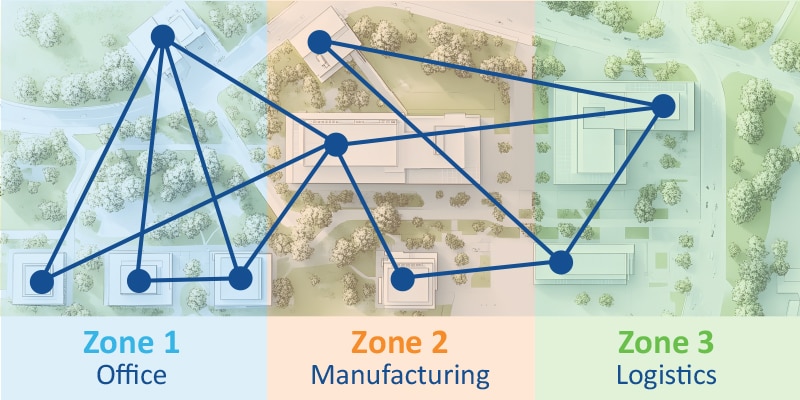
Rather than treating a deployment as a single, flat network, the infrastructure organizes devices into sectors that align with physical deployment areas such as rooms, zones or floor sections. This approach improves scalability, simplifies management, helps isolate issues and provides greater visibility into network operation as deployments grow.
The infrastructure also evaluates network performance across varying node counts, payload sizes, joining conditions, communication distances and multi-hop routing scenarios. By aligning logical network organization with physical deployment environments, engineers can better understand how wireless systems behave in realistic operating conditions.
 | For additional details on the sector-based architecture and deployment methodology, see the accompanying whitepaper. |
Validation at Scale
Our mesh validation infrastructure replicates real-world deployment environments across multiple physical zones. Within this environment, engineers can evaluate network formation, routing behavior, packet delivery, latency, round-trip time, throughput and transport protocol performance under realistic RF conditions across both single-hop and multi-hop communication paths.
The infrastructure is designed to characterize how network performance changes as deployments scale, payload sizes increase, routing paths become more complex and environmental conditions evolve. By collecting repeatable measurements across a large-node network, engineers can gain insight into the tradeoffs between scalability, responsiveness, reliability and data throughput before deployment.
Performance Metrics Evaluated
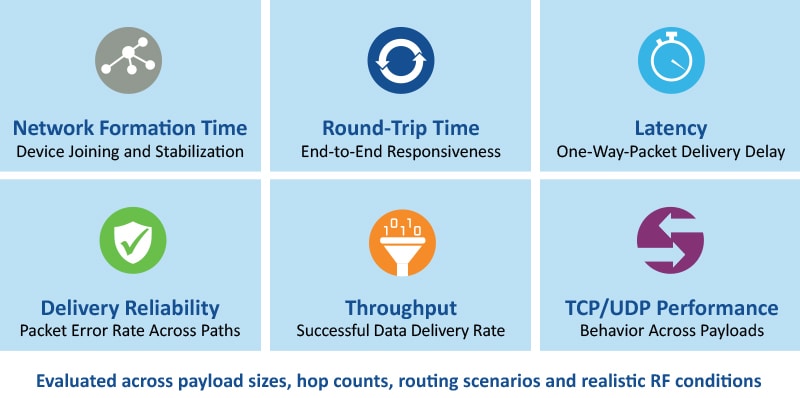
These metrics help characterize how a mesh network behaves under realistic operating conditions and provide a more complete view of network performance than network formation or packet delivery alone.
200-Node Network Formation
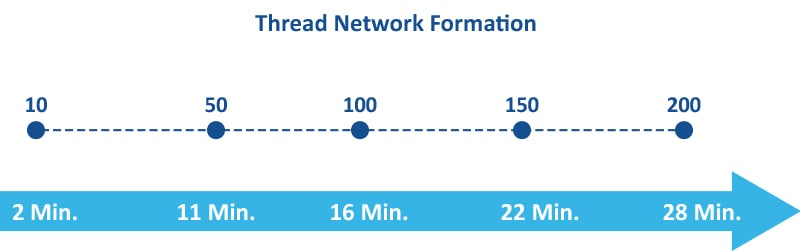
Within the large network infrastructure, a 200-node Thread network formed and stabilized within 28 minutes using an optimized network formation strategy. Formation remained predictable as the network expanded from tens of nodes to hundreds of participating devices, providing insight into how joining time scales in large deployments.
While network formation is an important indicator of scalability, it represents only one aspect of large-network validation. Additional testing evaluated latency, round-trip time, throughput, packet delivery reliability and transport protocol performance across multiple payload sizes and communication paths. These measurements help engineers understand how network behavior changes as traffic loads increase, packets traverse multiple hops and deployment complexity grows.
These deployment-oriented environments provide a more meaningful evaluation than a controlled demonstration because devices must maintain connectivity through physical barriers, communicate across multiple areas and continue transmitting data as RF conditions evolve.
| Detailed test configurations, measurement methodology and complete performance results are available in our Large-Scale Thread Mesh Network Test Infrastructure application note. |
Designed for Continuous Operation
Large wireless networks are dynamic. Devices may be added, removed, relocated, blocked or powered down while people, equipment, inventory and interference sources continuously change throughout the environment. A robust mesh network must adapt to these changes without requiring constant manual intervention.
To evaluate this behavior, we validated network formation, routing-table updates, route optimization and network stability during node joining, removal and movement over extended periods. Additional scenarios including node movement, random power cycling and external RF interference are introduced to assess mesh healing, recovery from node failures and adaptation to changing environmental conditions.
Deployment Practices That Support Network Scaling
Reliable large-scale mesh networking requires more than a protocol stack. Successful deployments depend on architecture, deployment methodology, monitoring and recovery mechanisms working together to maintain performance as networks grow.
We applied large-scale deployment experience through practices such as staged rollouts, capacity planning, transmit-power optimization, site surveys, link-quality monitoring, packet-delivery analysis and redundant path design. These practices help manage congestion, interference, routing complexity and node failures while maintaining network connectivity and performance.
Supporting Multiple Wireless Technologies
Every deployment has unique requirements. Some applications prioritize low power consumption, while others require high node density, broad interoperability or integration with enterprise and cloud-connected systems.
Across protocols, our large network infrastructure provides a common validation environment for assessing wireless mesh network behavior before deployment. By supporting a protocol-agnostic approach, the infrastructure helps engineering teams assess performance using testing methodologies that more closely reflect real-world operating conditions.
Conclusion
By combining realistic deployment modeling, sector-based architecture, continuous operation testing and support for multiple wireless technologies, we help engineering teams evaluate wireless networks with greater confidence before moving systems into production. Learn more about our multiprotocol, wireless microcontrollers that we used in our large network infrastructure setup and testing.