
Design Energy-Aware 48V Systems With Smarter Power Monitoring
Designers building 48V power systems can move beyond point-in-time monitoring by tracking energy behavior over time and responding more confidently to changing loads with PAC1761 and PAC1861 digital power monitors.
If you have ever packed for a long trip, you know the difference between glancing at your fuel gauge and understanding how far you can actually go. A single reading matters, but context matters more. Are you climbing hills, sitting in traffic, carrying extra weight or conserving energy on a long downhill stretch?
Power system design presents a similar challenge. A voltage or current snapshot can tell you what is happening right now. But in many systems, you also need to know how power is being consumed, accumulated and changing over time.
Our PAC1761 and PAC1861 families of single-channel digital power monitors help address that challenge by combining 65V, full-scale bus-voltage measurement with accumulated power measurement data. The PAC1761 provides 12-bit resolution, while the PAC1861 provides 16-bit resolution, giving you scalable options for designs that need different levels of measurement granularity.
In this post, you’ll learn how energy-aware digital power monitoring can help you design more resilient 48V systems. We will look at why accumulated power data matters, how alerting can help systems respond sooner, why 65V measurement headroom supports 48V architectures and how package flexibility can reduce design and sourcing risk.
You will also see how the PAC1761 and PAC1861 families build on our digital power monitoring portfolio by offering 12-bit and 16-bit options, on-chip accumulation, configurable alerts, I2C/SMBus communication and package choices that include VDFN-8, VDFN-10 and MSOP-10.
Why 48V Systems Need More Context
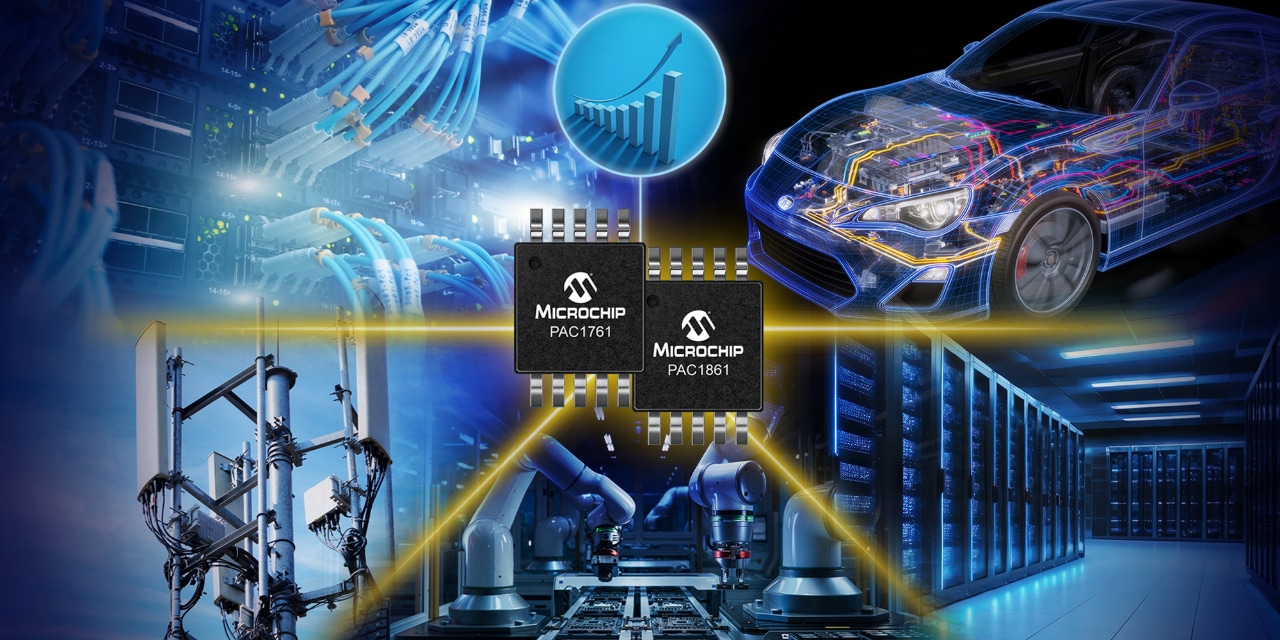
As 48V architectures grow across automotive, AI/data center, networking and industrial systems, designers need systems that can understand energy use over time and respond quickly to changing power conditions.
That shift matters because a single measurement does not always tell the full story. A power rail may look normal at one instant and still be trending toward a limit. A load may behave as expected during one operating state and then change rapidly during another. A battery-powered or energy-constrained system may remain within its voltage and current limits while consuming energy faster than the end application can tolerate.
The PAC1761 and PAC1861 families help by monitoring bus voltage, shunt resistor voltage and accumulated proportional power data. The devices can also support step-limit detection, helping the system identify meaningful changes in measured power behavior. The host controller can then read the stored data and use it as part of a broader system-control strategy.
Measure More Than the Moment
Traditional power monitoring often focuses on instantaneous measurements. Those measurements remain important, but they become more valuable when designers can also examine accumulated behavior. Both the PAC1761 and PAC1861 perform power calculations and energy accumulation in digital circuitry, enabling power monitoring with integration periods up to one year or longer.
That accumulated view can support practical design questions. How much energy did this subsystem consume during a defined operating mode? Did power consumption change after a firmware update? Is a load consuming more energy over time than expected? Those are system-level questions, and they are harder to answer with only a point-in-time reading.
The devices include a 56-bit power accumulator register for recording accumulated power data and a 32-bit accumulator count register. PAC1761 uses on-chip accumulation of 24-bit results for power measurement, while PAC1861 uses on-chip accumulation of 32-bit results for power measurement.
Add Headroom for 48V Designs
A 48V system does not mean every relevant electrical condition stays neatly at 48V. Designers need margin for real-world operating conditions, and 65V measurement headroom is an important part of the system story. The PAC1761 and PAC1861 families support a 65V full-scale bus-voltage range.
The datasheets list absolute maximum ratings up to +75V on the VBUS+ and VSENSE pins, giving designers important context for transient survivability while keeping normal operation within the specified operating range.
That combination of operating range and survivability context can matter in systems where power rails experience transients, startup behavior or changing load conditions. It helps designers think beyond nominal voltage and consider the margin needed for a more robust power-monitoring implementation.
Respond Faster With Configurable Alerts
Knowing what happened is useful. Knowing soon enough to act is better. The PAC1761 and PAC1861 include configurable alert systems that can trigger alerts when the device detects voltage, current or power excursions.
Programmable alerts are provided for voltage, current and power excursions, step-limit detection to identify sudden load changes and configurable accumulated-energy thresholds for proactive system management.
That makes the alerting story broader than a single over-limit threshold. Designers can use individual limits for undercurrent, overcurrent, undervoltage, overvoltage and overpower conditions. The devices also include step-limit capability for average variation detection.
For your design, that can mean earlier visibility into abnormal system behavior. Instead of waiting for a rail to fail outright, a host controller can receive information that supports housekeeping, protection, performance tuning or diagnostic decisions.
Scale Resolution to Your Design Needs
Not every rail needs the same level of measurement resolution. Some systems need a cost-effective 12-bit monitor. Others need the finer measurement detail of a 16-bit device. The PAC1761 provides 12-bit resolution for sense voltage and bus voltage measurements, while the PAC1861 provides 16-bit resolution for those measurements.
Both devices support 100 mV full-scale range for sense input voltage, selectable bipolar current-sense capability and 65V full-scale bus-voltage monitoring.
Both devices also use real-time auto-calibration of offset error for voltage and current, with no user adjustment required. The datasheets state that no input filters are required and that built-in adjustable averaging produces low-noise, high-resolution measurement results.
Reduce Monitoring Overhead
Measurement should help your design without becoming a major load of its own. The PAC1761 and PAC1861 use dynamic power scaling, where lower sampling rates result in lower active current. The PAC1761 can operate as low as 6 µA at eight samples per second, and the PAC1861 can operate as low as 7 µA at eight samples per second.
At 1,024 samples per second, PAC1761 typical active current is specified as 90 µA, while PAC1861 typical active current is specified as 145 µA.
This matters for applications where the act of measuring power should not meaningfully undermine the power budget. It is also useful when the system does not always need the same sample rate. You can choose operating modes based on what the system needs at a given time.
Use Package Options to Reduce Redesign Risk
Power monitors do not exist in isolation. Board layout, sourcing options and qualification work all effect how quickly a device can move into production. The PAC1761 and PAC1861 families include VDFN package options, while the PAC1761 family also supports an MSOP-10 option that can help designers address footprint and second-source considerations in automotive designs.
The MSOP-10 package option was created to address a common footprint and pinout for TI INA automotive parts, helping capture competitive designs where customers may prefer second-source flexibility.
For customers, the practical value is straightforward. Pin-compatible options can reduce redesign risk, shorten qualification cycles and give customers flexibility to move between devices as design requirements, availability, cost or performance change.
Where These Devices Fit
Target applications include automotive, AI/data center, networking, industrial, server, telecom/Power over Ethernet and 48V power distribution systems.
Across these applications, the common theme is not simply “measure voltage and current.” The more useful goal is to understand how power behaves across operating modes, transient events and longer usage periods. That is where accumulated power data, configurable alerts and scalable resolution can help you make better system decisions.
Next Steps
As 48V systems become more common, power monitoring needs to move beyond the instant reading. You need measurement headroom, useful resolution, low monitoring overhead, alerts that help the system respond and accumulated data that shows how energy is used over time.
The PAC1761 and PAC1861 digital power monitors are designed to help you build more energy-aware systems using 65V full-scale bus-voltage measurement, on-chip accumulated power measurement, configurable alerting and scalable 12-bit or 16-bit options.
To evaluate these devices, review the product information for the PAC1761 and PAC1861 families, explore the available package options and consider how accumulated power monitoring could improve your next 48V architecture. Development support includes evaluation boards, a Python command-line interface with library, a Linux driver and a generic C library with multiple MCU code examples.
Ready to design more energy-aware 48V systems? Visit our purchasing portal or contact a Microchip authorized distributor to learn more about the PAC1761 and PAC1861 families.