
How 8-Bit MCUs Are Pushing Sensorless BLDC Motor Control Into High-Speed Territory
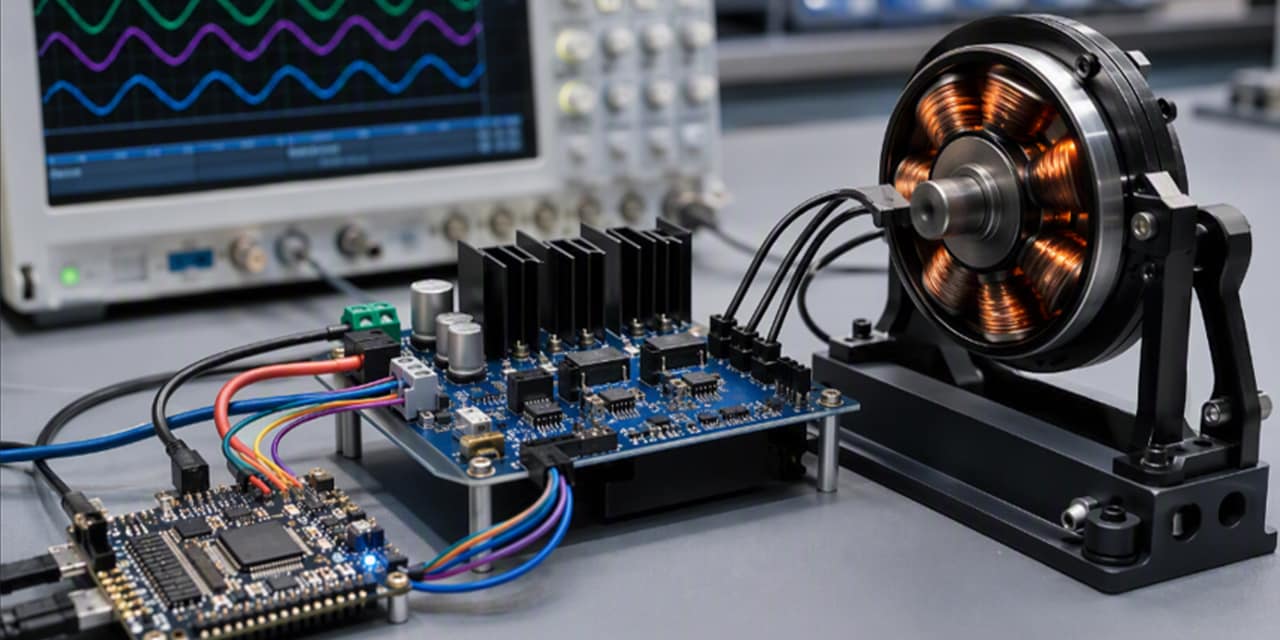
Extreme-speed trapezoidal BLDC control using AVR® demonstration application.
Introduction
Modern BLDC motor designs increasingly demand faster response, lower BOM cost and tighter integration, even in systems that once required higher-end processors or dedicated motor-control Integrated Circuits (ICs). Our “Extreme-Speed Trapezoidal BLDC Control Using AVR® Demonstration Application” shows how advanced motor-control techniques can now run on compact 8-bit AVR microcontrollers (MCUs) by shifting critical timing and synchronization functions into hardware-assisted peripherals.
The reference design focuses on sensorless trapezoidal control for Brushless DC (BLDC) motors and Permanent Magnet Synchronous Motors (PMSMs) while supporting operation from 6V to 50V with a 10A rating at 24V. Rather than positioning the MCU as a software-heavy control engine, the design demonstrates how intelligent peripherals inside the AVR EB family can manage time-critical motor tasks with reduced CPU overhead.
The Engineering Challenge
Heading toward extreme motor speeds creates a difficult control problem, particularly in sensorless systems. Rotor position must be inferred from back-electromotive force (BEMF) signals instead of Hall sensors or encoders, which means timing accuracy becomes increasingly important as rotational speed rises. Traditional software-driven approaches can struggle when Pulse-Width Modulation (PWM) generation, commutation timing, analog measurements and protection handling all compete for processor cycles.
The challenge becomes even more complex when the drive method must change dynamically across the motor’s speed range. PWM-based drive methods are effective at low and moderate speeds because they provide fine current control, but they become less efficient at very high rotational speeds where switching overhead and timing limitations start to matter. Maintaining stable synchronization during those transitions is critical to avoiding instability or stall conditions.
Understanding the Reference Design
Our reference design addresses those constraints with a hardware-assisted six-step trapezoidal drive architecture built around AVR EB, AVR DA and ATmega® device families. The implementation supports sensorless BLDC and PMSM operation using zero-cross detection of each motor phase’s BEMF signal to determine rotor position.
Beyond the core commutation strategy, the platform emphasizes deterministic event routing between peripherals so protection responses and timing updates can occur with minimal interrupt latency during high-speed operation.
How the Solution Works
The operational flow centers on detecting BEMF zero-crossing events and using those measurements to synchronize commutation timing. A proportional-integral (PI) algorithm continuously compares the measured zero-cross timing against the ideal commutation point, then corrects timing error to keep the motor synchronized as operating conditions change.
At lower and moderate speeds, the system uses a 40 kHz PWM driving scheme. As motor speed increases, the firmware transitions into a single-pulse drive mode designed for extreme-speed operation. Two configurable transition thresholds create hysteresis between PWM and single-pulse modes so the controller avoids unstable oscillation between operating states.
Key Technologies and Capabilities
Several protection capabilities are integrated directly into the platform, including peak overcurrent protection, average overcurrent protection, overvoltage protection and stall detection. These features are particularly important in compact industrial and consumer systems where motor faults can rapidly damage power electronics or mechanical assemblies.
Why This Matters to Developers
For developers, the more important takeaway is how the architecture achieves that shift: hardware-assisted timing and event-driven peripherals reduce CPU involvement while still maintaining responsive commutation and integrated protection handling.
That approach is especially relevant in appliances, smart tools, compact automation systems and embedded motion platforms where reducing system cost and software complexity can directly affect product viability. Designs that previously required external sensing or additional control hardware may now consolidate more functionality inside the MCU itself.
Applications and Design Considerations
Applications for this architecture include high-speed fans, pumps, handheld power tools, compact robotics and industrial actuators where efficient sensorless control and fast commutation matter. Engineers evaluating the design should instead focus on validating BEMF signal integrity and protection-threshold calibration under real load conditions, since those factors strongly affect stability at extreme rotational speeds.
Key Takeaways
- The reference design demonstrates sensorless trapezoidal BLDC/PMSM control on 8-bit AVR MCUs
- Zero-cross BEMF detection and PI-based synchronization maintain rotor timing without position sensors
- A configurable transition between PWM and single-pulse drive supports operation across a wide speed range
- AVR EB hardware peripherals reduce software burden through event-driven motor-control functions
- Integrated fault handling helps simplify deployment in industrial and consumer motor systems
Conclusion
As motor-control systems continue pushing for lower cost, smaller form factors and higher performance, hardware-assisted architectures like this one are likely to become increasingly important. The design illustrates how intelligent peripherals can extend the practical range of 8-bit MCUs into applications that once demanded far more computational overhead.
Explore the Demonstration Application
Learn more about how the design combines sensorless trapezoidal control, the transition from PWM to single-pulse drive, hardware-assisted peripherals and integrated protection.
Explore the Extreme-Speed Trapezoidal BLDC Control Using AVR® Demonstration Application.
Q/A
How does sensorless trapezoidal BLDC control determine rotor position without Hall sensors?
The controller monitors the back-electromotive force (BEMF) generated on the motor’s unpowered phase. By detecting zero-crossing events in the BEMF waveform, the system can estimate rotor position and synchronize six-step commutation timing without requiring external position sensors.
Why does high-speed BLDC operation become more difficult in sensorless systems?
As motor speed increases, commutation timing windows become significantly smaller. The controller must process BEMF signals, update PWM timing and handle protection events with minimal latency. Small synchronization errors at high rotational speeds can lead to instability, missed commutation or motor stall.
Why does the design switch from PWM drive to single-pulse drive at extreme speeds?
PWM control provides fine current regulation at low and moderate speeds, but switching overhead becomes less efficient at very high rotational speeds. The single-pulse drive mode reduces switching activity and helps maintain stable operation in extreme-speed conditions.
What is the purpose of hysteresis between PWM and single-pulse operating modes?
The controller uses two configurable transition thresholds so it does not rapidly switch back and forth between drive modes near a speed boundary. This hysteresis improves stability and prevents oscillation between operating states.
Which AVR MCU families are supported by the reference design?
The implementation supports AVR EB, AVR DA and ATmega device families. The design highlights how AVR EB devices use hardware-assisted peripherals to offload motor-control timing and synchronization functions from the CPU.